History of Nova Scotia
with special attention given to
Transportation and Communications
Chapter 17
1 January 1910 to 31 December 1919
Index with links to the other chapters
— Robert A. Heinlein
1910 February 21
A.G. Bell Travels to Nova Scotia
Tuesday, Feb. 22, (1910): Left Truro (Nova Scotia) for Iona (Cape Breton Island) by morning train. At Iona found Mr. and Mrs. Baldwin, Douglas McCurdy, and Gardiner Hubbard waiting for us. The steamer Blue Hill took us from Iona to Central Wharf of Beinn Bhreagh. We reached home in time for supper. A.G.B.
1910 Feb 23 --- Wednesday --- at BB (Beinn Bhreagh)
A.G.B.'s movements continued

Source: The A.G. Bell Family papers at the U.S. Library of Congress
Historical Collections for the U.S. National Digital Library
Page 90, low res:
http://memory.loc.gov/mss/magbell/338/33800101/0089.gif
Page 90, high res:
http://memory.loc.gov/mss/magbell/338/33800101/0089.jpg
Page 91, low res:
http://memory.loc.gov/mss/magbell/338/33800101/0090.gif
Page 91, high res:
http://memory.loc.gov/mss/magbell/338/33800101/0090.jpg
Also see:
Beinn Bhreagh Recorder, volume 3, page 210, February 24th, 1910
http://bell.uccb.ns.ca/cgi-bin/bbr.pl?Volume=3&Page=210
1910 February 23
Celebration of Anniversary of First Flight
Last night (Feb. 23) the Social Aero Club of Beinn Bhreagh held a meeting here (at Beinn Bhreagh, near Baddeck, Nova Scotia) to celebrate the anniversary of the first flight of a heavier than air flying machine in Canada — the successful flight of Douglas McCurdy in the aerodrome (airplane) Sliver Dart, Feb. 23, 1909, over the ice in Baddeck Bay.
The Naval policy of Canada was discussed by Mr. Macfarlane, Mr. Baldwin and others. AGB
Feb 24: Douglas McCurdy proposes to try a flight in [-?-] of aerodrome (airplane) Baddeck No. 2 tomorrow (Feb. 25) to test out the endurance of the engine with its new spark plugs.
1910 Feb 24 --- Thursday --- at BB (Beinn Bhreagh)

Source: The A.G. Bell Family papers at the U.S. Library of Congress
Historical Collections for the U.S. National Digital Library
Low resolution: http://memory.loc.gov/mss/magbell/338/33800101/0093.gif
High resolution:
http://memory.loc.gov/mss/magbell/338/33800101/0093.jpg
1910, Feb. 25 Beinn Bhreagh Recorder 212
Social Aero Club of Beinn Bhreagh

Alexander Graham Bell Institute, University College of Cape Breton
Beinn Bhreagh Recorder, volume 3, page 212, February 25th, 1910
http://bell.uccb.ns.ca/cgi-bin/bbr.pl?Volume=3&Page=212
1910 February 25
First Flights of 1910
Flying Around Baddeck Bay, Nova Scotia
Quoted from Dr. Bell's Notebook
Feb. 25th, 1910, pages 95-96
Feb. 25: — The drome (airplane) Baddeck No. 2 was taken out upon the ice on Baddeck Bay this morning. Mr. Baldwin is here and as I was not present during the tests, I will ask him to dictate an account of what happened. (Initialled by) A.G.B.
Mr. Baldwin says: — The machine was taken out and John (McCurdy) ran her down towards the warehouse or about as far as the Laboratory wharf, then turned round and came back towards the big shed putting her nicely into the air and flew for about 100 yards (about 100 m) and began to turn to the left. The turn was a little too sharp, the inside wing touched (on the ice); so John, after straightening her up, shut off the motor.
As there was a little wind blowing down over the hill from the East we decided to just run the machine along the ice.
John took her for a spin of about ten minutes. The water (in the radiator) boiled a little bit but the engine showed no signs of over-heating. We decided to balance up the wing tips which were not adjusted. The angle came a little more on the one side than the other and the yoke wasn't in the center. (Initialled by) F.W.B.
Mr. Douglas McCurdy has just come in and so I shall ask him to give his own independent account of what has been going on this morning before he reads Mr. Baldwin's notes. (Initialled by) A.G.B.
Mr. McCurdy says: — We took her up about off the Lodge wharf there and started down the shore towards the head of the Bay. Rose about off the Silver Dart shed when immediately the machine spun around to the laft and landed facing the other way.
We thought that this suddenly turning around might have been due to the little puff of East wind and also to the fact that the wing tips proved to be out of the normal position both having slightly a positive angle. When the aviator moved to the high side &$150; starboard — the port tip would offer a greater drift up than the starboard tip. We decided not to try another flight until the wind went down. And so for sake of practice ran the machine around the Bay (on the ice) four times in about ten minutes. (Initialled by) J.A.D.McC.
1910 Feb 25 --- Friday --- at BB

Source: The A.G. Bell Family papers at the U.S. Library of Congress
Historical Collections for the U.S. National Digital Library
Low resolution: http://memory.loc.gov/mss/magbell/338/33800101/0094.gif
High resolution:
http://memory.loc.gov/mss/magbell/338/33800101/0094.jpg
1910 Feb 25 --- Friday --- at BB

Source: The A.G. Bell Family papers at the U.S. Library of Congress
Historical Collections for the U.S. National Digital Library
Low resolution: http://memory.loc.gov/mss/magbell/338/33800101/0095.gif
High resolution:
http://memory.loc.gov/mss/magbell/338/33800101/0095.jpg
1910, Feb. 28 Beinn Bhreagh Recorder 241
First Flights of 1910

Alexander Graham Bell Institute, University College of Cape Breton
Beinn Bhreagh Recorder, volume 3, page 241, February 28th, 1910
http://bell.uccb.ns.ca/cgi-bin/bbr.pl?Page=241&Volume=3
1910, Feb. 28 Beinn Bhreagh Recorder 242

Alexander Graham Bell Institute, University College of Cape Breton
Beinn Bhreagh Recorder, volume 3, page 242, February 28th, 1910
http://bell.uccb.ns.ca/cgi-bin/bbr.pl?Page=242&Volume=3
1910 February 26
Flying Over Baddeck Bay, Nova Scotia
1910, March 4 Beinn Bhreagh Recorder 243

In the above photo, the typing has been digitally enhanced
as much as I can manage. The bottom caption reads:
"McCurdy circum-droming Baddeck Bay in C.A.C.
aerodrome, Baddeck No. 2. Feb 26. Photo by
John McNeil."
"C.A.C.": Canadian Aerodrome Company
"aerodrome": airplane
"droming": flying
Source: Alexander Graham Bell Institute, University College of Cape Breton
Beinn Bhreagh Recorder, volume 3, page 243, March 4th, 1910
http://bell.uccb.ns.ca/cgi-bin/bbr.pl?Page=243&Volume=3
1910 March 3
Flying Over the Ice 100 Feet in the Air
1910 Mar 4 --- Friday --- at BB (Beinn Bhreagh)
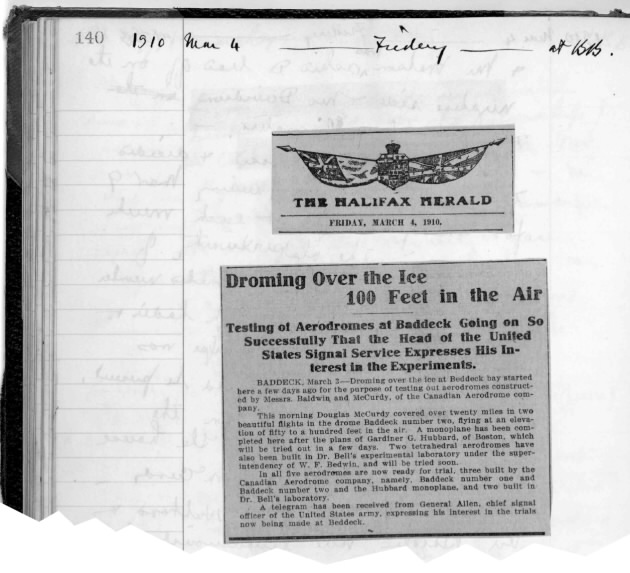
Source: The A.G. Bell Family papers at the U.S. Library of Congress
Historical Collections for the U.S. National Digital Library
Low resolution:
http://memory.loc.gov/mss/magbell/338/33800101/0139.gif
High resolution:
http://memory.loc.gov/mss/magbell/338/33800101/0139.jpg
Droming (Flying) Over the Ice 100 Feet in the Air
Testing of Aerodromes (airplanes) at Baddeck Going on So
Successfully That the Head of the United
States Signal Service Expresses His
Interest in the Experiments
BADDECK, March 3, 1910 — Droming (flying) over the ice at Baddeck bay started here a few days ago for the purpose of testing out aerodromes (airplanes) constructed by Messrs. Baldwin and McCurdy, of the Canadian Aerodrome company.
This morning Douglas McCurdy covered over twenty miles (over 30 km) in two beautiful flights in the drome (plane) Baddeck Number Two, flying at an elevation of fifty to a hundred feet in the air. A monoplane has been completed here after the plans of Gardiner G. Hubbard, of Boston, which will be tried out in a few days. Two tetrahedral aerodromes have also been built in Dr. Bell's experimental laboratory under the superintendency of W.F. (Baldwin), and will be tried soon.
In all five aerodromes are now ready for trial, three built by the Canadian Aerodrome company, namely, Baddeck Number One and Baddeck Number Two and the Hubbard monoplane, and two built in Dr. Bell's laboratory.
A telegram has been received from General Allen, chief signal officer of the United States army, expressing his interest in the trials now being made at Baddeck.
[The Halifax Herald, 4 March 1910]
McCurdy and Bell Describe the Flights
1910, March 3 Beinn Bhreagh Recorder 250
Morning Flight of Baddeck No. 2, Mar. 3

Alexander Graham Bell Institute, University College of Cape Breton
Beinn Bhreagh Recorder, volume 3, page 250, March 3rd, 1910
http://bell.uccb.ns.ca/cgi-bin/bbr.pl?Page=250&Volume=3
1910, March 3 Beinn Bhreagh Recorder 251

Alexander Graham Bell Institute, University College of Cape Breton
Beinn Bhreagh Recorder, volume 3, page 251, March 3rd, 1910
http://bell.uccb.ns.ca/cgi-bin/bbr.pl?Page=251&Volume=3
1910, March 3 Beinn Bhreagh Recorder 252

Alexander Graham Bell Institute, University College of Cape Breton
Beinn Bhreagh Recorder, volume 3, page 252, March 3rd, 1910
http://bell.uccb.ns.ca/cgi-bin/bbr.pl?Page=252&Volume=3
|
|
1910 Feb. 25 Friday at B.B.
 Clipping from the Dallas Morning News, May 21st, 1939

|
|
1910 April 22
Maritime Telegraph & Telephone
Company Limited
On this day, the Legislature passed an Act (chapter 156, 1910, ) to incorporate the Maritime Telegraph & Telephone Company Limited, head office in Halifax, with capital of $500,000 divided among 50,000 shares of $10 each, with legal authority to "construct, buy, lease, or otherwise acquire telegraph and telephone lines and cables, conduits, and plant, and to maintain and operate same... To amalgamate with any telegraph or telephone company...".
The Act named the founding shareholders as: Samuel M. Brookfield, of the City of Halifax, Contractor; Walter H. Covert, of the City of Halifax, Barrister-at-law; and A. Ernest Ings, of the City of Charlottetown, Barrister-at-law.
Section 21 specified that MT&T "shall on or before the first day of May in each and every year, deliver to the Clerk of each County," or where a County is divided into two or more municipalities then to the Clerk of each Municipality, "a sworn statement of the number of miles of pole lines owned by the Company in such County or Municipality, together with a sum of money equal to one dollar" for each mile of pole line in the district, "and such sum of one dollar per mile shall be payment in full by the Company" of all county and municipal property taxes.
Section 28 prohibited the tapping of telephone lines, and section 29 specified that the penalty for illegally tapping a telephone line was $100 plus $40 per day during the time the tap remained in place.
Section 32 enabled MT&T to set up and operate its own electric generating equipment "in any city or town" where no electric utility system was available.
1910 May 27
Four-Dollar Bill
Mr. J.L. Peters, Digby's well-known dry goods man, received among his sales a few days ago a four-dollar Union Bank of Halifax bank note which was printed in 1871. It had a plain back, containing no fancy engraving. The bill had every appearance of being new (showing none of the signs of wear that a circulating bank note normally displays).
[The Digby Weekly Courier, 27 May 1910]
1910 June 27
Contract Signed for Railway from Dartmouth to Guysboro
Company backed by London capitalists
agree to operate road from Dartmouth to Guysboro
with branches to Country Harbor and Pictou County
Receiving a government subsidy of $6,400 per mile
Putting up a forfeit deposit of $50,000
Construction to start by September 1, 1910
and to be completed by September 1, 1913
In the afternoon of Monday, June 27th, 1910, the contract for the construction of the Nova Scotia Eastern Railway from Dartmouth to Guysboro via Dean's Settlement, Musquodoboit, was signed by Hon. Christopher P. Chisholm, commissioner of Public Works and Mines, representing the Provincial Government, and by John B. Bartram, Barrister, of Toronto, President, and George E. Boak of Halifax, Secretary pro tem, representing the Halifax and Eastern Railway Company.
At a meeting of the Executive Council the contract was approved of and Hon. Mr. Chisholm was authorized to sign the document. The work of building the railway will be commenced before September 1st, 1910, and the road is to be completed by September 1st, 1913.
The contract provides that the company shall at once proceed with the necessary surveys and the preparation of the plans of construction which are to be submitted to the Governor in Council for approval and the work of construction to be commenced by the first day of September of this year. The road is to be a single track line of the standard gauge and the construction work is to be regularly inspected by the provincial engineer. The total length of the road will be 216 miles 347 km made up as follows:
- from Dartmouth to Guysboro 164 miles 264 km
- New Glasgow branch 40 miles 64 km, and
- the Country Harbor branch 12 miles 19 km.
[Halifax Chronicle, 28 June 1910]
[Reprinted in the Guysborough County Journal, 12 July 2000]
- Notes (written 18 July 2000):
- The spellings "Guysboro" and "Guysborough" are shown above as printed in the Journal.
- The use of the word "road" when referring to a railway sounds strange to us, but in those days the term "road" often meant a railway. (The literal meaning of "railroad".)
- "Executive Council" or "Governor in Council" means the group usually called the provincial cabinet. Hon. Christopher P. Chisholm then was a member of the Executive Council (he was a cabinet minister).
- "Standard gauge" for railways was universally understood to mean the Stephenson Gauge of 4 feet 8½ inches 144 cm.
- This railway was bult from Dartmouth to Dean's, as planned, and was officially opened for regular operation on 1 January 1916. By 1916 it was owned by the ICR, and was formally named the Dartmouth Branch Extension of the Intercolonial Railway, but is usually known as the Musquodoboit Railway. It ran 69.3 miles 111.6 km from Dartmouth, through Eastern Passage, Lawrencetown, Three-Fathom Harbour, Seaforth, West Chezzetcook, Head of Chezzetcook, East Chezzetcook, Meagher Grant, and Middle Musquodoboit, to Upper Musquodoboit. Trains continued to operate over this line into the 1980s.
Map showing the surveyed route from Deans to Eden Lake
This is a portion of a "Map of the Province of Nova Scotia to illustrate the report 'Gold Fields of Nova Scotia' by E.R. Faribault" complied and published by the Geological Survey of Canada, 1906. This map was primarily a geological map, but it also showed all existing railways in Nova Scotia and several that were in the planning stage. (On the left side of this map, along the Stewiacke River, we can see a part of the planned route of the Stewiacke Valley & Lansdowne Railway, which got as far as constructing part of the roadbed — cuts and embankments — but never laid any rail.)
See: History of Railway Companies in Nova Scotia
http://ns1758.ca/rail/railways.html
1910 June 28
MT&T Buys PEI Telco
On this day the Maritime Telegraph & Telephone Company bought the Prince Edward Island Telephone Company, which had been operating a public telephone service on the Island since 10 April 1885.
1910 September 1
First Run of Rotundus
Certified for 250 passengers
August 31st 1910, on a Wednesday morning, the whistle of the ferryboat Rotundus was heard on her second and final trial run. September 1st 1910 was the day, with Captain Terfry at the helm, Rotundus steamed out of the harbour to succeed the old Avon, she remained in service until 1935.
She made her daily runs according to tide times in the Minas Basin. Her home was in Summerville, Hants County, Nova Scotia. People waited for her to steam by and pick them up at Hantsport, Centre Burlington (Card Beach), Windsor and Avondale (Newport Landing). This way people could go to town to do their shopping at a round trip which cost 50 cents for adults and children over twelve travelling to Summerville and Windsor. People would have an hour and a half to two hours to do their shopping before the reverse tide would start and the Rotundus would have to make her return trip.
The Rotundus was a steam powered ferryboat, owned by over 120 different shareholders. The term "Ferryboat" was lightly used because the Rotundus was also used to deliver supplies back from town to local merchants and homeowners.
She was a comfortable, sturdily built and commodious rivercraft. The cabin seats were upholstered with crimson plush and she had every modern convenience and safety feature available, including 250 life belts.
Sizewise, she measured in length 92 feet, in breadth 20.6 feet, and in depth 6.8 feet. Her gross tonnage was 122.68, her registered tonnage was 66.24 and she was certified to carry 250 excursion passengers.
The Rotundus cruised steadily against the tides at a speed of 10 knots. She always returned on the same tide, hence the name "Rotundus."
When the Rotundus sadly left the Avon River in 1935 she went to work in Newfoundland only to be called back to Halifax during the second World War. She had the important task of taking water to the thousands of naval and merchant vessels massed in convoy off the coast.
In late November 1946, the Rotundus made her last run. She left Halifax on her way to Sydney with a load of supplies. She got caught up in a big storm off the coast of Cape Breton. The constant fight with the high winds and heavy flow of water proved too much for her crew to handle. They abandoned ship and down she went, never to be seen again.
The Rotundus is a small but very significant part of the Hants Shore history. Many people do not realize the important role the Hants Shore played in our local history. I hope in having people read this article and future articles, it will help them see the Hants Shore not as just a place where people live, but a place which always had an abundance of history to offer and always will.
Source:
The Forgotten History of the Hants Shore: The Rotundus by Jody Lunn, Centre Burlington
http://fox.nstn.ca/~hantsrda/rotundus.html
The Wayback Machine has archived copies of this document:
The Forgotten History of the Hants Shore: The Rotundus
Archived: 1998 December 2
http://web.archive.org/web/19981202055246/http://fox.nstn.ca/~hantsrda/rotundus.html
Archived: 1999 April 24
http://web.archive.org/web/19990424153101/http://fox.nstn.ca/~hantsrda/rotundus.html
Archived: 1999 November 15
http://web.archive.org/web/19991115142024/http://fox.nstn.ca/~hantsrda/rotundus.html
Archived: 2000 March 10
http://web.archive.org/web/20000310044025/http://fox.nstn.ca/~hantsrda/rotundus.html
Archived: 2000 October 16
http://web.archive.org/web/20001016173805/http://fox.nstn.ca/~hantsrda/rotundus.html
Archived: 2001 February 7
http://web.archive.org/web/20010207214713/http://fox.nstn.ca/~hantsrda/rotundus.html
Archived: 2001 July 13
http://web.archive.org/web/20010713031426/http://fox.nstn.ca/~hantsrda/rotundus.html
|
1910 October 5
First Canadian Pilot's License
On this day, J.A.D. McCurdy became the first Canadian to obtain an aircraft pilot's license.
[Halifax Daily News, 5 October 1999]
|
The Wayback Machine has archived copies of this document:
John Alexander Douglas McCurdy
(1886-1961)
Archived: 2000 January 08 Part One
http://web.archive.org/web/20000108090025/http://exn.ca/FlightDeck/Aviators/mccurdy.cfm
Archived: 2000 January 08 Part Two
http://web.archive.org/web/20000108103841/http://exn.ca/FlightDeck/Aviators/mccurdy2.cfm
Archived: 2000 January 08 Biography
http://web.archive.org/web/20000108121619/http://exn.ca/FlightDeck/Aviators/mccurdy3.cfm
Archived: 2002 August 04 Part One
http://web.archive.org/web/20020804105822/http://exn.ca/FlightDeck/Aviators/mccurdy.cfm
Archived: 2002 August 04 Part Two
http://web.archive.org/web/20020804195554/http://www.exn.ca/FlightDeck/Aviators/mccurdy2.cfm
Archived: 2002 August 04 Biography
http://web.archive.org/web/20020804195404/http://www.exn.ca/FlightDeck/Aviators/mccurdy3.cfm
Archived: 2006 July 23 Part One
http://web.archive.org/web/20060723043552/http://www.exn.ca/FlightDeck/Aviators/mccurdy.cfm
Archived: 2006 July 26 Part Two
http://web.archive.org/web/20060726052606/http://www.exn.ca/FlightDeck/Aviators/mccurdy2.cfm
Archived: 2006 July 26 Biography
http://web.archive.org/web/20060726190440/http://www.exn.ca/FlightDeck/Aviators/mccurdy3.cfm
Archived: 2008 May 31 Part One
http://web.archive.org/web/20080531065214/http://exn.ca/FlightDeck/Aviators/mccurdy.cfm
Archived: 2008 May 01 Part Two
http://web.archive.org/web/20080501135017/http://exn.ca/FlightDeck/Aviators/mccurdy2.cfm
Archived: 2008 May 01 Biography
http://web.archive.org/web/20080501160515/http://exn.ca/FlightDeck/Aviators/mccurdy3.cfm
These links were accessed and found to be valid on 5 March 2013.
|
1910 October 10
10/10/10
1911
N.S. Carriage and Motor Car Co. Ltd.
The Nova Scotia Carriage Company, established in Kentville in 1868, was reorganized by the McKay brothers as the Nova Scotia Carriage and Motor Car Company Limited. Over the next year or so, this company produced 25 automobiles in Kentville. The company built a large building in Amherst, and installed machinery there during the winter of 1912-13. It produced another one hundred cars in Amherst, but closed in 1914, having produced about 125 cars in all.
1911 March 31
Blomidon Railway
On March 31, 1911, an act to incorporate the Blomidon Railway Company Limited was passed by the Nova Scotia Legislature. The act indicates that the new railway – to be built entirely within Kings County – would connect with the existing main line track of the Dominion Atlantic Railway at Wolfville, cross the Cornwallis River at Port Williams, and continue generally northward to Canning via Starr's Point and Canard.
At or near Canning there would be a connection with and crossing of the existing Cornwallis Valley Railway. The new Blomidon Railway would run northward from Canning, through Woodside, North Corner, Upper Pereau, and Delhaven. The plan was to build the track to the top of Cape Blomidon to the site of the National Park, and from there continue to Scott's Bay and then to Cape Split.
A serious proposition
Rumoured to have the blessing of Sir Frederick Borden, and with initial capital of a quarter million dollars, the plan to build the Blomidon Railway was far from a fanciful scheme. The act gave the Company two years from the date of incorporation to start work on the railway, but there is no known record of any significant construction work having been done. The Blomidon Railway was never built.
[Excerpted from Ed Coleman's column Looking Back: The Blomidon Railway
in the Kentville Advertiser, 9 April 1999.]
See: History of Railway Companies in Nova Scotia
1911 September 15
Deadline for Tenders for Construction of
Guysboro Railway
Department of Railways and Canals
Branch line of Railway from Guysboro to Sunny Brae
through Country Harbor Cross Roads with an extension from
Country Harbor Cross Roads to Deep Water of Country Harbor
Sealed Tenders addressed to the undersigned and endorsed "Tender for Guysboro - Country Harbor line" will be received at this office until 16 o'clock, on Friday, September 15th, 1911, for section No. 1 of the above line of railway, comprising that portion extending from Guysboro to Country Harbor Cross Roads and from the latter point to Deep Water, Country Harbor.
Plans, profiles, specifications and form of contract to be entered into can be seen on or after the 15th instant [August 15] at the office of the Chief Engineer of the Department of Railways and Canals, Ottawa; at the office of the Chief Engineer of the Intercolonial Railway, Moncton; and at the office of the Board of Trade, Halifax. Forms of tender may be procured from the Chief Engineer of the Intercolonial Railway. Parties tendering will be required to accept the fair wages schedule prepared or to be prepared by the Department of Labor, which schedule will form part of the contract.
Contractors are requested to bear in mind that tenders will not be considered unless made strictly in accordance with the printed forms, and in the case of firms, unless there are attached the actual signature, the nature of the occupation, and the place of residence of each member of the firm.
An accepted bank cheque for the sum of $100,000, made payable to the order of the Minister of Railways and Canals must accompany each tender, which sum will be forfeited if the party tendering declines entering into contract for the work, at the rates stated in the offer submitted. The cheque thus sent in will be returned to the respective contractors whose tenders are not accepted. The cheque of the successful tenderer will be held as security, or part security, for the due fulfilment of the contract to be entered into. The lowest or any tender will not necessarily be accepted.
By order, L.K. Jones,
Secretary
Department of Railways and Canals, Ottawa
[Halifax Morning Chronicle, 22 August 1911]
and reprinted in Addresses delivered by Hon. James Cranswick Tory, LL.D. (book) published by The Mortimer Company Limited, Ottawa, 1932. Mr. J.C. Tory was a Member of the Legislative Assembly of Nova Scotia 1911-1923, and Lieutenant-Governor of Nova Scotia 1925-1930.
1911 September 15
Deadline for Tenders for Construction of
Musquodoboit Railway
Department of Railways and Canals
Branch line of Railway from Dartmouth to Deans
Sealed Tenders addressed to the undersigned and endorsed "Tender for Branch Line, Dartmouth to Deans" will be received at this office until sixteen o'clock, on Friday, September 15th, 1911.
Plans, profiles, specifications and form of contract to be entered into can be seen on and after the 15th instant [August 15] at the office of the Chief Engineer of the Department of Railways and Canals, Ottawa; at the office of the Chief Engineer of the Intercolonial Railway, Moncton; and at the office of the Board of Trade, Halifax. Forms of tender may be procured from the Chief Engineer of the Department of Railways and Canals, or from the Chief Engineer of the Intercolonial Railway.
Parties tendering will be required to accept the fair wages schedule prepared or to be prepared by the Department of Labor, which schedule will form part of the contract.
Contractors are requested to bear in mind that tenders will not be considered unless made strictly in accordance with the printed forms, and in the case of firms, unless there are attached the actual signature, the nature of the occupation, and the place of residence of each member of the firm.
An accepted [certified] bank cheque for the sum of $150,000, made payable to the order of the Minister of Railways and Canals must accompany each tender, which sum will be forfeited if the party tendering declines entering into contract for the work, at the rates stated in the offer submitted. The cheque thus sent in will be returned to the respective contractors whose tenders are not accepted. The cheque of the successful tenderer will be held as security, or part security, for the due fulfilment of the contract to be entered into.
The lowest or any tender not necessarily accepted.
By order, L.K. Jones,
Secretary
Department of Railways and Canals, Ottawa
[Halifax Morning Chronicle, 14 August 1911]
and reprinted in Addresses delivered by Hon. James Cranswick Tory, LL.D. (book) published by The Mortimer Company Limited, Ottawa, 1932.
1911 October 5
Tenders Accepted for Construction of
Guysboro Railway
and
Musquodoboit Railway
On October 5th, 1911, an announcement appeared in the two daily Halifax newspapers, as follows:
An Order-in-Council has been passed awarding the contracts for the extensions of the Intercolonial Railway in Nova Scotia for which money was unanimously voted by Parliament last June, and for which the tenders were received over a month ago. The lowest tenderer in each case is awarded the contract. The branch from Dartmouth to Deans will be built by M.P. Davis, and the Guysboro County line will be built by the Nova Scotia Construction Company. The Government in awarding the contracts have simply complied with the mandate of Parliament and have followed the usual procedure in concurring in the recommendation of the Departmental Engineers as to the lowest figures submitted by the various firms tendering.
[Halifax Morning Chronicle, 5 October 1911]
[Halifax Herald, 5 October 1911]
and reprinted in Addresses delivered by Hon. James Cranswick Tory, LL.D. (book) published by The Mortimer Company limited, Ottawa, 1932.
See: History of Railway Companies in Nova Scotia
http://ns1758.ca/rail/railways.html
1911 November 11
11/11/11
1912 April 15, Monday
Telegram: Titanic Disaster

Captain Rostron of Carpathia informs AP New York of Titanic disaster
Source: http://home.iprimus.com.au/oseagram/tgram.html
1912 April 17
Mackay-Bennett Departs from Halifax
The cable ship Mackay-Bennett, usually assigned to the laying and repair of undersea telegraph cables, steamed out of Halifax Harbour on this day on the voyage for which this ship will always be remembered — to search the surface of the North Atlantic 600 kilometres off Newfoundland for bodies of victims of the Titanic disaster. Titanic had gone to the bottom shortly after 2am on 15 April. Carpathia had picked up most of the survivors on 15 April, but had retrieved only a very few bodies.
Under the command of captain Frederick Larnder [this is the correct spelling], Mackay-Bennett departed from what is now (1998) Karlsen's Wharf, north of the site of the new Halifax Casino. Before the ship sailed, tons of ice had been placed in the holds, and a hundred wooden coffins and embalming supplies taken on board. Several undertakers and Canon Kenneth Hind of All Saints Cathedral were on the ship. At daylight on 21 April, Mackay-Bennett lowered boats amid large waves and dangerous ice floes, and began retrieving bodies floating on the water. A crew member reported that "as far as the eye could see the ocean was strewn with wreckage and debris with bodies bobbing up and down in the cold sea." The undertakers on board started embalming procedures while the search continued.
On 22 April, a crewman on Mackay-Bennett wrote: "This day we picked up 27 bodies, Col. John Jacob Astor among them. Everybody had on a lifebelt and bodies floated very high in the water in spite of sodden clothes and things in pockets." On Astor, the 47-year old New York multimillionaire, they found a belt with a gold buckle, a gold watch, gold-and-diamond cufflinks, a diamond ring, $2440 in US money, and £225 in British money.
Mackay-Bennett recovered 306 bodies but ran out of supplies and 116 bodies were buried at sea, weighted with iron which had been brought for that purpose. Mackay-Bennett returned to Halifax with 190 bodies. A few days later Minia found another 17 bodies.
Sources:
Embalmers from Across Maritimes Called in for Titanic by Shirley Hill,
in the Halifax Chronicle-Herald, 10 April 1998
Volume 1 Number 2 of The Sunday Herald, Halifax, 26 April 1998
Halifax Daily News, 10 August 1999
The Globe and Mail, 9 October 1999
Titanic was not a Cunard ship.
Titanic was a White Star ship,
two decades before the merger
of White Star with Cunard in 1934.
|
1912 April 30
Mackay-Bennett Returns to Halifax
On this day, the cable ship Mackay-Bennett steamed into Halifax Harbour with the bodies of 190 Titanic victims. Crewmen lined the rails, and a tarpaulin covered a pile of bodies on deck. The ship had run out of coffins. Mackay-Bennett tied up at the Halifax Dockyard on the east side of Barrington Street, now (1998) under the Angus L. Macdonald Bridge. Horse-drawn hearses awaited the ship's arrival.
Shirley Hill wrote: "Even in death the class distinctions were maintained as the unloading began with the bodies of first-class passengers in coffins, second and third class in canvas bags, and bodies of crewmembers on stretchers." Some families came to claim bodies of their loved ones and made their own funeral arrangements. The rest, unclaimed or unidentified, were buried in local cemeteries — 19 in Mount Olivet, 10 in Baron de Hirsch, and 121 in Fairview. The White Star Line paid for gravestones with the victim's number, and name if known.
The 121 graves in Fairview Lawn Cemetery on Windsor Street in Halifax, constitute the largest concentration in the world of Titanic victims; including John Law Hume, the ship's violinist, and Ernest Edward Samuel Freeman, personal secretary to Bruce Ismay, President of the White Star Line. Ismay paid for the special headstone at Freeman's grave.
[Excerpted from:
Embalmers from Across Maritimes Called in for Titanic by Shirley Hill,
in the Halifax Chronicle-Herald, 10 April 1998]
Role of the Mackay-Bennett in the Titanic Disaster
http://homepages.rootsweb.com/~capstick/titanic.html
The Wayback Machine has archived copies of this document:
Role of the Mackay-Bennett in the Titanic Disaster
Archived: 1999 October 11
http://web.archive.org/web/19991011195323/http://homepages.rootsweb.com/~capstick/titanic.html
Archived: 2000 December 7
http://web.archive.org/web/20001207063100/http://homepages.rootsweb.com/~capstick/titanic.html
Archived: 2001 April 19
http://web.archive.org/web/20010419165045/http://homepages.rootsweb.com/~capstick/titanic.html
Archived: 2001 October 6
http://web.archive.org/web/20011006235226/http://homepages.rootsweb.com/~capstick/titanic.html
|
1912 June 24
Yarmouth Light and Power Company
On this day, the Yarmouth Light and Power Company Limited was incorporated under the provisions of the Nova Scotia Companies Act, with an authorized capital of $250,000. Subsequently it acquired the property and rights of the Yarmouth Street Railway Company Limited, and the Yarmouth Electric Company Limited. These purchases were confirmed and the objects and powers of the Company added to under Chapter 162 of the Acts of Nova Scotia, 1919. The Company generated and distributed electric power in the Town of Yarmouth and immediate vicinity, and operated an electric streetcar system in the Town of Yarmouth.
Reference:
Historical Notes about the Yarmouth Light and Power Company
http://ns1758.ca/electric/electricpwr05.html
1912 August 27
The First Trans-Canada Auto Trip
Departed Halifax: 27 August 1912
Arrived Victoria: 17 October 1912
In 1912, Thomas Wilby and Jack Haney drove a 1912 REO automobile across Canada. It was the first Trans-Canada automobile trip. In 1997, Lorne, Irene, and Peter Findlay will re-trace Wilby and Haney's historic route in their own 1912 REO. Accompanying them will be Ontario writer John Nicol.
Source (found in the Google cache):
http://www.google.com/search?q=cache:stargate.vsb.bc.ca/
autotour/+first+trans-canada+trip&hl=en
The Wayback Machine has archived copies of this document:
The First Trans-Canada Auto Trip
(stargate.vsb.bc.ca "vsb": Vancouver School Board)
Archived: 1998 December 1
http://web.archive.org/web/19981201033559/http://stargate.vsb.bc.ca/autotour/
Archived: 1999 October 6
http://web.archive.org/web/19991006003128/http://stargate.vsb.bc.ca/autotour/
|

1912 REO automobile
Earliest Drive Across Canada
Letter to Editor
Further to your Canada Day questions and answers (The Sunday Herald, 1 July 2001), I wish to note an error in the answer to question 9.
Thomas Wilby and F.V. Haney, in their 1912 motor trip, did not drive across Canada. At least one or several portions of their journey were done by transporting their vehicle on a railway train. A trans-Canada motor trip was not possible until a Canadian highway link was completed in 1943.
Then in May of 1946, Brigadier R.A. Macfarlane, DSO, and Squadron Leader K.A. MacGillivary dipped the rear wheels of a new post-war Chevrolet in the waters of the Atlantic Ocean at Louisbourg, Nova Scotia, and nine days and 4,743 miles 7636 km later, dipped the front wheels in the Pacific Ocean at Victoria, British Columbia. By this accomplishment, Macfarlane and MacGillivary were the recipients of the A.E. Todd Gold Medal first offered in 1912 by the then mayor of Victoria.
W.J. Phillips, Halifax
[Halifax Sunday Herald, 15 July 2001]
History of Automobiles in Nova Scotia
http://ns1758.ca/auto/automobiles.html
1912 November 1
MT&T Begins 24-Hour Service in Kentville
In response to an Order issued by the Public Utilities Board, on this day MT&T began continuous (24-hour) telephone service at the Kentville Exchange, "excepting on Sundays and statutory holidays, on which days the Exchange may be closed from 7:00am to 9:00am, 10:00am to 1:30pm, and 2:30pm to 10:00pm".
This meant MT&T had to keep at least one switchboard operator on duty in the Kentville Exchange building at all times except during the specified closure hours. The PUB Order was issued after the Nova Scotia Carriage and Motor Car Company Limited [the McKay company] of Kentville, made a formal request for all-night service because their business needed it.
Before this, there was no service from 9:00pm to 7:30am on any day. "No service" meant that it was impossible to make a call to or from any telephone connected to the Kentville Exchange because there was nobody on duty to make the switchboard connections.
1912 December 12
12/12/12
1913
Halifax - Bermuda Mail Service
In 1913, the Royal Mail Steam Packet Company signed a contract with the Canadian Government to operate the service formerly run by Pickford & Black of Halifax with its Tayworth Castle and Duart Castle. Vessels employed in the new Royal Mail service were the Canadian ships Cobequid, Caraquet, Chignecto and Chaleur. Cobequid was wrecked on her first voyage and Caraquet came to grief on a Bermuda reef in 1923.
Source:
http://bermuda-online.org/canada.htm
1913
Marconi's Duplex TransAtlantic Radio Service
Since 1907, the Marconi Company had been operating equipment for sending radio (wireless telegraph) messages between Marconi Towers near Glace Bay, Nova Scotia, and Clifden, Ireland. This was a simplex system, which could carry messages across the Atlantic Ocean both eastbound and westbound, but only one way at a time.
In 1913, this was converted to a duplex system, which could carry messages both ways at the same time. This important improvement was accomplished by moving the receiving antennas and associated equipment several miles away from the transmitter locations. In Nova Scotia, the transmitter remained at Marconi Towers, near Glace Bay, and a new receiving site was installed near Louisbourg.
On the other side of the Atlantic, the transmitter remained at Clifden, in Cornwall, England, and a new receiving site was built at Letterfrack, Ireland. Beginning in 1913, eastbound messages were sent continuously from Marconi Towers to Letterfrack, and westbound messages were sent continuously from Clifden to Louisbourg.
Marconi now had full-time staff employed 24 hours a day, seven days a week, at Marconi Towers and Louisbourg in Nova Scotia, and at Clifden and Letterfrack.
1913
700,000 tons of Coal produced in Pictou County
Fifty years ago a wilderness of scrubby birch and hemlock covered the site on which the town of Westville now stands, with a population of over 5000. In the year 1854 prospectors began searching for coal, and discovered the outcrop of a seam on the north side of the town where the land slopes toward the Middle River. The Black Diamond Company was the first to commence operations, and was soon followed by the Acadia, and in 1868 by the Drummond. A railway was completed to Granton and later to Abercrombie, where there are wharves and all conveniences necessary for shipping coal. The works of the Vale Colliery at Thorburn were started in 1872. Thorburn is prettily situated and has a population of over 1200. A railroad six miles [10km] long leading from the to New Glasgow is in operation. The total coal production in Pictou County for 1913 was 700,000 tons.
1915
Canada's Principal Ports
Sea-Going Vessels Entered and Cleared
at the Principal Ports of Canada
1915
|
| |
British |
Foreign |
Total |
| Port |
No. |
Tonnage |
No. |
Tonnage |
No. |
Tonnage |
|
Nova Scotia |
| Annapolis Royal
| 18 |
2,933 |
3 |
588 |
21 |
3,521 |
| Amherst |
4 |
923 |
3 |
1,466 |
7 |
2,389 |
| Arichat |
162 |
4,085 |
56 |
4,842 |
218 |
8,927 |
| Baddeck |
101 |
33,967 |
74 |
24,432 |
175 |
58,399 |
| Barrington |
22 |
912 |
98 |
4,814 |
120 |
5,726 |
| Barton |
66 |
7,147 |
- |
- |
66 |
7,147 |
| Bridgewater |
93 |
28,475 |
60 |
34,308 |
153 |
62,783 |
| Canso |
235 |
29,653 |
470 |
37,622 |
705 |
67,275 |
| Digby |
31 |
3,865 |
22 |
1,828 |
53 |
5,693 |
| Halifax |
1,681 |
2,561,777 |
542 |
499,406 |
2,223 |
3,061,183 |
| LaHave |
195 |
18,743 |
21 |
1,990 |
216 |
20,733 |
| Liverpool |
92 |
15,360 |
447 |
35,601 |
539 |
50,961 |
| Lockeport |
119 |
5,519 |
146 |
9,581 |
265 |
15,100 |
| Louisburg |
347 |
320,452 |
548 |
240,505 |
895 |
560,957 |
| Lower East Pubnico |
86 |
4,477 |
76 |
4,338 |
162 |
8,815 |
| Lunenburg |
631 |
53,319 |
44 |
4,075 |
675 |
57,494 |
| North Sydney |
1,801 |
683,375 |
537 |
145,226 |
2,338 |
828,604 |
| Parrsboro |
190 |
98,481 |
105 |
36,062 |
295 |
134,543 |
| Pictou |
27 |
49,270 |
6 |
7,221 |
33 |
56,491 |
| Sandy Point |
27 |
3,334 |
474 |
37,333 |
501 |
40,667 |
| Shelburne |
61 |
7,391 |
164 |
15,003 |
225 |
22,394 |
| Sydney |
657 |
506,976 |
292 |
494,686 |
949 |
1,001,662 |
| Windsor |
162 |
150,938 |
166 |
131,809 |
328 |
282,747 |
| Yarmouth |
649 |
331,543 |
295 |
30,774 |
944 |
362,317 |
|
Prince Edward Island |
| Charlottetown |
140 |
135,956 |
15 |
8,027 |
155 |
143,983 |
|
New Brunswick |
| Campbellton |
14 |
12,202 |
42 |
45,916 |
56 |
58,118 |
| Campo Bello |
296 |
47,963 |
537 |
13,484 |
833 |
61,447 |
| Chatham |
76 |
148,644 |
19 |
23,995 |
95 |
172,639 |
| Dalhousie |
22 |
24,399 |
27 |
29,723 |
49 |
54,122 |
| Hillsboro |
15 |
10,599 |
59 |
36,920 |
74 |
47,519 |
| Lord's Cove |
657 |
28,383 |
322 |
3,096 |
979 |
31,479 |
| Moncton |
32 |
35,875 |
36 |
24,620 |
68 |
60,495 |
| Newcastle |
20 |
13,803 |
42 |
32,673 |
62 |
46,476 |
| North Head |
367 |
50,226 |
36 |
888 |
403 |
51,154 |
| St. Andrews |
590 |
42,422 |
1,974 |
109,511 |
2,564 |
151,933 |
| St. George |
27 |
2,237 |
256 |
18,889 |
283 |
21,126 |
| St. John |
713 |
1,161,744 |
1,154 |
800,248 |
1,867 |
1,961,992 |
| St. Martins |
44 |
16,432 |
106 |
23,013 |
150 |
39,445 |
| St. Stephen |
407 |
40,275 |
256 |
15,654 |
663 |
55,929 |
|
Quebec |
| Chicoutimi |
26 |
49,666 |
11 |
14,089 |
37 |
63,755 |
| Montreal |
1,009 |
3,779,778 |
94 |
251,451 |
1,103 |
4,031,229 |
| Paspebiac |
14 |
8,968 |
18 |
14,662 |
32 |
23,630 |
| Quebec |
415 |
1,915,193 |
35 |
82,136 |
450 |
1,997,329 |
| Rimouski |
42 |
60,710 |
13 |
16,511 |
55 |
77,221 |
| Three Rivers |
46 |
112,984 |
- |
- |
46 |
112,984 |
|
British Columbia |
| Chemainus |
37 |
14,264 |
12 |
3,236 |
49 |
17,500 |
| Ladysmith |
92 |
9,445 |
131 |
51,800 |
223 |
61,245 |
| Nanaimo |
299 |
100,180 |
495 |
371,934 |
794 |
472,114 |
| Newport |
38 |
36,089 |
48 |
50,561 |
86 |
86,650 |
| New Westminster |
67 |
13,259 |
33 |
12,021 |
100 |
25,280 |
| Powell River |
12 |
21,009 |
149 |
72,803 |
161 |
93,812 |
| Port Simpson |
63 |
67,950 |
14 |
110 |
77 |
68,060 |
| Prince Rupert |
385 |
156,149 |
302 |
223,270 |
687 |
379,419 |
| Union Bay |
91 |
184,325 |
73 |
66,348 |
164 |
250,673 |
| Vancouver |
1,954 |
2,608,972 |
1,108 |
982,539 |
3,062 |
3,591,511 |
| Victoria |
1,522 |
2,014,577 |
1,754 |
2,093,151 |
3,276 |
4,107,728 |
Source: The Canada Year Book 1915, published 1916 by the Department of Trade and Commerce, Ottawa
1915 July
Amherst Concentration Camp
After the entry of Great Britain into the First World War on 4 August 1914, the government of Canada issued an Order In Council which provided for the registration and in certain cases for the internment of aliens of "enemy nationality". Suddenly, and entirely as a result of Government decree, many Ukrainian Canadians found themselves described as "enemy aliens". Over the next six years various repressive measures would be directed against them. Since they were also known at the time by such regional names such as "Galician" and "Bukovynian", or as "Ruthenians", the ethnic identity of these victims of Canada's first national internment operations has sometimes been misunderstood...
In Sydney, Nova Scotia a group of Ukrainian internees sent from Ontario to work in the local mines and steel mills went on a hunger strike, demanding to be returned to Ontario or sent back to Austria...
Source:
A Time for Atonement: Canada's First National Internment Operations and the Ukrainian Canadians 1914-1920, by Lubomyr Luciuk, The Limestone Press, 1988
http://www.infoukes.com/history/internment/booklet01/

Information about Vasil Trofin, internee #1137, a Ukrainian born in the city of Chernivtsi, Bukovyna. Trofin was arrested in Saint John, New Brunswick and interned at the Amherst, Nova Scotia, camp on 22 January 1918.
Source:
http://www.infoukes.com/history/internment/booklet01/figure15.jpg
[Original document is in the National Archives of Canada, RG 24, Volume 4541].

Part of a list of internees, including twenty transferred from Amherst, Nova Scotia, at the Valcartier, Quebec, camp, 23 July 1915. Many of those listed as "Austrians" were, in fact, of Ukrainian nationality.
Source:
http://www.infoukes.com/history/internment/booklet01/figure14.jpg
[Original document is in the National Archives of Canada, RG 24, Volume 4513, File 4].
Ukrainian Canadians interned during World War One
House of Commons Debates
27 September 1991
Mr. Peter Milliken (Kingston and the Islands):
...Many Canadians are unaware of the plight of the Ukrainian Canadians who were interned during World War One. In fact, when the war broke out, the government said that Canadian Ukrainians who had emigrated to Canada from the western Ukrainian territories of Galicia and Bukovyna, both of which were then part of the Austro-Hungarian Empire, were enemy aliens and they posed a threat to national security.
The government took the view that this threat required that these particular persons, who were in many cases Canadian citizens, ought to be interned and held in camps for the duration of the war. Accordingly, about 5,000 Ukrainian Canadians were in fact interned by the federal government in 26 camps that were located across Canada. One of those camps happened to be in my riding of Kingston and the Islands and was in the famous old fort there, Fort Henry, which was built some time in the middle of the 19th century.
Approximately 88,000 others, most of them Ukrainian Canadians, were forced to report regularly to local police and to internal security authorities, this, in spite of the fact that in many cases these persons posed absolutely no risk, security or otherwise, to the Canadian state.
I would like to read a quotation from a book written by Lubomyr Luciuk, a constituent of mine who is a professor at Queen's University in the Department of Geography. Mr. Luciuk is a well-known Canadian Ukrainian and a member of the committee that is seeking redress in this case. He has written a little pamphlet called A Time for Atonement, subtitled Canada's First National Internment Operations and the Ukrainian Canadians, 1914 to 1920. I quote from his book at page 19:
Upon each individual's arrest, whatever valuables they might have had were seized. Some of this confiscated money was stolen. As early as 1915, General Otter wrote that "difficulties have arisen in accounting for the monies received".
In his final report, he observed that as many of those interned were residents of Canada and possessed real estate and securities, etc., such have been turned over to the Custodian of Enemy Alien Properties for the future decision of the government ... What the property, security and other valuables that were also confiscated might now be worth has yet to be calculated. The human costs of these internment operations are, of course, incalculable.
The internment went on for a considerable period, until 1920 in fact...
Those imprisoned had their property confiscated as I have already indicated. Some committed suicide while they were in prison and some were killed in unsuccessful escape attempts.
When the war ended [in November 1918], a large number of Ukrainian Canadians were still interned. The government changed their status from that of "enemy-alien" to "Bolshevik" and kept them locked up for fear that they might be sympathetic to the new communist regime in the Soviet Union.
Not until 1920 were the camps finally closed down. There was never any evidence presented in any public place that the Ukrainian Canadians posed a threat to national security. Indeed, the government never produced any evidence to that effect at all. In January 1915 the British Foreign Office informed the federal government that Ukrainian Canadians should be treated as friendly aliens. The government was told that many Ukrainians, like other nationalities within the Austro-Hungarian empire, were opposed to Austro-Hungarian rule and would not be sympathetic with Canada's enemy in the war...
The purpose of the motion I have put before the House is to urge the government to look at the facts, look at the record and see if something cannot be done to commemorate the evil perpetrated by our country on these people at that time.
These were innocent citizens of our country, never convicted of any crime, who just happened to have come from an area with which Canada was at war. As a result they were deemed unsuitable to carry on their daily lives on their farms and their homes wherever they happened to live in Canada, they were rounded up and herded into these camps. They were separated from their friends, from their families, from their communities and held far longer than was necessary solely because the government perceived that there might be a security risk to our country because they came from that particular part of Europe...
Source:
Ukrainian Canadians: Redress for Internment
House of Commons Debates, Private Member's Business, 27 September 1991
http://www.infoukes.com/history/internment/booklet02/doc-104.html
1916
Radio Direction Finding Stations
Radio direction-finding stations were operated by the Dominion Government, at Chebucto Head, at the mouth of Halifax Harbour, and at Canso, Guysborough County. These stations could determine the direction of incoming radio signals. "The bearings given by these stations were reliable within two degrees." By triangulation of two of these bearings, such as those reported by the Canso and Chebucto stations, the location of a ship's radio transmitter could be mapped to a close approximation.
[The quote is from Radio Communication in Canada: An Historical and Technological Survey, by Sharon A. Babaian, National Museum of Science and Technology, 1992.]
1916 January 1
Musquodoboit Railway Opening Ceremony
On this day was held the official ceremony marking the opening for regular traffic of the Musquodoboit Railway, formally known as the Dartmouth Branch Extension of the Intercolonial Railway. This line ran 69.3 miles 111.6 km from Dartmouth, through Eastern Passage, Lawrencetown, Three-Fathom Harbour, Seaforth, West Chezzetcook, Head of Chezzetcook, East Chezzetcook, Meagher Grant, and Middle Musquodoboit, to Upper Musquodoboit. The plan was to continue building track through to Country Harbour, but this was never done.
1916 August 1
Chambers Electric Light & Power Company
The electric plant and equipment owned and operated by Chambers Electric Light & Power Company, was acquired by the Town of Truro on this day.
1916 October - November
Mauretania at Halifax
World's Largest and Fastest Passenger Liner
On 29 September 1916 Mauretania was requisitioned again, by the British Government, to carry Canadian troops. In October-November 1916 it made two voyages from Halifax to Liverpool carrying Canadian troops bound for France. After this Mauretania was laid up on the Clyde until 1918. In March 1918 it was again used as a troopship carrying more than 30,000 American troops to Europe before the Armstice in November 1918. After the end of the war the ship was used in the repatriation of American and Canadian troops. It departed on its final troop voyage on 28 June 1919 and was then refitted for regular passenger service at Southampton.
[Source: http://www.aic.co.uk/~mburland/Ships/mauritania/mauretan.htm]
1917
Mail Contract
We all can remember Jerry Morine, Wolfville Ridge/Port Williams, delivering the local mail in recent years. You probably do not know that his grandfather, Jeremiah "Jerry" Morine, was the mail carrier for 1913 & 1917 (according to the contracts the family still have).
In the 1917 contract, Grandfather Jerry was to deliver the mail between Wolfville Post Office and Gaspereau 6 days a week for the grand total of $313.00 per year. The contract expired in 1921.
Keep in mind that in the early 1900s, mail delivery was done by horse & wagon 6 days a week.
Jerry was to "Leave Gaspereau Post Office daily, Sundays excepted, at such hour as will ensure arrival half an hour before Postal Car train from Halifax is due and return after arrival of said train, performing trip either way in half an hour." The computed distance was 2½ miles. He also had to load & unload the mailbags.
The rate of travelling, "...five miles per hour including stoppages".
As a mail carrier, he was supplied with a Post Horn, which "...he is to sound distinctly on approaching and leaving a Post Office and occasionally along the road".
He was also to "...carry a side bag slung over his shoulder for reception of Way Letters and they shall receive all letters offered to the carrier by any individual on the route provided that when a letter is so offered the distance from the nearest Post Office exceeds one mile and deliver the same to the Postmaster at the first Post Office at which they may arrive stating to the said Postmaster where the said letters were received."
He would lose up to $10.00 for each instance he was unable to deliver the mail – bridges out, roads blocked did not matter.
— Submitted by Diana & Herby (another grandson) Morine
Source: excerpted from Gaspereau Valley Gazette, September 2010
1917 April 3
Leon Trotsky Arrested at Halifax
On 3 April 1917, Lev Davidovich Bronstein (1879-1940) a.k.a. Leon Trotsky, was arrested by British authorities when the steamship he was travelling on docked at Halifax, Nova Scotia. Trotsky was held in detention in Nova Scotia for about four weeks, spending most of the time in a concetration camp in Amherst. At the end of April he was released and returned to Russia, where he quickly became prominent in Russian political affairs. He was leader, with Vladimir Ilyich Lenin, of the 1917 October Revolution, and architect of the Red Army. He was Soviet Commissar of Foreign Affairs 1917-1918 and Commissar of Military and Naval Affairs 1918-1924.
In his memoirs, Trotsky wrote: "The police left my wife and children in Halifax; the rest of us were taken by train to Amherst, Nova Scotia, a camp for German prisoners. And there, in the office, we were put through an examination the like of which I had never before experienced, even in the Peter-Paul fortress. For in the Czar's fortress the police stripped me and searched me in privacy, whereas here our democratic allies subjected us to this shameful humiliation before a dozen men ... Not until the next morning did the camp commander, Colonel Morris, in answer to our repeated demands and protests, tell us the official reason for the arrest. 'You are dangerous to the present Russian government,' he said briefly ... The Amherst concentration camp was located in an old and very dilapidated iron foundry that had been confiscated from its German owner. The sleeping bunks were arranged in three tiers, two deep, on each side of the hall. About eight hundred of us lived in these conditions. The air in this improvised dormitory at night can be imagined. Men hopelessly dogged the passages, elbowed their way through, lay down or got up, played cards or chess. Many of them practised crafts, some with extraordinary skill. I still have, stored in Moscow, some things made by Amherst prisoners. And yet, in spite of the heroic efforts of the prisoners to keep themselves physically and morally fit, five of them had gone insane. We had to eat and sleep in the same room with these madmen..."
Source: Excerpted from Chapter 23, "In a Concentration Camp"
My Life by Leon Trotsky, Charles Scribner's Sons, New York, 1930
Complete text of Chapter 23, "In a Concentration Camp" by Leon Trotsky
http://ns1758.ca/quote/trotsky1917.html
1917 December 6 9:04:35am
The Halifax Explosion
The precise time of the Halifax explosion was unclear for decades. There was general agreement that the explosion occurred a few minutes after nine o'clock, but that was the best that could be done. The time was recorded only by the position of the hands of various clocks and watches stopped by the explosion, and these varied by several minutes. In the late 1980s, Halifax historian Alan Ruffman found surviving records from the seismograph at Dalhousie University, which recorded the time of the explosion as 9:04:35am. In seismology, it is very important to have precise times for various recorded seismic events; these times, as recorded by seismographs at various geographic locations, are used in conjunction with the known speed of seismic waves through the Earth to determine the location of the epicenter. Because of the importance of precise timing in this scientific field, it is accepted that the Dalhousie seismograph trace is the definitive record of the time of the Halifax explosion.
[Halifax Daily News, 10 August 1999, and other sources.]
Reference:
Stories of Courage During the Halifax Explosion
http://www.navy.dnd.ca/halifax_e.htm
1917 December 31
138 Rural Telephone Companies
On this day, there were 138 telephone companies in operation, which had been organized under the Nova Scotia Rural Telephone Act, according to the annual report of the provincial Inspector of Rural Telephones, which was placed before the Legislature on March 25, 1918. "Of these companies, 127 had their lines in operation, and of the remaining eleven, four were preparing to start operations in the spring (of 1918), while seven probably were waiting a more favourable time to start operations." These 127 companies had 1712 miles 2754 km of pole lines in operation, carrying 1801 miles 2898 km of "metallic" (two-wire) circuit, and 3602 miles 5796 km of single-wire circuit, an increase during the year 1917 of 157 miles 253 km in pole line and 192 miles 309 km of wire circuits. 2413 telephones had been installed on the subsidized lines, making an increase of 310 for the year. "It is stated in the report that the majority of the companies report an increase in the number of their subscribers during the year (1917), thus proving that the people appreciate the service and disposes of the oft repeated suggestion that lines should be allowed to take care of themselves and eventually be allowed to go down altogether."
[The quotations are from the 26 March 1918, issue of the Halifax Chronicle, emphasis added.]
Note: This item refers only to the 138 Mutual Telephone Companies
organized under the Rural Telephone Act, which provided provincial
subsidies for these lines in thinly-populated rural areas; in addition
there were about 64 privately-owned telephone companies operating
in Nova Scotia at this time, making a total of about 202 telephone
companies in operation in the province, each with its own officially
designated territory in which it had a legally-enforced monopoly.
|
Reference: History of Telephone Companies in Nova Scotia
http://ns1758.ca/tele/telephone.html
1918 February 18
Imperial Oil Refinery
Begins Operating in Dartmouth
"...Imperial Oil has a long history in common with Nova Scotians. One week from today [11 February 1998], our Dartmouth refinery will mark 80 years of continuous operation. And Imperial was part of Nova Scotia for more than 20 years before the refinery was built. It's an association that started with Sid and Frank Shatford's fuel business in the bustling city of Halifax — population 31,000 — just about 100 years ago..."
[Source: http://www.soep.com/nr/pr887315098.html Long History in Nova Scotia Speech by Roy Millar, Project Executive,Imperial Oil Resources Limited, at the official launch of Sable Offshore Energy Incorporated in Halifax, 11 February 1998.]
1918 October 31
Ravages of Influenza in Lunenburg
Lunenburg, Oct. 31
During the past week Philip Morris died at the home of his father.
Francis Mason of Eastern Points, the second in the family to succumb to the influenza in a week.
Rosadelle, wife of Captain Albert Himmelman also passed away from the same disease, leaving her husband, 4 sons and 3 daughters.
At Centre, Mrs. Harris Naas, a young woman who was a former resident of Halifax, died after a very few days illness. This family has been sadly affected, this being the eighth death to occur from various causes in the past three months.
At First South, Jervois Warren Lohnes, son of Joseph Lohnes, died of
influenza, aged 16.
Hector Mossman died at Rose Bay, after a short attack of influenza.
Harry Baker, a well known resident of Bridgewater succumed to influenza after a very short illness. He went to a friend's house on Sunday and died on Monday. He was 30 years of age and conducted an ice business in Bridgewater for many years.
[Halifax Evening Mail, Friday, 1 November 1918]
Message-ID: 37F01892.8AD96EDB@supercity.ns.ca
Date: Mon, 27 Sep 1999 22:23:30 -0300
Subject: [LL] Ravages of Influenza in Lunenburg
To: LUNEN-LINKS-L@rootsweb.com
1918 November 19
Canadian National Railways
On this day, the federal cabinet passed an Order In Council to amalgamate all government-owned railways. This was the origin of CNR, Canadian National Railways.
[National Post, 19 November 1999]
- In Nova Scotia, this order included:
- the Intercolonial Railway (the main line line track from Halifax through Rockingham, Bedford, Windsor Junction, Shubenacadie, Truro, Maccan and Amherst to Montreal)
- the Intercolonial Railway Mulgrave Branch (the track from Truro through Stellarton, New Glasgow and Antigonish to Mulgrave)
- the Intercolonial Railway Cape Breton Branch (the track from Point Tupper through McIntyre Lake, River Denys, and Orangedale, to Sydney)
- the Intercolonial Railway Pictou Town Branch (the track from Stellarton through Westville and Alma to Brown's Point and Pictou)
- the Intercolonial Railway Pictou Landing Branch (the track from New Glasgow through Trenton to Pictou Landing)
- the Intercolonial Railway Sunnybrae Branch (the track from Ferrona to Sunnybrae, in Pictou County)
- the Intercolonial Railway Dartmouth Branch (the track from Windsor Junction through Waverley to Dartmouth)
- the Intercolonial Railway Dartmouth Branch Extension (the track from Dartmouth through Eastern Passage, Lawrencetown, Head of Chezzetcook, and Middle Musquodoboit, to Upper Musquodoboit)
- the Great European and North American Short Line Railway (the track from Oxford Junction through Oxford, Pugwash Junction, Tatamagouche, and Scotsburn to Brown's Point, including the spur from Pugwash Junction to Pugwash)
- the Halifax and South Western Railway (the main line track from Halifax through French Village Station, Hubbards, Chester, Mahone Bay, Bridgewater, Liverpool, Shelburne, Barrington and Argyle to Yarmouth, including the spur from Mahone Bay to Lunenburg)
- the Nova Scotia Central Railway (the track from Bridgewater through New Germany, Springfield, and Nictaux to Middleton and from Middleton through Clarence to Bridgetown, including the branch line track from New Germany through Pleasant River and Brookfield Mines to Caledonia, and the spur track from Nictaux to Torbrook Mines)
- the Middleton & Victoria Beach Railway from Middleton through Granville Centre, Granville Ferry, and Karsdale to Port Wade)
- the Liverpool & Milton Railway along the west side of the Mersey River, between Liverpool and Rapid Falls, near Milton, in Queens County
By 1923, all of these rail lines were controlled by the CNR.
1919 May 27
The First Airplane Trip Across the Atlantic
The first airplane trip across the ocean began on 8 May 1919. In 1917, the United States Navy had purchased four "flying boats" from Glenn Curtiss, the great airplane designer. These planes, which landed on and took off from water, were given the designation NC, for "Navy-Curtiss." The three that participated in the first transatlantic plane trip were NC-1, NC-3, and NC-4. The first leg took the planes from New York to Nova Scotia; the second leg was to Newfoundland; the third leg was planned to end at the Azore Islands, across 1,200 miles of ocean; the fourth leg was supposed to end at another island in the Azores; followed by an 800-mile trip to Portugal.
On Thursday morning, 8 May, NC-1 NC-3, and NC-4 took off from Rockaway Naval Air Station on Long Island, New York, for Halifax, Nova Scotia, on the first leg of the transatlantic journey. The flight was under the command of John Towers, who was also commanding officer and navigator of NC-3. NC-4 was commanded by Lieutenant Commander Albert C. Read, and NC-1 by Lieutenant Commander Patrick N. L. Bellinger.
— Source: The First Airplane Trip Across the Atlantic
Today (May 27th) in Technology History
1919 June 6
Canadian National Railways Incorporated
As Canada's Leader of the Opposition in the early years of the 20th century, Robert L. Borden had argued that what Canada needed was a truly national transportation system, owned by the Canadian people, through Canadian territory, and serving Canadian ports. He pointed out that 90 percent of the Grand Trunk's transcontinental ambitions were already publicly funded through government loans. For only 10 percent more, he said, the country could own and control the system.
After he became prime minister, Borden took action. In 1917, the government took over the Canadian Northern Railway, combining it the following year with a group of 15 other railroads already owned by government. This group was known as the Canadian Government Railways and included the National Transcontinental and the Intercolonial. At the same time, the government authorized use of the term "Canadian National Railways" as a descriptive name for its holdings.
On June 6, 1919, Parliament passed an act to incorporate the Canadian National Railway Company Limited, appointing David B. Hanna, a Canadian Northern vice-president, as its first chairman and president. The new company took over the Grand Trunk Pacific in 1920, and with the acquisition of the Grand Trunk Railway itself early in 1923, CN was fully formed.
Source:
http://www.cn.ca/cnwebsite/cnwebsite.nsf/public/en_AbouttheCNandICStory

CGR locomotive #5304 type 4-6-2 class J-7-c
References:
Canadian National Steam Locomotive Roster 1895-1962 by G.W. Nicks
http://www.trainscan.com/cnlines/cycl/loco/cnsteam.html
Canadian National Steam Locomotive Classifications
http://www.mgl.ca/~chrism/cn-steam.html
1919 September 24
Airmail Begins in the Maritime Provinces
On this day, Capt. L.E.D. Stevens took off from Truro, Nova Scotia, with 200 letters intended for delivery in Charlottetown, Prince Edward Island. He was flying a JN4, nicknamed a Jenny, which was built of fabric-covered plywood and was capable of flying 115 miles an hour 185 km/h. Capt. Stevens returned to Truro six days later.
[Historical item in the Halifax Sunday Herald, 19 September 1999]
1919 November
Kentville Soon To Have
All-Day Electric Service
Negotiations which have been going on between the Kentville Electric Light Commission and the Provincial Government have at last been satisfactorily arranged. As a result, in a few weeks, or early in December, the Town of Kentville will be supplied with electricity from the thoroughly efficient plant now being operated at the Nova Scotia Sanatorium. This will give the town of Kentville a continuous service day and night and will save the town from the expense of purchasing a new engine in the present power house, which was a matter of immediate necessity if the town was to continue the use of its present plant.
A change is being made in the wiring in the town. The street lights will all be placed on the same wires so that lights out of doors need not be operated as early as is required in stores, offices, dwellings, etc.
This will be another step in advance for the town and will be one of many things to bring to Kentville in 1920 more business, growth and prosperity than in any year of its history. If our prosperity in 1920 will increase over that of the last three years, it will be going some.
[The above has been quoted whole from the Kentville Advertiser of 31 October 1919.]
Reference: History of Electric Power Companies in Nova Scotia
http://ns1758.ca/electric/electric.html
Index with links to the other chapters
Go To: History of Telegraph and Telephone Companies in Nova Scotia
http://ns1758.ca/tele/telephone.html
Go To: History of Railway Companies in Nova Scotia
http://ns1758.ca/rail/railways.html
Go To: History of Electric Power Companies in Nova Scotia
http://ns1758.ca/electric/electric.html
Go To: History of Automobiles in Nova Scotia
http://ns1758.ca/auto/automobiles.html
Go To: Nova Scotia History, Chapter One
http://newscotland1398.ca/hist/nshistory01.html
Go To: Nova Scotia in the War of 1812
http://ns1758.ca/1812war/war1812-atlantic.html#war1812-novascot
Go To: Nova Scotia Historical Biographies
http://newscotland1398.ca/hist/nshistory00.html#ns-historical-biog
Go To: Proclamations: Land Grants in Nova Scotia 1757, '58, '59
http://planter2010.ca/proc/proclamations-ndx.html
Go To: Statutes of Nova Scotia, 1805, edited by Richard John Uniacke
http://ns1763.ca/law/ns-statutes1805-titlepg.html
Go To: Home Page
http://newscotland1398.ca/index.html
Moved to new hosting company: 2011 February 02
Latest update: 2013 March 04

