
North cannon
Photographed on 30 April 2003
Located beside the War Memorial on the Parade,
South Street at Central Street
GPS location: 44°32'11"N 64°14'33"W
Photographed on 30 April 2003

Photographed on 30 April 2003

Photographed on 30 April 2003
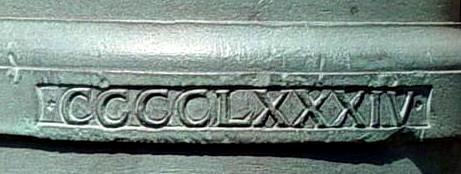
Photographed on 30 April 2003

This pattern on the barrel represents Henry Phipps,
First Earl of Mulgrave,
Master General of the Ordnance 1810-1818
Photographed on 30 April 2003
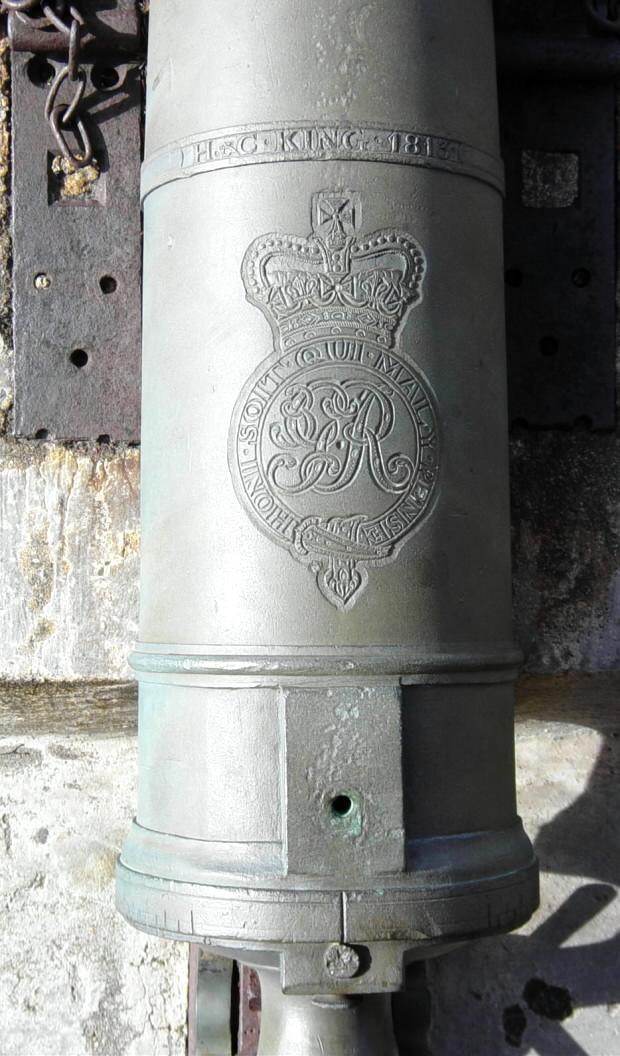
Photographed on 4 November 2002

Photographed on 31 October 2002
Note: This photograph was taken eleven days before the
the official unveiling of the plaque facing the camera.
|
Two Bronze Cannons Chester, Lunenburg County, Nova Scotia March 2004 positions on the cannons' barrels. These reflect the differing hierarchies of ownership and responsibility for the issue and manufacture of the cannon and can be separately described and reported on, as follows: |
|
Because Henry and Cornelius King were Master Founder and Assistant Founder at the Royal Brass Foundry between 1813 and 1818, and because Henry Phipps, as Earl of Mulgrave, was Master General of the Ordnance at the same time, all cannon cast at Woolwich between 1813 and 1818 should bear the same combination of markings as those demonstrated on these two examples. These two cannon at Chester in Nova Scotia, and especially that cast in 1813, will be among the earliest cannon cast by the partnership of Henry and Cornelius King. It must be remembered that during the War of 1812-1814 with the United States of America, Britain was also fully engaged in a war with Napoleonic France: thus, the outbreak of war with the USA in 1812 would have necessitated the casting of additional cannon. It is probable that these two cannon were cast for the war in North America in 1812-1814. — Research report by Stephen Wood, 1 March 2004 Stephen Wood Research, 24 Stanley Street Southsea, Hampshire PO5 2DS, United Kingdom
|
|
Thanks to Mr. Peter Finer |

Photographed on 30 April 2003

Photographed on 30 April 2003

Photographed on 20 March 2003

This pattern on the barrel represents Henry Phipps,
First Earl of Mulgrave,
Master General of the Ordnance 1810-1818
Photographed on 30 April 2003
BronzeBronze is an alloy of copper and tin commonly used in18th and 19th century artillery. Often mistakenly called brass. |
Brass versus BronzeBRASS: An alloy composed of copper and zincand not suitable for ordnance. BRONZE: An alloy composed of copper and tin and definitely suitable for ordnance. |
BronzeA metal made of two or more pure metals (pure chemical elements),mixed and melted together, is called an alloy. Any alloy, or mixture, of copper and tin is called bronze. Many bronze alloys also contain small amounts of other materials. Bronze was one of the first alloys developed by metal workers in ancient times. The Mesopotamians ushered in the Age of Bronze about 4500 years ago. In the earliest fortified towns bronze was used for shields, helmets, and battle axes. 4000 years ago the Chinese made early coins of bronze. Bronze melts at a lower temperature than iron, reducing the manufacturing cost. Bronze is softer and weaker than iron, but bronze resists corrosion (especially seawater corrosion) and metal fatigue better than iron. Because it does not rust, bronze was preferred aboard ship or in seacoast forts. Originally "bronze" was a term for copper alloys having tin as the only or principal alloying element. In modern usage the name "Bronze" is seldom used alone, and a term such as "Phosphor Bronze" or "Aluminum Bronze" is used for identifying alloys of copper and tin with small amounts of other elements added to produce special characteristics. |
Brass or Bronze?As we prepare almost every issue of The Artilleryman Magazinethe confusion of "brass" and "bronze" comes up in things written in an earlier time period when the terminology was incorrect, or by modern writers who don't know the difference. We recently came across this in Harold L. Peterson's Round Shot and Rammers (Bonanza Books, 1969): "In almost all the contemporary [18th and early 19th centuries] references the term used is brass. Bronze is almost never mentioned. Yet the alloy itself sometimes consisted only of copper and tin, which would make it bronze according to a modern definition..." The only brass guns were those made by the uninformed. All surviving antique cannon of a copper-based alloy are in fact "bronze." The actual definition of "gun metal" was 90 percent copper and 10 percent tin, which was the strongest of the various bronze alloys. — Submitted by Bill Anderson, 1st Continental Artillery Online source: Brass or Bronze?The NWTA Spy, Spring 2000 http://www.nwta.com/Spy/spring00/brass.html |
Links to Relevant WebsitesThe story of copper and its principal alloys, bronze and brass... http://64.90.169.191/education/60centuries/middle_ages/mediaeval.html Cast Bronze Muzzle-Loaders A first-class bronze cannon of 1500 differed hardly at all in essential technology and ballistic performance from a cannon of 1850 designed to shoot a ball of the same weight... http://www.sportshooter.com/reloading/earlyweapons.htm Cannon History and Technology Gunfounding 101 by the Mel Fisher Maritime Heritage Museum, Key West, Florida http://www.melfisher.org/cannonsurvey/gunfounding101.htm Manufacturing a Cast-Iron or Cast-Bronze Cannon by the Mel Fisher Maritime Heritage Museum, Key West, Florida http://www.melfisher.org/cannonsurvey/castguns.htm Governor's Cannon by Turks and Caicos National Museum Bronze cannons are relatively rare, perhaps because bronze retains considerable value as scrap metal and is frequently recycled, particularly during times of war. Those guns that have survived often provide a wealth of historical information... http://www.tcmuseum.org/projects/governors_cannon/ Appendix 3: The Design and Construction of Bronze Cannon in the 16th Century ...Sixteenth-century cannon founders, at least the good ones, made a serious and largely successful effort to standardize their production methods. When we consider the primitive conditions under which they worked of necessity and the almost total lack of any direct means of measuring the quality of their product except by destructive testing, either intentional or inadvertent, this level of standardization is nothing short of amazing... http://www.angelfire.com/ga4/guilmartin.com/Appendix3.html Gunfounding in the Late XVIIIth Century http://home.europa.com/~bessel/Naval/Forge.html Chapter 2: Why Bronze Came Before Iron and Steel http://www.usgennet.org/usa/topic/preservation/science/inventions/chpt2.htm History of the Rifled Cannon http://home.earthlink.net/~turnerbrigade/modemrif.htm |
|
Art of Gunfounding: The Casting of Bronze Cannon in the Late 18th Century edited by Carel de Beer published 1991 by Jean Boudriot Publications Crowborough, United Kingdom ISBN 0948864079 232 pages with tables, 102 b/w figures, 2 b/w photos, 50 watercolours and 34 b/w full-page plates Story of the Woolwich Brass Foundry and its refurbishment and modernisation between 1770 and 1774 by the Verbruggens, gunfounders from the Hague. First UK edition limited to 1000 copies Round Shot and Rammers by Harold L. Peterson Illustrated by Peter F. Copeland, Donald W. Holst, and Robert L. Klinger Published 1969 by Bonanza Books, New York ISBN 051711948X, 128 pages This is an introduction to muzzle-loading land artillery in the United States. Hundreds of specially developed drawings and construction plans of the cannon and their carriages. English Artillery 1326 - 1716 by Oliver F.G. Hogg published 1963 by the Royal Artillery Institution, London 310 pages with 8 illustrations An Illustrated History of Artillery by Joseph Jose published 1971 by Crescent Books, New York 217 pages with 24 color plates, 281 b/w illustrations Traces the history and technology of artillery from its beginnings in the 14th century to the 20th century. Report on the Manufacture of Bronze Cannon 1850-1851 by W. Wade, published 1856 reprinted 1982 by Antique Ordnance Publishers, Port Huron, Michigan Cast For War: A History of Muzzle-Loading Artillery by Joseph Thatcher, published 1985 New York State Bureau of Historic Sites Waterford, New York Ordnance and Gunnery by Brevet-Col.J.G. Benton published 1867, 107 pages |
|
Two Bronze Cannons Chester, Lunenburg County, Nova Scotia Royal Cypher of King George III 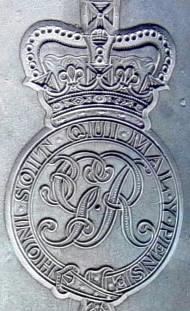
This denotes the cannon as being the property of the British Crown, symbolised in the person of the King as Head of State. Markings such as this have been used to denote the ownership of cannons in Britain since the sixteenth century. The crown that surmounts the Garter symbolises the monarchy, the Royal Cypher GR stands for Georgius Rex ("King George" in Latin, the formal language traditionally used in the Royal Style and Titles of the monarch) and the Garter is used to denote the fact that King George III was both the Sovereign of The Most Noble Order of the Garter and the Principal Knight Companion of the Order, the senior Order of Chivalry in the British honours system. — Research report by Stephen Wood, 1 March 2004 Stephen Wood Research, 24 Stanley Street Southsea, Hampshire PO5 2DS, United Kingdom More about these bronze cannons |
|
Two Bronze Cannons Chester, Lunenburg County, Nova Scotia Earl of Mulgrave Master General of Ordnance 
This symbol denotes The Honourable Henry Phipps, 1st Earl of Mulgrave (1755-1831). At the time of these cannons being cast, he was Master General of the Ordnance, having been appointed to that post on 1 May 1810 and created Earl of Mulgrave on 7 September 1812; he remained Master General of the Ordnance until 1818. The post of Master General of the Ordnance was a Cabinet post always held by retired or semi-retired soldiers of senior rank. The office of "Master of The King's Ordnance" was created in 1414 and had assumed the title "Master General of the Ordnance" by the end of the sixteenth century. The Master General held senior responsibility for the Board of Ordnance (created in 1518 and abolished in 1855), the Civil Department of State that was charged with the procurement, issue, repair and recovery of all warlike stores used by the British Army and Royal Navy: this covered all forms of weaponry, from bayonets to cannon, and included their ammunition too. The Master General was also, in his military capacity, commander of the Royal Regiment of Artillery and the Corps of Royal Engineers. Whereas the manufacture of small arms tended, especially in time of war, to be contracted out to private contractors, the manufacture of cannon was, by the early nineteenth century, a carefully controlled and monitored process undertaken at the Royal Brass Foundry at Woolwich (the basis of the famous Woolwich Arsenal). From the early sixteenth century some reference to the Master (or Master General) of the Ordnance usually appeared on cannon barrels cast for the British Army and, by the seventeenth century, it had become standard practice, when casting cannon barrels, to use some of the Master General's personal heraldry to symbolise his responsibility for the production and provision of the cannon. Sometimes, Master Generals decided to use their full armorial achievement ("coat of arms") but more usually, and certainly by the early nineteenth century, the Master General was symbolised by the initial letter of his title surmounted by the coronet appropriate to his rank in the peerage. Thus, for The Honourable Henry Phipps as Earl of Mulgrave and Master General (1812-1818), the letter M was used and surmounted by the coronet of an earl. During his time as Master General but prior to his elevation in the peerage from the rank of baron to the rank of earl (1810-1812), Lord Mulgrave's cannon would have cast into them the letter M surmounted by the coronet of a baron, which is different in its form from that of an earl. The wreath of laurel that encloses the letter M signifies the fact that Lord Mulgrave was a distinguished soldier – laurel wreaths having been used since the time of the Roman Empire to symbolise and recognise military prowess. The Honourable Henry Phipps was the third son of the 1st Baron Mulgrave (in the peerage of Ireland) and was educated at Eton College between 1767 and 1771. In 1775 he entered the British Army as an ensign (2nd lieutenant) in the 1st Regiment of Foot Guards. He was promoted lieutenant in his regiment, and captain in the army, in 1778 and purchased the rank of major in the 85th Regiment of Foot in 1779, purchasing promotion to lieutenant-colonel in the 88th Regiment of Foot in 1780, transferring to the 45th Regiment of Foot in 1782 and transferring back to the 1st Regiment of Foot Guards in 1783. He served in America during the War for Independence, as well as in the Caribbean. Remaining in the army for the rest of his life, he was able to combine a military career with that of a politician: he was elected to represent the borough of Totnes in Devon in 1784 and then to represent that of Scarborough in Yorkshire in 1790. Promoted colonel in the army in 1790, he became a brigadier-general in 1793 and was also briefly governor of Toulon in the south of France during the British occupation of that port in that year. He was appointed honourary colonel of the 31st Regiment of Foot in 1793 and promoted to major general in 1794, being advanced to lieutenant-general in 1801 and to general in 1809. He retained an affection for the army throughout his life and vigourously supported it, its officers' welfare and all military affairs in both Houses of the British Parliament. Succeeding his brother as 3rd Baron Mulgrave (in the peerage of Ireland) in 1792, he was created 1st Baron Mulgrave (in the peerage of Great Britain) in 1794 and so had to relinquish his seat in the House of Commons, exchanging it for one in the House of Lords. He was appointed a Privy Counsellor in 1804 and sat in successive British Cabinets from 1804 until 1818, holding the offices of Chancellor of the Duchy of Lancaster (1804-1805), Secretary of State for Foreign Affairs (1805-1806), 1st Lord of the Admiralty (1807-1810) and Master General of the Ordnance (1810-1818). He was advanced in the peerage to the rank of an earl, with the title Earl of Mulgrave (and the secondary title Viscount Normanby) on 7 September 1812 and was created a Knight Grand Cross of the Order of the Bath (GCB) on 20 May 1820. Lord Mulgrave married Martha Sophia Maling on 20 October 1795 and their marriage produced four sons and five daughters. He aged prematurely and was widely recognised as being, through mental and physical infirmiry, unfit for future public office by 1820. Lord Mulgrave died on 7 April 1831. — Research report by Stephen Wood, 1 March 2004 Stephen Wood Research, 24 Stanley Street Southsea, Hampshire PO5 2DS, United Kingdom More about these bronze cannons |
Mulgrave, Nova ScotiaNova Scotia, was named for George Augustus Constantine Phipps (1819-1890), Earl of Mulgrave, Governor of Nova Scotia 1858-1863. George Augustus Constantine Phipps (1819-1890) was the son of Constantine Henry Phipps (1797-1863), first Marquess of Normanby. Constantine Henry Phipps succeeded his father as Earl of Mulgrave in 1831. George Augustus Constantine Phipps (1819-1890) was the grandson of Henry Phipps (1755-1831), the 1st Earl of Mulgrave and Master General of the Ordnance (1810-1818). George Augustus Constantine Phipps, second Marquis of Normanby, born 23 July 1819, entered the Scots Fusilier Guards in 1838, and was comptroller, and subsequently treasurer, of the Queen's household from 1853 till 1858. He was Governor of the British Colony of Nova Scotia Feb 1858 - Sep 1863. He was Governor of Queensland, Australia, 1871-1874; Governor of New Zealand 1874-1879; and Governor of Victoria, Australia, 1879-1884. Marquesses of Normanby, Second Creation (1838) Constantine Henry Phipps (1797-1863), 1st Marquess of Normanby George Augustus Constantine Phipps (1819-1890), 2nd Marquess of Normanby Constantine Charles Henry Phipps (1846-1932), 3rd Marquess of Normanby Oswald Constantine John Phipps (1912-1994), 4th Marquess of Normanby Constantine Edmund Walter Phipps (1954- ), 5th Marquess of Normanby |
|
General The Earl of Mulgrave GCB 1793-1831 Henry Phipps
http://www.queensroyalsurreys.org.uk/colonels/054.html Mulgrave, Earldom of Encyclopaedia Britannica 1911 http://www.1911encyclopedia.org/Earldom_Of_Mulgrave Constantine Henry Phipps, 1st Marquess of Normanby Encyc. Britannica 1911 http://www.1911encyclopedia.org/Constantine_Henry_Phipps%2C_1st_contess_of_Normanby George Augustus Constantin Phipps (1816-1890) Earl of Mulgrave http://lt.gov.ns.ca/inner/frames/honourable/content/past/Mulgrave.htm This webpage has disappeared from the WWW, but archived copies are available in the Wayback Machine: |
|
The Wayback Machine has archived copies of this document:
Archived: 2005 April 27
Archived: 2005 December 23
Archived: 2006 May 03
|
|
Henry Phipps, 1st Earl of Mulgrave Wikipedia
http://en.wikipedia.org/wiki/Henry_Phipps%2C_1st_Earl_of_Mulgrave Constantine Henry Phipps, 1st Marquess of Normanby Wikipedia http://en.wikipedia.org/wiki/ Constantine_Henry_Phipps%2C_1st_Marquess_of_Normanby Master-General of the Ordnance Wikipedia http://en.wikipedia.org/wiki/Master-General_of_the_Ordnance Constantine John Phipps Mulgrave Appletons Encyclopedia http://www.famousamericans.net/constantinejohnphippsmulgrave/ Obituary: Oswald Constantine John Phipps (1912-1994), 4th Marquis of Normanby http://www.rnib.org.uk/xpedio/groups/public/documents/ visugate/public_nbjun94.hcsp |
|
Two Bronze Cannons Chester, Lunenburg County, Nova Scotia Henry & Cornelius King Royal Brass Foundry, Woolwich 
From the sixteenth century, British cannon began to be cast bearing the names of the men who were ultimately responsible for their casting. Such men were highly skilled and trained artisans. The practice of placing the founders' names on objects cast by them predates the casting of cannon, medieval church bells in England also often bearing the names of the men who cast them. Henry and Cornelius King are believed to have been uncle and nephew. The brothers Henry and John King were first employed at the Royal Brass Foundry at Woolwich prior to 1770, when Andrew Schalch (1692-1776) was Master Founder there. Schalch retired in 1770 and was replaced by John (1712-1782) and Peter (1734-1786) Verbruggen, a father-and-son partnership from the United Provinces of the Netherlands who were joint Master Founders at Woolwich and who are believed to have thought highly of the skills of Henry and John King. Although the Royal Brass Foundry had been exceptionally busy with the production of cannon during the American War for Independence (1775-1783), work almost ceased in 1784 and it was only through petitions, supported by Peter Verbruggen, that the brothers King were able to remain employed at Woolwich. On Peter Verbruggen's death in 1786, the Mastership of the Royal Brass Foundry notionally passed to Frederick Groves but, in Groves' absence, control was exercised over the Foundry by John King. In 1789, John King was appointed Foreman of the Foundry and his brother, Henry, appointed Assistant Foreman. At the same time, John King is believed to have successfully applied for his son, Cornelius, to be appointed to the post of Assistant Moulder (moulders were responsible for the artistic, and often heraldic, decoration cast into cannon barrels). The outbreak of Britain's war with Revolutionary France in 1793 galvanised production at Woolwich and the production of cannon increased considerably. In 1797, John King was promoted to Master Founder and Henry King appointed Assistant Founder; in 1805, Cornelius King was appointed Foreman. John King died in office in 1813 and his brother Henry was promoted to Master Founder, with Cornelius being promoted to Assistant Founder simultaneously. The partnership of Henry and Cornelius King continued at the Royal Brass Foundry until Henry's retirement in 1818 (coincidentally, the same year that Lord Mulgrave retired as Master General); Cornelius continued at Woolwich as Assistant Founder until retiring in 1822. Henry King died in 1825 and Cornelius died in 1835. — Research report by Stephen Wood, 1 March 2004 Stephen Wood Research, 24 Stanley Street Southsea, Hampshire PO5 2DS, United Kingdom More about these bronze cannons |
Woolwich Churchyardaged 53. Mrs. Mary King his wife died 16 May 1828 aged 40. http://www.kentarchaeology.org.uk/Research/Libr/MIs/ MIsWoolwich/MIsWoolwich001-450.htm |
Nowadays, cannon and other forms of artillery from the 1700s and 1800s are nothing more than quaint noise-makers. We see them only in the movies and on TV, or at occasional demonstrations at historic sites. In their day, cannons were the most powerful, far-reaching and fearsome weapons available...
|
The Wayback Machine has archived copies of this document:
Archived: 2003 November 25
Archived: 2004 May 11
Archived: 2004 October 15
Archived: 2005 March 09
Archived: 2005 October 26
Archived: 2006 February 15
|
 Chester war memorial
 Chester Legion cannons Chester
 Norwegian war memorial at Chester
 Chester volunteer firemen memorial Chester
 Swissair Flight 111 Memorial, Bayswater
 New Ross war memorial New Ross
 Chester Basin war memorial Chester Basin
 Western Shore war memorial Western Shore
 Military Engineers Gold River Bridge
 Military Engineers Martins River Bridge
 Hubbards war memorial Hubbards
 Riverport war memorial Riverport
 Mosher memorial Lower LaHave
 Five Houses cannon Lower LaHave
 Blockhouse Hill cannon Lunenburg
 Camp Norway memorial Lunenburg
 Veterans' Memorial Bridge Bridgewater
 Parkdale-Maplewood war memorial Parkdale-Maplewood
 Montbeliard monument Lunenburg
 Fort Point monument LaHave
 Ritcey monument Riverport
  Hits per calendar month
       2015 Jan    60

       2014 Dec    71
       2014 Nov    88
       2014 Oct   108
       2014 Sep    59
       2014 Aug    62
       2014 Jul   168
       2014 Jun   106
       2014 May   141
       2014 Apr    92
       2014 Mar   443
       2014 Feb    59
       2014 Jan    93

       2013 Dec    79
       2013 Nov    62
       2013 Oct    66
       2013 Sep    70
       2013 Aug    75
       2013 Jul    73
       2013 Jun    73
       2013 May    76
       2013 Apr    72
       2013 Mar    75
       2013 Feb    54
       2013 Jan    53

       2012 Dec    98
       2012 Nov    66
       2012 Oct    62
       2012 Sep    93
       2012 Aug    53
       2012 Jul    92
       2012 Jun    76
       2012 May    95
       2012 Apr    70
       2012 Mar    71
       2012 Feb    60
       2012 Jan    67

       2011 Dec    57
       2011 Nov    83
       2011 Oct    78
       2011 Sep    87
       2011 Aug   101
       2011 Jul    76
       2011 Jun    62
       2011 May    84
       2011 Apr    82
       2011 Mar    89
       2011 Feb    93
       2011 Jan   107

       2010 Dec    96
       2010 Nov   123
       2010 Oct   107
       2010 Sep   151
       2010 Aug   104
       2010 Jul   133
       2010 Jun    91
       2010 May    96
       2010 Apr    74
       2010 Mar   123
       2010 Feb   107
       2010 Jan   105

       2009 Dec   161
       2009 Nov   132
       2009 Oct   125
       2009 Sep    94
       2009 Aug    75
       2009 Jul   124
       2009 Jun   117
       2009 May   119
       2009 Apr   125
       2009 Mar   132
       2009 Feb   139
       2009 Jan   171

       2008 Dec   102
       2008 Nov   164
       2008 Oct   200
       2008 Sep   144
       2008 Aug    96
       2008 Jul   178
       2008 Jun   176
       2008 May   174
       2008 Apr   196
       2008 Mar   175
       2008 Feb   213
       2008 Jan   159

       2007 Dec   132
       2007 Nov    97
       2007 Oct    89
       2007 Sep   138
       2007 Aug   112
       2007 Jul   124
       2007 Jun    82
       2007 May   114
       2007 Apr   115
       2007 Mar    72
       2007 Feb    66
       2007 Jan    69

       2006 Dec    35
       2006 Nov    67
       2006 Oct     -
       2006 Sep     -
       2006 Aug     -
       2006 Jul     -
       2006 Jun     -
       2006 May     -
       2006 Apr     -
       2006 Mar     -
       2006 Feb     -
       2006 Jan   146
"-" means data are not available

       2005 Dec   100
       2005 Nov   144
       2005 Oct   146
       2005 Sep   133
       2005 Aug   126
       2005 Jul   115
       2005 Jun   108
       2005 May    90
       2005 Apr   116
       2005 Mar   129
       2005 Feb    98
       2005 Jan   121

       2004 Dec   107
       2004 Nov   125
       2004 Oct   112
       2004 Sep    99
       2004 Aug   107
       2004 Jul   109
       2004 Jun   104
       2004 May   202
       2004 Apr   131
       2004 Mar   129
       2004 Feb    94
       2004 Jan   105

       2003 Dec    52
       2003 Nov    69
       2003 Oct     0