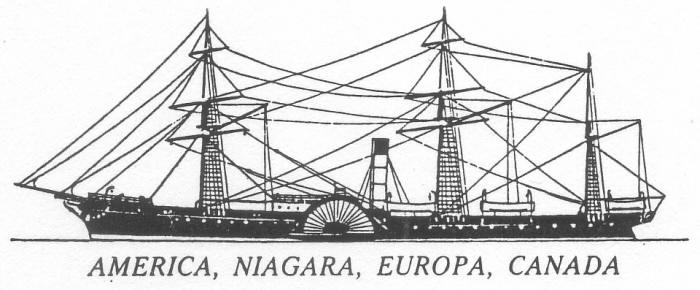
The newest, largest, and fastest (in 1849)
were America, Canada, Europa, and Niagara.
The Halifax Express (as it was known at the time) or the Nova Scotia Pony Express (as it is now known), which operated for nine months in 1849, carried Associated Press news dispatches from Halifax to Victoria Beach, in Nova Scotia.
It is clear that each westbound trip of this Express service, from Halifax to Victoria Beach, carried one small Associated Press package only – no mail. The Royal Mail was far too heavy to be carried by a single horse, and the contract specified that Cunard, not AP, was the mail carrier from Liverpool through to Boston or New York. The return (eastbound) trips of this Express service carried nothing for AP, and was solely for the transfer of individual horses to the places where they awaited the next westbound trip.
In 1849 there was a complex system of regularly-scheduled communication between London on the east side of the North Atlantic Ocean, and several locations on the west side of the North Atlantic, including Halifax, Pictou, Quebec, Boston, and New York.
The main link in that system was the Cunard steamship fleet, which, under contract with the British Admiralty, carried the Royal Mail and news across the North Atlantic, between Liverpool in England, and Halifax, Boston, and New York in North America. Cunard's ships also carried freight and any passengers who wanted to make the trip, but the regular mail service was the reason the British Government was willing to pay Cunard a large subsidy to operate his transatlantic transportation system. In 1849, Cunard's annual subsidy for carriage of the Royal Mail across the North Atlantic was £173,340.
In April 1848 Cunard's average time from Liverpool to New York (including the stop at Halifax) was down to 12 days 22 hours. In 1851, Cunard averaged 11 days 12 hours eastbound, and 12 days 9 hours westbound.
The Nova Scotia Pony Express operated in very close association with Cunard's North Atlantic steamship service; the pony express runs were operated immediately after the arrival of one of the Cunard Royal Mail ships at Halifax. This webpage describes the Cunard steamship fleet as it existed during 1849.
In 1849, Cunard had seven steamships to maintain the schedule on the North Atlantic Royal Mail service. In alphabetical order, these were:
America
Caledonia
Cambria
Canada
Europa
Hibernia
Niagara
| ||||||||||||||||
Steam Engine IHPIHP means Indicated HorsePower. In the days of reciprocating (piston in cylinder) steam engines, a Steam Engine Indicator was a sophisticated scientific instrument frequently used to measure the power output of an engine. For example, if a ship owner wanted proof that a particular engine was delivering the power that the manufacturer claimed, the usual method, especially for large engines such as those used for ship propulsion, was to take an Indicator Diagram. The Engine Indicator was an instrument that was set up beside the engine to be tested, the engine was started and run under load, and the Indicator produced graphs on paper that showed the steam pressure inside the engine cylinder plotted against piston position. As the piston travelled back and forth in the cylinder, the instrument graphed the steam pressure acting against the piston. The indicator graph was a closed loop for each return stroke (revolution) of the engine. The area enclosed in the loop could be interpreted so as to provide an accurate measure of the energy output for each piston stroke. Then this energy per stroke was multiplied by the engine speed in revolutions per minute to yield the engine power output. The usual procedure was to take several indicator diagrams for the engine under test, at various throttle positions and valve cutoff settings, and at various steam pressures from somewhat below to somewhat above the design pressure. An analysis of these indicator diagrams would provide reliable measures of the engine power under various operating conditions. Indicator results were accepted as trustworthy by engine manufacturers and operators alike, and, in case of serious disputes, the courts would accept indicator diagrams taken by competent technicians as legal proof of engine performance. The use of "IHP" means these power outputs were actual measured performances, not just something stamped on a nameplate by a manufacturer. References: Indicator diagram (for steam engines) Wikipedia Steam Engine Pressure-Volume Diagram by Robert A. Booty, Oshkosh, Wisconsin http://home.new.rr.com/trumpetb/loco/steampv.html
References: The Steam Engine Indicator http://www.archivingindustry.com/Indicator/contentback.htm The engine indicator is a fascinating instrument that records how the pressures in the cylinders of steam and internal-combustion engines change during the operating cycle. Used properly, they can identify problems ranging from bad valve settings to constricted steam pipes... The first major improvement in the design of the Watt Indicator was made by an employee of Boulton & Watt, John Southern (1758-1815), who designed the first method of recording the operating cycle of the steam engine automatically. In the summer of 1796, Southern suggested adapting the 'recording indicator' by adding a recording-board or tablet that slid within a supporting frame. A cord attached to the beam pulled the tablet sideways as, simultaneously, the pencil-pointer recorded the rise of pressure in the cylinder on a sheet of paper. As the beam returned, a weight attached to the free end of the operating cord reversed the movement of the tablet. The pencil recorded the cylinder pressure as it dropped to nothing, and in so doing closed the diagram of pressure against time... The New England Wireless and Steam Museum, East Greenwich, Rhode Island Indicator diagram taken from one of the museum's steam engines http://www.newsm.org/steam-engines/greene.html Whatever the type of indicator, the resulting diagram was always in the shape of a boot. The highest part shows the pressure as the steam entered the cylinder... http://www.greatwestern.org.uk/basic8.htm Indicator: An instrument designed to measure and record the variation in the cylinder pressure of steam engines, pumps, etc., throughout the entire length of stroke... http://titanic-model.com/glossary/i.shtml |
Launched 13 May 1847
Builder: Robert Steele & Co., Greenock (Glasgow), Scotland
1,826 gross tons
Dimensions: 76.5m x 11.6m
One funnel
Three masts
Wood hull
Propulsion: Paddle (sidewheel)
Two side lever jet condensing reciprocating steam engines,
built by Robert Napier, Glasgow
670 horsepower [500 kilowatts]
Normal working steam pressure: 18 pounds per square inch [120 kPa]
Four boilers, flue (fire-tube) type
Sixteen furnaces consuming 60 tons of coal per day
Bunker capacity: 450 tons (7.5 days at normal speed)
Service speed: 10 knots [18.5 km/h]
Fuel consumption: 7.3 kilometres per ton of coal
Accomodation: 140 First Class passengers
Crew: 90
Cargo capacity: 450 tons
Launched: 1840
Builder: R.Wood, Glasgow, Scotland
1,138 gross tons
Dimensions: 63.1m x 10.4m
One funnel
Three masts
Wood hull
Propulsion: Paddle (sidewheel)
Power: Two side lever reciprocating steam engines, built by Robert Napier, Glasgow
Fuel: Coal
Service speed: 9 knots [16 km/h]
Accomodation: 115 First Class passengers
Launched 1 August 1844
Builder: Robert Steele & Co., Greenock (Glasgow), Scotland
1,423 gross tons
Dimensions: 66.7m x 10.7m
One funnel
Three masts
Wood hull
Propulsion: Paddle (sidewheel)
Two side lever reciprocating steam engines, built by Robert Napier, Glasgow
Service speed: 9 knots [16 km/h]
Accomodation: 120 First Class passengers
Launched June 1848
Builder: Robert Steele & Co., Greenock (Glasgow), Scotland
1,831 gross tons
Dimensions: 76.5m x 11.6m
One funnel
Three masts
Wood hull
Propulsion: Paddle (sidewheel)
Two side lever jet condensing reciprocating steam engines,
built by Robert Napier, Glasgow
670 horsepower [500 kilowatts]
Normal working steam pressure: 18 pounds per square inch [120 kPa]
Four boilers, flue (fire-tube) type
Sixteen furnaces consuming 60 tons of coal per day
Bunker capacity: 450 tons (7.5 days at normal speed)
Service speed: 10 knots [18.5 km/h]
Fuel consumption: 7.3 kilometres per ton of coal
Accomodation: 140 First Class passengers
Crew: 90
Cargo capacity: 450 tons
Go To: Excellent diary of a voyage across the North Atlantic on Canada 1856
http://www.johnwaltongenealogy.com/Diary.html
William Blakesley Walton and his wife Sarah Jane (Butler) and two children departed from Birmingham England for America May 8th, 1856. According to this diary they first went from Birmingham to Liverpool and after two days stay there, they sailed on the Steam Ship Canada the 10th of May en-route to Boston...
Launched September 1847
Builder: Robert Steele & Co., Greenock (Glasgow), Scotland
1,834 gross tons
Dimensions: 76.5m x 11.6m
One funnel
Three masts
Wood hull
Propulsion: Paddle (sidewheel)
Two side lever jet condensing reciprocating steam engines,
built by Robert Napier, Glasgow
670 horsepower [500 kilowatts]
Normal working steam pressure: 18 pounds per square inch [120 kPa]
Four boilers, flue (fire-tube) type
Sixteen furnaces consuming 60 tons of coal per day
Bunker capacity: 450 tons (7.5 days at normal speed)
Service speed: 10 knots [18.5 km/h]
Fuel consumption: 7.3 kilometres per ton of coal
Accomodation: 140 First Class passengers
Crew: 90
Cargo capacity: 450 tons
Gross Tonnage - 1,422
Dimensions - 66.7m x 10.7m
Number of funnels - 1
Number of masts - 3
Construction - Wood hull
Propulsion - Paddle (sidewheel)
Engines - Side lever, two, built by Robert Napier, Glasgow
Fuel - Coal
Service speed - 9 knots
Builder - Robert Steele & Son, Greenock
Accomodation - 120 First Class passengers
Launched August 1847
Builder: Robert Steele & Co., Greenock (Glasgow), Scotland
1,824 gross tons
Dimensions: 76.5m x 11.6m
One funnel
Three masts
Wood hull
Propulsion: Paddle (sidewheel)
Two side lever jet condensing reciprocating steam engines,
built by Robert Napier, Glasgow
670 horsepower [500 kilowatts]
Normal working steam pressure: 18 pounds per square inch [120 kPa]
Four boilers, flue (fire-tube) type
Sixteen furnaces consuming 60 tons of coal per day
Bunker capacity: 450 tons (7.5 days at normal speed)
Service speed: 10 knots [18.5 km/h]
Fuel consumption: 7.3 kilometres per ton of coal
Accomodation: 140 First Class passengers
Crew: 90
Cargo capacity: 450 tons
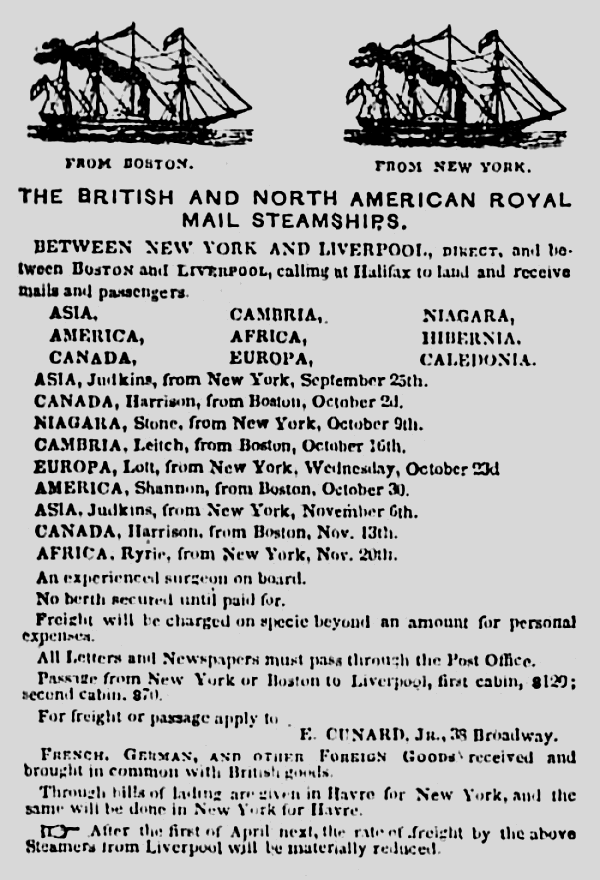
| From Boston | From New York | |
|---|---|---|
|
THE BRITISH AND NORTH AMERICAN ROYAL MAIL STEAMSHIPS | ||
|
Between New York and Liverpool, direct, and be- tween Boston and Liverpool, calling at Halifax to land and receive mails and passengers. | ||
| ASIA AMERICA CANADA |
CAMBRIA AFRICA EUROPA |
NIAGARA HIBERNIA CALEDONIA |
|
ASIA, Capt. Judkins, from New York, Wed. September 25th, 1850 CANADA, Capt. Harrison, from Boston, Wed. October 2nd, 1850 NIAGARA, Capt. Stone, from New York, Wed. October 9th, 1850 CAMBRIA, Capt. Leitch, from Boston, Wed. October 16th, 1850 EUROPA, Capt. Lott, from New York, Wed. October 23rd, 1850 AMERICA, Capt. Shannon, from Boston, Wed. October 30th, 1850 ASIA, Capt. Judkins, from New York, Wed. November 6th, 1850 CANADA, Capt. Harrison, from Boston, Wed. November 13th, 1850 AFRICA, Capt. Ryrie, from New York, Wed. November 20th, 1850 | ||
|
An experienced surgeon on board. No berth secured until paid for. Freight will be charged on specie beyond an amount for personal expenses. All Letters and Newspapers must pass through the Post Office. Passage from New York or Boston to Liverpool, first class, £120; second cabin £70 For freight or passage apply to: | ||
| E. Cunard, Jr., 38 Broadway | ||
|
French, German, and other Foreign Goods received and brought in common with British goods. Through bills of lading are given in Havre for New York, and the same will be done in New York for Havre. After the first of April, 1851, the rate of freight by the above Steamers from Liverpool will be materially reduced. | ||
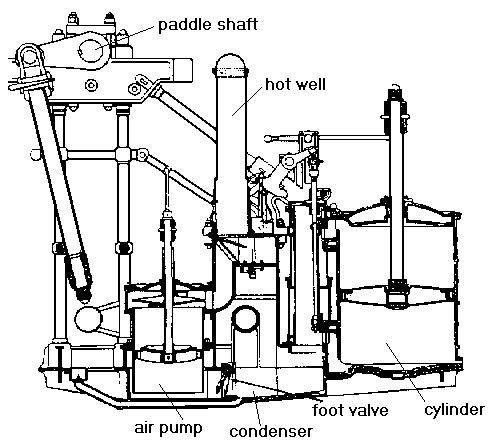
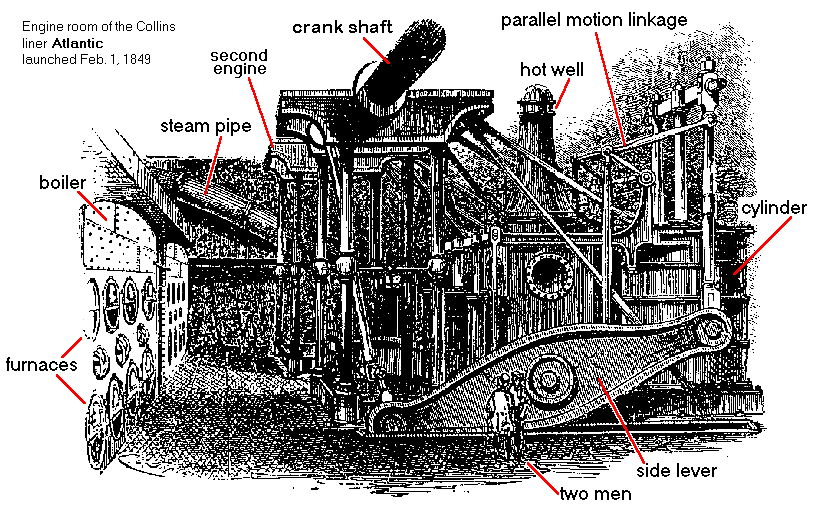
Above is a view of the engine room of the Collins liner Atlantic. This view gives a good idea of the appearance and size of the side-lever steam engines installed in the late 1840s and early 1850s in ships designed for the transatlantic service. Atlantic's engines were about twenty percent larger than the engines bought by Cunard for America, Europa, Niagara, and Canada. Except for the slightly smaller size, the 670-horsepower Cunard engines were very much like this 800-horsepower Collins engine. In the 1850s, Edward Knight Collins was the main competitor of Cunard's North Atlantic service. In 1847, he negotiated an annual subsidy of $385,000 from the United States government, set up the New York and Liverpool United States Mail Steamship Company, and ordered four 2,885-ton, wooden-hulled side-wheel steamships, the world's largest. The first vessel of this fleet was named Atlantic, and the others were Pacific, Baltic, and Arctic. Atlantic and Pacific were launched on the same day, February 1, 1849. The paddle wheels were 36 feet in diameter, with 36 paddles. Each ship was powered by two side-lever 800-horsepower [600 kW] engines. Each engine had one cylinder 95 inches (nearly eight feet) [241 cm] in diameter, supplied with steam at a pressure of seventeen pounds per square inch [120 kPa] (which then was at the bleeding edge of boiler technology). When the ship was running on both cylinders at full power, about sixteen revolutions per minute, and a little assistance from auxiliary sails, Collins' steamers could make 12 or 13 knots (23 to 25 km/h) most of the time. Their coal consumption was enormous, one ton for every 265 revolutions of the paddle wheels, or 85 tons in 24 hours; in a round trip one of these ships burned a quantity of coal almost equal to the ship's tonnage. Put in modern terms, they got about 6 kilometres (4 miles) to the ton. Atlantic sailed for Liverpool on her maiden voyage on April 27, 1850. She returned to New York in a record ten days sixteen hours. By then, captains, owners, and the newspapers could see it coming — a transatlantic trip in under ten days. In 1851, Cunard averaged 11 days 12 hours eastbound, and 12 days 9 hours westbound; Collins averaged 10 days 21 hours eastbound and 11 days 3 hours westbound. In April 1852, from Liverpool, Pacific reached Sandy Hook in nine days twenty hours fifteen minutes, the first ship, sail or steam, to cross the Atlantic to New York in under ten days.
Sources: The Magnificent Failure, by E. Milburn Carver, (a history of the Collins Steamship Company), originally published in Yankee Magazine (date not known), anthologized in Yankees Under Steam, edited by Austin N. Stevens, published by Yankee, Inc, Dublin, New Hampshire, 1970; and Steam at Sea: Two Centuries of Steam-Powered Ships by Denis Griffiths, Conway Maritime Press, 1997, ISBN 0851776663.
Note: The Collins ship Atlantic, launched in 1849, was not the passenger ship Atlantic which was wrecked on April 1, 1873, on rocks close to Meagher's Island, near the small village of Prospect, on the shore of Nova Scotia.
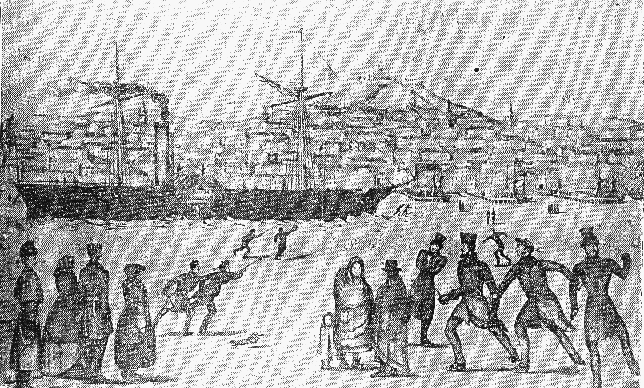
Cunard steamship America entering Halifax Harbour on February 14, 1859. Citadel Hill is seen in the background. From the Halifax Herald, February 1, 1924. The clipping bears the handwritten notation: "Navigation partially closed by ice, 14-19 February 1859." The mottled appearance of this image is an artifact a Moire pattern arising from the interaction of the pixel structure of the digitized image with the halftone structure of the original newspaper image.
Britannia was launched on 5 February 1840. It departed Liverpool on its maiden voyage to Halifax and Boston on 4 July 1840. The passage took 14 days 8 hours, which was very fast time for those days. During a voyage in February 1844 Britannia became trapped in the ice in Boston Harbour but at their own expense the citizens of the town cut an escape channel, seven miles [eleven kilometres] long for the ship. Later, in September 1847, it was stranded at Cape Race but was repaired at New York. November 1848 saw Britannia's last voyage on this service. In March 1849 Britannia sailed from Liverpool to Bremen and was renamed Barbarossa, part of the former German Confederation Navy. In 1852 it was transferred to the Prussian Navy under the same name. In 1880 it was sunk when acting as a target ship.
On 4 August 1840 Cunard steamship Acadia began her maiden voyage from Liverpool to Halifax and Boston, and continued in this service until November 1848. On 9 March 1849 she began sailing from Liverpool to Bremen and on the first trip became stranded on Terschelling Island in Holland. She was soon refloated and became part of the former German Confederation Navy under the name Erzherzog Johann. In 1852 she was refitted by W.A.Fritze & Co. and Karl Lehmkuhl, and renamed Germania. In August 1853 she began the Bremen - New York service which she maintained until the end of 1854. In 1855 she was chartered to the British Government as a Crimean War transport. She was finally scrapped at London in 1858.
|
The Wayback Machine has archived copies of this webpage:
Archived: 1999 May 07
Archived: 1999 October 07
Archived: 2000 June 14
Archived: 2000 October 19
Archived: 2001 April 07
Archived: 2001 November 15
|
More About the
|
  Hits per calendar month
       2013 Sep     134
       2013 Aug     150
       2013 Jul     126
       2013 Jun     145
       2013 May     185
       2013 Apr     166
       2013 Mar     189
       2013 Feb     118
       2013 Jan     232

       2012 Dec     213
       2012 Nov     228
       2012 Oct     173
       2012 Sep     171
       2012 Aug     181
       2012 Jul     208
       2012 Jun     183
       2012 May     320
       2012 Apr     432
       2012 Mar     287
       2012 Feb     214
       2012 Jan     166

       2011 Dec     130
       2011 Nov     168
       2011 Oct     169
       2011 Sep     120
       2011 Aug     130
       2011 Jul     103
       2011 Jun     115
       2011 May     139
       2011 Apr     141
       2011 Mar     178
       2011 Feb     170
       2011 Jan     242

       2010 Dec     255
       2010 Nov     304
       2010 Oct     326
       2010 Sep     329
       2010 Aug     284
       2010 Jul     266
       2010 Jun     307
       2010 May      -
       2010 Apr      -
       2010 Mar     379
       2010 Feb     357
       2010 Jan     363

       2009 Dec     313
       2009 Nov     355
       2009 Oct     308
       2009 Sep     271
       2009 Aug     171
       2009 Jul     300
       2009 Jun     242
       2009 May     403
       2009 Apr     412
       2009 Mar     445
       2009 Feb     427
       2009 Jan     410

       2008 Dec     255
       2008 Nov     439
       2008 Oct     448
       2008 Sep     363
       2008 Aug     266
       2008 Jul     370
       2008 Jun     370
       2008 May     391
       2008 Apr     484
       2008 Mar     503
       2008 Feb     478
       2008 Jan     544

       2007 Dec     320
       2007 Nov     166
       2007 Oct     236
       2007 Sep     338
       2007 Aug     176
       2007 Jul     186
       2007 Jun     134
       2007 May     130
       2007 Apr     134
       2007 Mar     134
       2007 Feb     138
       2007 Jan      50

       2006 Dec      20
       2006 Nov      85
       2006 Oct      -
       2006 Sep      -
       2006 Aug      -
       2006 Jul      -
       2006 Jun      -
       2006 May      -
       2006 Apr      -
       2006 Mar      -
       2006 Feb      -
       2006 Jan      -
"-" means data are not available

       2005 Dec     149
       2005 Nov     194
       2005 Oct     158
       2005 Sep     146
       2005 Aug     127
       2005 Jul     117
       2005 Jun     154
       2005 May     155
       2005 Apr     204
       2005 Mar     213
       2005 Feb     200
       2005 Jan     190

       2004 Dec     172
       2004 Nov     227
       2004 Oct     220
       2004 Sep     195
       2004 Aug     149
       2004 Jul     142
       2004 Jun     145
       2004 May     155
       2004 Apr     195
       2004 Mar     221
       2004 Feb     182
       2004 Jan     229

       2003 Dec     116
       2003 Nov     167
       2003 Oct     158
       2003 Sep     140
       2003 Aug     105
       2003 Jul     123
       2003 Jun     135
       2003 May     195
       2003 Apr     155
 W3C HTML Validation Service http://validator.w3.org/ |
 W3C CSS Validation Service http://jigsaw.w3.org/css-validator/ |
First uploaded to the WWW: 1999 April 05
Script upgraded to HTML 4.0: 2001 July 18
Moved to new hosting service: 2001 November 04
Moved to new hosting service: 2006 May 16
Moved to new hosting service: 2006 October 05
Latest update: 2013 October 16