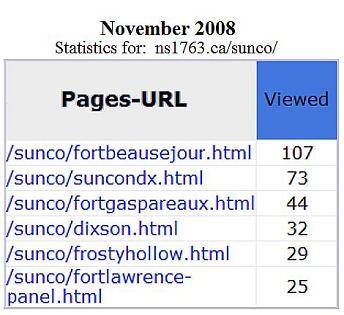
Traffic report: November 2008
Before 1784, the area now known as Westmorland County,
New Brunswick, was part of Sunbury County in Nova Scotia,
and was administered by the Governor and Council at Halifax.
In 1765, the Nova Scotia Government established Sunbury County,
which included all the area now known as New Brunswick, and
a substantial chunk of what is now eastern Maine. From
September 1768 to October 1785, Sunbury County had two elected
representatives in the Nova Scotia Provincial Parliament at Halifax.
After October 1785, this area was no longer eligible to send
representatives to the Nova Scotia Provincial Parliament.
Sunbury County, Nova Scotia by Wikipedia
http://en.wikipedia.org/wiki/Sunbury_County,_Nova_Scotia
 Aulac —
Fort Beausejour plaques
Aulac —
Fort Beausejour plaques
 Fort Cumberland —
Thomas Dixson, November 1776, plaque
Fort Cumberland —
Thomas Dixson, November 1776, plaque
 Fort Cumberland —
Fort Lawrence 1750-1756, interpretative panel
Fort Cumberland —
Fort Lawrence 1750-1756, interpretative panel
 Frosty Hollow —
Frosty Hollow historic plaque
Frosty Hollow —
Frosty Hollow historic plaque
 Port Elgin —
Fort Gaspareaux cairn and plaque, 1751
Port Elgin —
Fort Gaspareaux cairn and plaque, 1751
The wise policy of the government of Nova Scotia, which induced New England farmers to settle upon the lands in the peninsula from which the Acadians had been removed, was extended to others who wished to establish themselves in other sections of the province; and grants were soon made to companies and to individuals in different parts of the district which now forms the province of New Brunswick. Many also went northward and westward towards the Canadian (Quebec) border. "A perfect fever for emigration from the older towns commenced," as Kidder says,
["Military Operations in Eastern Maine and Nova Scotia during the Revolution," by Frederic Kidder]
"and a very few years sufficed to carry civilization over the largest part of Vermont, New Hampshire and much of Maine along and west of the Penobscot." But the greater part of the emigration came toward Nova Scotia.
The rapidity and extent of this influx of population are almost incredible. Gov. Lawrence's proclamations had drawn attention to the province; the fall of Quebec, and the Indian treaty of 1760, left no fear of an immediate renewal of the French and Indian wars; there were also, doubtless, greatly exaggerated reports of the fertility of the soil; yet it is impossible to fully account for the migration without supposing a sort of restlessness, such as sometimes seizes upon people en masse, and such as we have seen paralleled only in the early days of the "California fever". Unlike the gold hunters, however, the New Englanders who came to Nova Scotia came as permanent settlers...
In 1763, a number of families, led by Israel Perley, arrived in four vessels from New England, and settled at Maugerville, on the St. John – the first permanent British settlement above the mouth of the river... In 1765, this district (including St. John and Passamaquoddy) was erected into a county called the county of Sunbury in the province of Nova Scotia. In the same year, the township of Burton, adjoining Maugerville, and Perkins' Island, (probably Indian Island) in Passamaquoddy bay, were granted to a New England company...
— Source:
Glimpses of the Past: The County of Sunbury
Saint Croix Courier, St. Stephen, New Brunswick, 29 September 1892
— Reference:
Glimpses of the Past: Index
Saint Croix Courier, St. Stephen, New Brunswick, 7 January 1892