Cheverie Telephone Company
share certificate, 1889
The original is held by the West Hants Historical Society, Windsor.
• #
Government-Owned Telephone and Telegraph Companies
• #
Privately-Owned Telephone and Telegraph Companies
• # Antigonish & Sherbrooke Telephone Company
• # Bell Aliant
• # Fonorola
• # Hants & Halifax Telephone Company
• # Maitland Telephone Company
• # Maritime Telegraph & Telephone Company
• # Nova Scotia Telephone Company
• # Sprint Canada
• # Valley Telephone Company
• #
Mutual Telephone Companies Under the Rural Telephone Act
• # Bayfield & Summerside Mutual Telephone Company
• # Blue Mountain Mutual Telephone Company
• # Chedabucto Mutual Telephone Company
• # Glengarry Mutual Telephone Company
• # Glen-Habitant Mutual Telephone Company
• # Guysboro Intervale Mutual Telephone Company
• # Heatherton Mutual Telephone Company
• # Hillside Mutual Telephone Company
• # Jordan Bay Mutual Telephone Company
• # Mineral Rock Mutual Telephone Company
• # Pomquet Mutual Telephone Company
• # Salmon River Mutual Telephone Company
• # Tor Bay Mutual Telephone Company
• # Trout Brook Mutual Telephone Company
• # Number of Telephone Companies
Operating in Nova Scotia, Year by Year
• # Links to Telegraph History Websites
• # Links to Telephone History Websites
• # Recent additions to this list
• # Telephone Exchange names
• # LIberty3
• # JUniper2
• # Fire Numbers before 911
• # Notes
1876 March 10: The first complete sentence was spoken by telephone.
Alexander Graham Bell's Path to the Telephone
1880 February 23
A stable legal context for the development of a national telephone system in Canada was secured when the Canadian government asserted legislative control over the telephone system and granted the Bell Telephone Company of Canada a Charter with extensive rights. The Charter was introduced into Parliament on 23 February 1880, and was passed less than a month later by both the House and the Senate.
—Source:
A Social History of Canadian Telecommunications by Dwayne Winseck
Now, in 2005, when few people can remember life without telecommunications, can we really understand how people, 120 years ago, viewed inventors who said they talked over wires without electricity? Hardly anyone then understood, even vaguely, the physics involved, or could visualise the history-changing developments arising out of these early, imperfect telephones. Is it surprising that in the turmoil of trial and error, and constant discouragement, first-class ideas were stillborn from lack of funds and business knowledge, or because some vital factor for commercial success was missing, and other projects were more pressing? Conversely, lesser inventions might be more fortunately placed and backed by more influential people, and become world leaders in their field?...
—Source:
Blake Transmitters originally published in the Australian Historic Telephone Society Newsletter, October 2005
| ||||||||||||||||||||||||||||||||||||||||||||||||||||||||||||||||||||||||||||||||||||||||||||||||||||||||||||||||||||||||||||||||||||||||||||||||||||||||||||||||||||||||||||||||||||||||||||||||||||||||||||||||||||||||||||||||||||||||||||||||
Note: The following appears in the annual report of the PUB for each year 1983 to 1989 inclusive: "As of 31 December (in each year) there was one remaining mutual telephone company, namely Pugwash River Mutual Telephone Company Limited."
The 1976 Statistics Canada report lists 806 separate telephone companies operating within Canada.
[Source: Long Distance Please: The Story of the TransCanada Telephone System (book) by E.B. Ogle, Collins Publishers, 1979, ISBN 0002161672]
The large number of telephone companies that sprang up in Nova Scotia was not unusual.
"From 1894 to 1903, an estimated 20,000 telephone companies were started in the United States."
[The National Post, 4 March 2000]
The Nova Scotia assets of the Dominion Government Telegraph & Telephone Service were acquired by MT&T in 1960.
— Source: PUB Annual Report 1960, page xxxiii
Alfred Dickie (1860-1929) was a prominent lumber merchant and businessman in Stewiacke, Nova Scotia. One of his business interests was the Alfred Dickie Lumber Company, another was the Colchester Steamship Company Limited of Lower Stewiacke, and yet another was the Grand River Pulp and Lumber Company Limited of Labrador.
In 1902 the Newfoundland government granted a fifty-year timber concession on both sides of the Hamilton River in Labrador (297 square miles 770 square kilometres) to Dickie's Grand River Pulp and Lumber Company, which promptly started a substantial timber harvesting and saw-milling enterprise. The company developed two company centers of operation, one at Mud Lake (renamed Grand Village by the company) and another 20 miles to the east at Kenemich. These sites included: lodgings, a school, stables, smithy, and company store. This company issued its own coinage and bills, brought ships of 2000 tons within close anchorage of the mills, and by 1909 exported 12 million board feet of lumber. During the Dickie company's activities, the Quebec Government of 1902 sent surveyors by ship to mark the logs "P.Q.", and then challenged the legality of the cutting license. This precipitated the Labrador Boundary Case between Canada and Newfoundland, which was finally resolved in 1927 by the Imperial Privy Council at London, England.
[Reference: History of Mud Lake]
[Reference: Mud Lake]
[Reference: The Labrador Boundary
"...In 1902 the Newfoundland government granted a timber concession on both sides of the Hamilton River (297 sq mi) to a Nova-Scotia based company, the Grand River Pulp and Lumber Co. Ltd., owned by Alfred Dickie..."]
[Reference: Privy Council Documents: Introduction (Labrador Boundary Dispute)]
Rufus Edward Dickie (1886-1972) was a prominent lumber merchant and businessman in Stewiacke.
To Managers Offices Nova Scotia District:
The following rules will be observed regarding
all messages passing over the Atlantic Cable.
Tariff from all parts of Nova Scotia is fixed as follows:
|
The first 20 words to include address of sender and receiver, but not to exceed 100 letters, and if the number of letters exceed 100, the excess will be divided by five and each 5 letters or fractional remainder be charged as an additional word. The letters in all words after the first 20 will be counted and divided by five, each five or fractional remainder will be charged as a word.
Messages in cipher will be charged double the foregoing rates. All figures intended for transmission must be written in full length, and will be charged as words. Messages destined for places beyond the telegraphic system will be forwarded by mail.
All messages must be prepaid.
You will keep a totally distinct and separate record of all Atlantic Cable business, forward an accurate statement of receipts and checks, together with all money received on this account, to the Cashier and Auditor at Halifax, by mail at the end of each week. This business is not to be put in the regular monthly accounts.
In preparing weekly accounts state in detail date, address, signature and number of words in each message.
Alex. E. Hoyt
Asst. Superintendent
[The above is quoted whole, from the original document.]
Additional information about the transatlantic telegram business
http://ns1758.ca/tele/telegraph02.html#atlanticrates1866
The Antigonish & Sherbrooke Tel. Co. began operating in late May 1904.
— Source: Pages 799-800 of the Report of of the Select Committee appointed to inquire into the Various Telephone Systems in Operation in Canada and Elsewhere, Session No. 24, May 17, 1905, House of Commons, Ottawa
Known to have been in operation in 1904-05. See
Winfield's list.
In January 1922, the PUB reported that the Barrington Township Tel. Co. "operates two exchanges, one at Clarks Harbour and the other at Barrington, and owns about 90 miles 145 km of black spruce pole line... generally in good condition. The system also embraces considerable cable laid and maintained by the Federal Government in order to afford telephonic connection to certain islands. There are 36 circuits; 16 connecting with the Clarks Harbour exchange and 20 with the Barrington exchange. All of these, with two exceptions, are metallic circuits and carry in all 179 stations (telephones). Of the two grounded lines, one connects with a single core cable and as soon as the company is able to induce the Federal Government to lay twin-core or second single-core cables it is proposed to make these two circuits metallic." Barrington Township Tel. Co. rates, taking effect 1 January 1922, were:
|
Emergency Service shall be furnished between the hours 9:00pm and 11:00pm during March, April, and May each year at 15 cents per message, in addition to the regular rate.
The Belleville Rural Tel. Co. "operated 22 miles 35 km of line, two wires on hackmatack poles." It connected to the North American telephone network at Tusket.
On 3 December 1965, the Belleville Rural Tel. Co. sold its entire undertaking, including property, rights-of-way, pole lines,plant, apparatus, and equipment, all in working order, to MT&T. On the same day, the Belleville Rural Tel. Co. abandoned its territory and went out of business forever.
Sources: The Halifax Chronicle-Herald 20 March 1999, and records of the Public Utilities Board
On 28 November 1887, the Bell Telephone Company sold its telephone and telegraph operations in Nova Scotia and New Brunswick to the Nova Scotia Telephone Company.
[National Post, 28 November 2000]
Known to have been in operation in 1904-05. See
Winfield's list.
The Blandford Tel. Co. is named in the 1912 Annual Report of the Public Utilities Board, in the list of Private Utilities, Telephone Companies. (The 1912 list is the earliest published by the Public Utilities Board.) The Blandford Tel. Co. appears in each of the P.U.B.'s annual lists from 1912 through 1943. It does not appear in the 1965 list.
In 1912, the Brooklyn Tel. Co. reported total gross (before expenses) operating revenue of $947.80, for the year.
The Carleton Tel. Co. supplied telephone service in a large territory north and east of the Town of Yarmouth. It connected to the North American telephone network at the MT&T Yarmouth Exchange.
|
The PUB Annual Report of 1958 says the Carleton Tel. Co. "began operations in 1918," but it appears the company was in operation much earlier. J. Murray Lawson, in his book Yarmouth Reminiscences, published in Yarmouth in 1902, states that the Carleton Tel. Co. was organized on 11 February 1884, and required an increase in its capital in August 1895, which strongly indicates the company's system was then in operation. Murray Lawson was the son of Alexander Lawson, who was the owner and editor of The Yarmouth Herald 1833 - 1895; the book Yarmouth Reminiscences consists mainly of items gleaned from back issues of the newspaper, which provide contemporary reports of events, and Alexander Lawson was careful with his facts. While the Public Utilities Board was always meticulous about getting its facts right, and in case of a conflict between the PUB and another source I would normally choose to believe the PUB's version, in this particular case I think that Murray Lawson's version has to be given credence. Lawson reports that the first Directors were S.M. Ryerson, President; Edwin Crosby, Secretary-Treasurer; W.H. Miller, A.R. Durkee, and Nathan Hilton. ICS |
On 7 November 1922, the PUB officially approved the following operating schedule for the Carleton Tel. Co.:
|
On 3 September 1958, the Carleton Tel. Co. sold its entire undertaking, including property, rights-of-way, pole lines, plant, apparatus, and equipment, all in working order, to MT&T for $7,700.00. On the same day, the Carleton Tel. Co. abandoned its territory and went out of business forever. At the time of the shutdown, the Carleton Tel. Co. had 83 subscribers served by two circuits on about 49 miles 79 km of pole line. The poles carried 23,000 pounds 10,000 kg of number 9 iron wire which was "badly pitted and rusted". 14,000 pounds 6,000 kg of this wire was considered to be worthless, while the remaining 9,000 pounds 4,000 kg "would probably give service for another three or four years".
Known to have been in operation in 1904-05. See Winfield's list.
Known to have been in operation in 1904-05. See Winfield's list.
In 1912, the Clam Harbour and Owls Head Tel. Co. reported total gross (before expenses) operating revenue of $44.00, for the year.
— Source: PUB Annual Report 1912
In 1960, the Clam Harbour and Owls Head Tel. Co. ceased operation and abandoned its territory. Telephone service in this area was taken over by MT&T.
— Source: PUB Annual Report 1960
The Coastal Tel. Co. was incorporated 11 July 1907.
The Coastal Tel. Co. reported, for the year 1912, a total operating revenue of $673.25 and operating expense of $359.00, and it paid dividends of $120.00 on capital stock of $2,000.00.
On 7 July 1958, the Coastal Tel. Co. sold its entire undertaking, including property, rights-of-way, pole lines, plant, apparatus, and equipment, all in working order, to MT&T for $1,500.00.
On 9 November 1958, the Coastal Tel. Co. abandoned its territory and went out of business forever. At the time of the shutdown, the Coastal Tel. Co. served 75 subscribers on five circuits, with 35.2 miles of pole line carrying 93.3 miles of circuit; the rate was $2.50 per month for party line service. The shutdown was precipitated by the company's "inability to cope" with "the very rapid expansion of the district subsequent to World War Two, (which) presented the company with steadily increasing demands for extended service (which were) beyond its resources".
— Source: PUB Annual Reports, 1912 and 1958
The Commercial Cable Company was incorporated in New York in 1883 by John William Mackay (1831-1902) and James Gordon Bennett (the younger) (1841-1918).
Commercial Cable Company, historical notes
http://ns1758.ca/tele/telegraph02.html#commcabstart
Known to have been in operation in 1904-05. See Winfield's list.
The Cumberland Rural Tel. Co. reported, for the year 1912, a total operating revenue of $186.25 and operating expense of $360.00.
As of 19 December 1961, the Cumberland Rural Tel. Co. had this schedule for Regular Hours of Service:
|
The charge for Emergency Service shall be 25 cents per call, in addition to all other charges. The Emergency Charge shall be paid on all calls received or delivered outside of the Regular Hours of Service.
— Source: PUB Annual Report 1961
By Order dated 4 March 1980, the PUB authorized the Cumberland Rural Telephone Company Limited to abandon service within the territory reserved for that company. The abandonment became effective a few weeks later; on the same day, this territory was taken over by MT&T. Part of this territory was reassigned to the MT&T exchange in Amherst; the remainder was reassigned to the MT&T exchange in Pugwash. Other than MT&T (and the two remaining Mutual Telephone Companies), Cumberland Rural Telephone Company was the last privately owned telephone company in Nova Scotia.
— Source: PUB Annual Report 1980
Agreement between the District Five Telephone Company and the Nova Scotia Telephone Company, dated March 22, 1905, terminable on one year's notice.
The District Five Telephone Company shall purchase the telephone plant now owned by the Nova Scotia Telephone Company, carried on District Company's poles, twelve miles, in all, and pay therefore one hundred and forty-five dollars ($145), the Nova Scotia Telephone Company to apply and maintain either Byng or Blake bridging and telephones at a rental of $15 per annum to members of the District Company, the latter company to provide and maintain the lines. Long-distance transmitters charged $5 per annum additional.
Nova Scotia Company shall hand over to the District Company (less the agent's comission of 20 per cent) fifteen cents per conversation from parties in the River Hebert exchange. The Nova Scotia Company's subscribers to have the option to pay the District Company a flat rental of five dollars for residence and seven dollars and fifty cents for business instruments, (less the agents commission of 20 per cent) in lieu of the aforesaid tolls.
The District Company to charge ten cents on all long-distance messages over their lines to non-subscribers, to be collected by the Nova Scotia Company's agents for 20 per cent commission. The District Company shall not extend their line beyond Polling District No. 5 or connect with any other line or company without the consent of the Nova Scotia Company.
— Source: Report No. 16, 2 May 1905, of the Select Committee Appointed to Inquire into the Various Telephone Systems in Operation in Canada and Elsewhere, Ottawa
|
The Dominion Chair Company has had six factories in Bass River since 1860 when the first factory was built and operated as the Union Furniture and Merchandise Company. Each time the factories have burned down. The last factory burned on 5 February 1989 and has never been rebuilt. —Source: http://www.atnazarene.org/photo/album2/bassrv.html |
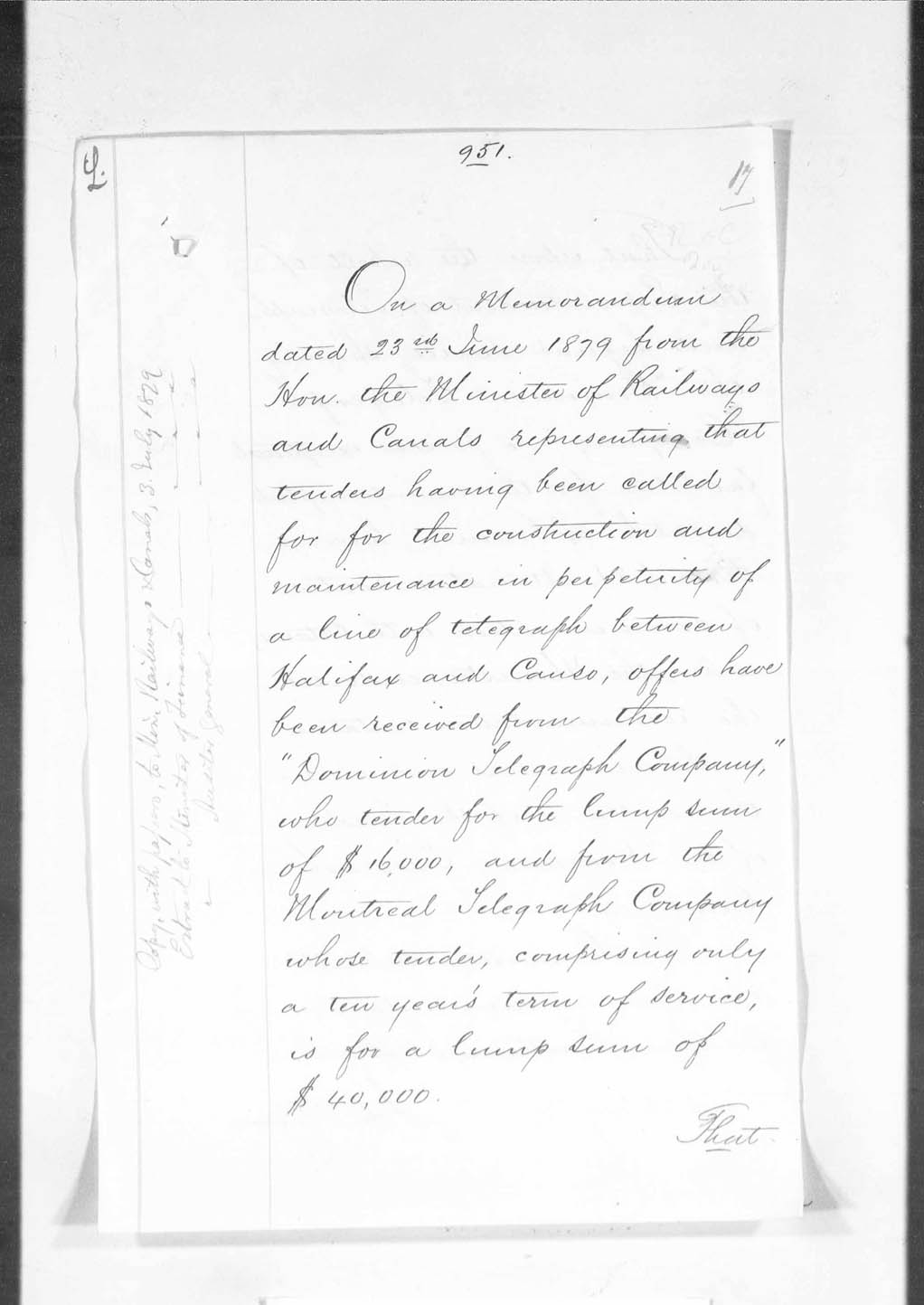
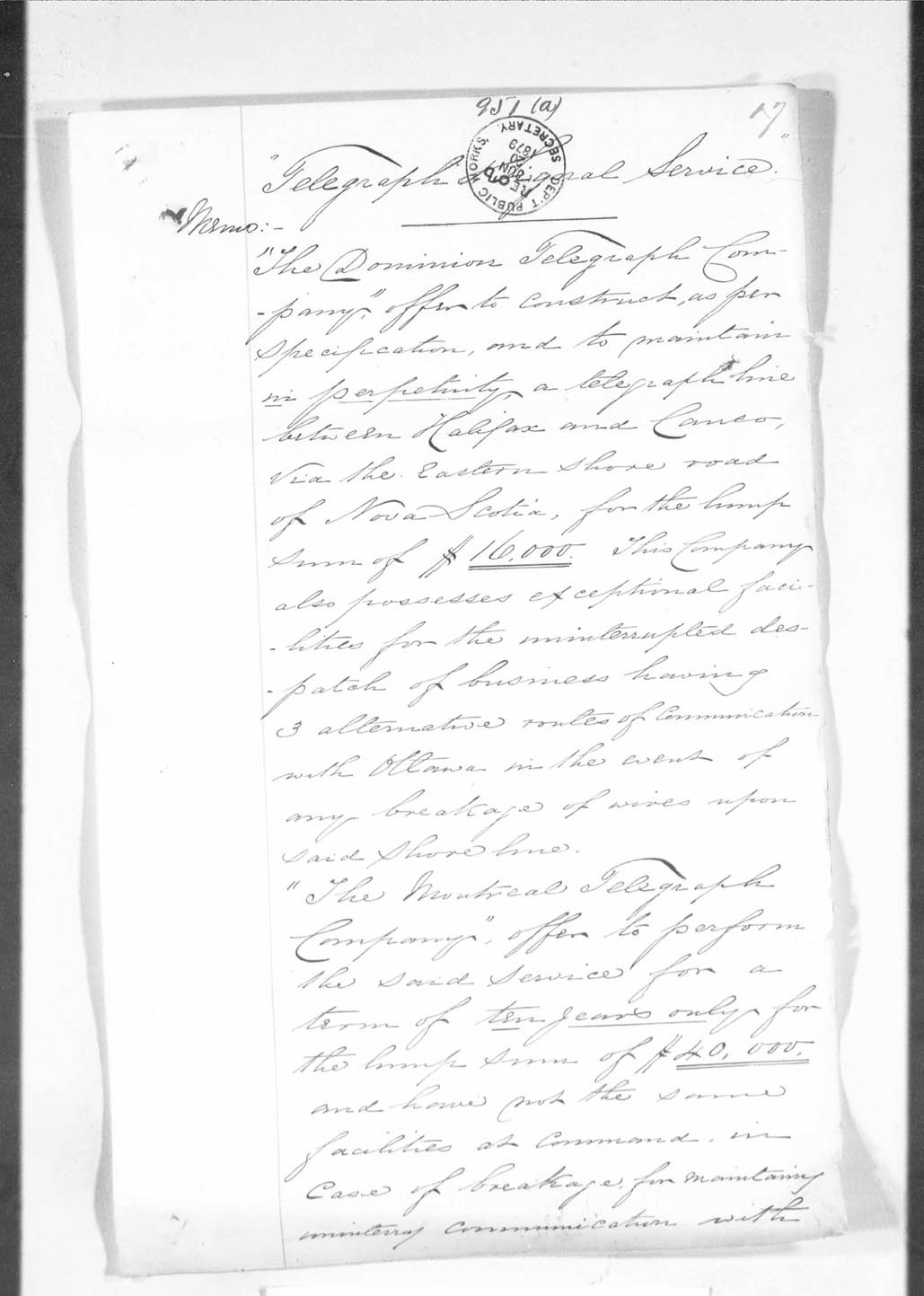
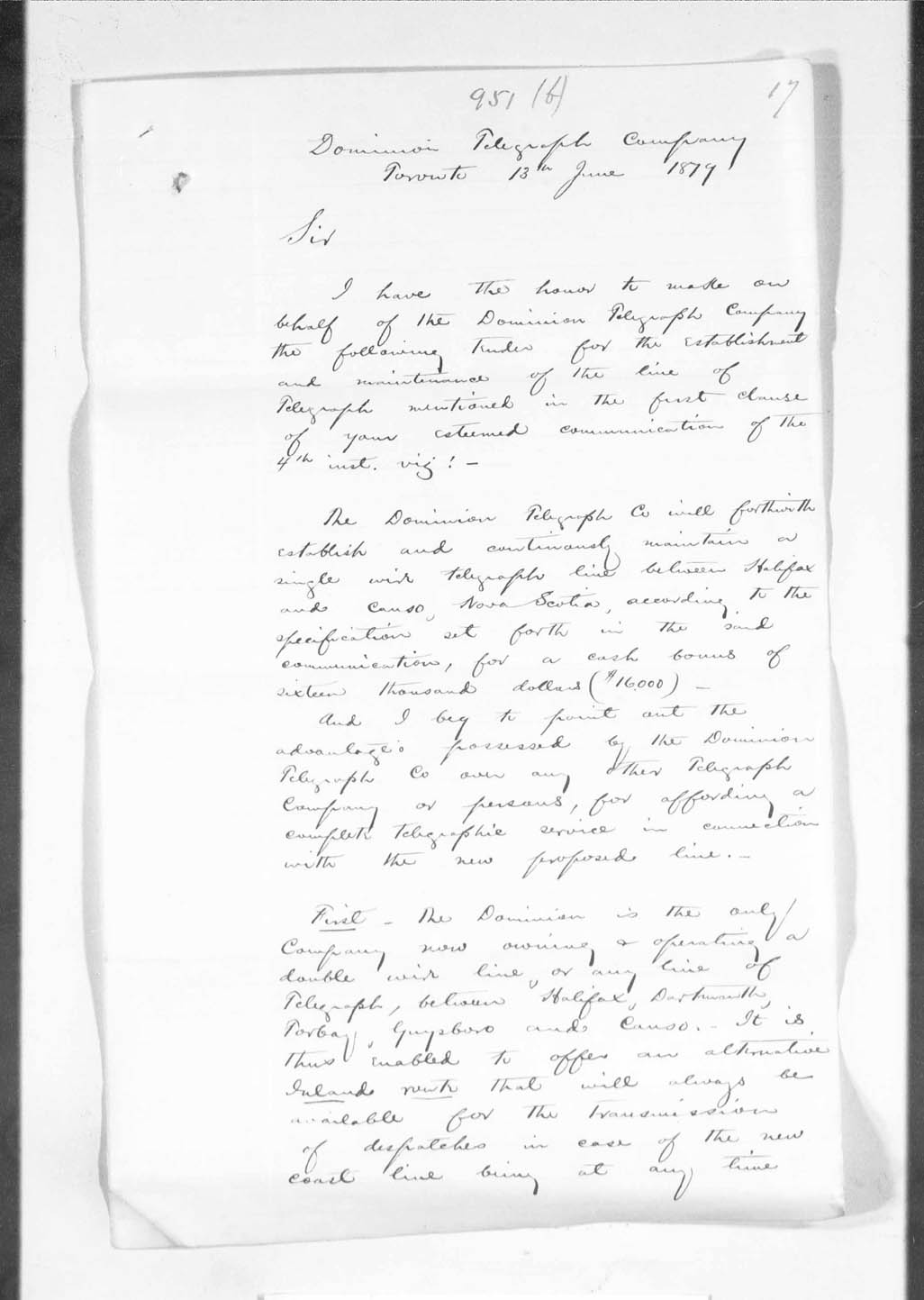
Subject: Telegraph line between Halifax and Canso via the Eastern Shore Road of Nova Scotia — Minister of Railways and Canals recommends acceptance of tender of Dominion Telegraph Company
OIC 1879-0951, page 1
(Page 1) On a Memorandum dated 23rd June 1879, from the Hon. the Minister of Public Works representing that tenders having been called for the construction and maintenance in perpetuity of a line of telegraph between Halifax and Canso, offers have been received from the “Dominion Telegraph Company” who tender for the lump sum of $16,000, and from the Montreal Telegraph Company whose tender, comprising only ten years' term of service, is for a lump sum of $40,000...
OIC 1879-0951, page 2
OIC 1879-0951, page 3
OIC 1879-0951, page 4
OIC 1879-0951, page 5
OIC 1879-0951, page 6
(Pages 5,6) Sir: I have the honor to make on behalf of the Dominion Telegraph Company the following tender for the establishment and maintenance of the line of Telegraph mentioned in the first clause of your esteemed communication of the 4th inst. viz:– The Dominion Telegraph Co will forthwith establish and continuously maintain a single wire telegraph line between Halifax and Canso, Nova Scotia, according to the specification set forth in the said communication, for a cash bonus of sixteen thousand dollars ($16,000). And I beg to point out the advantages possessed by the Dominion Telegraph Co over any other Telegraph Company or persons, for affording a complete telegraphic service in connection with the new proposed line. First – The Dominion is the only Company now owning & operating a double wire line or any line of Telegraph, between Halifax, Dartmouth, Torbay, Guysboro and Canso. It is thus enabled to offer an alternative Inland route that will always be available for the transmission of despatches in case of the new coast line being at any time interrupted particularly by storms, to which it must necessarily be much exposed. Secondly – The Dominion Company's Lines enable them also to offer from Torbay a direct cable connection with Europe, and with the United States a connection which it possesses to the exclusion of any other Telegraph Company. Thirdly – The Dominion Company have at Torbay, our office in connection with the meterological systems of Canada and the United States from whence observations are taken, and can be transmitted to the stations along the Coast to be established by the new line...
|
Thomas Swinyard Managing Director |
— Source:
Ottawa, Federal Government Orders in Council
http://www.collectionscanada.gc.ca/databases/orders/001022-100.01-e.php
Thomas Swinyard (1832-1915) of the Great Western Railway was an early example of the professional manager in an era dominated by amateurs.
—Source: Biography of F.W. Cumberland
...The following appointments were made yesterday [20 January 1887] by the New York, Ontario and Western Railway Company: Thomas Swinyard, assistant to the President; John B. Kerr, attorney; James E. Childs, General Manager.
—Source: New York Times, 21 January 1887
Thomas Swintard, President of the Dominion Telegraph Company and a former General manager of the Great Western Railway, died in New York yesterday in his eighty-fourth year. He had been prominent for many years in the railway and telegraph circles of England, Canada, and the United States. Mr. Swinyard started in the railway business in 1850 in England as secretary to the General Manager of the London & North Western Railway Company. Later he was made Assistant General Manager of the company... In 1862, when he was thirty years old, he was sent to Canada at the request of the British shareholders of the Great Western Railway and took charge of the property as General Manager. Mr. Swinyard made the first contract with the late George M. Pullman of Chicago for the use of his sleeping cars on Canadian railways.
—Source: New York Times, 26 February 1915
ln 1873, Prince Edward Island became part of Canada and Thomas Swinyard was dispatched by the Federal Government to inspect the P.E.I. Railway, which was taken over by the Governemt of Canada as part of the Confederation agreement. He studied the railway in detail, and submitted a report entitled "Reports to the Hon. the Minister of Public Works by Thomas Swinyard on the Prince Edward Island Railway 1874-75", which contains a great deal of information about the early railway stations there...
—Source: "One Every Two and a Half Miles"
The Dominion Telegraph Company was formed in the late 1860s and by the end of the 1870s they operated over 7000 miles [over 11,000km] of open wire. They operated mainly in Ontario and Quebec, but had rights to work in the eastern provinces too.
—Source: http://www.coogan.efirehose.net/robin/robin16/mtco1.JPG
The Dominion Telegraph Company was strong in the early 1870s. In the late 1870s, inadequate cash flow resulted in the DTCo being leased to the Union Telegraph Company, which was then bought out by Western Union. The Great North Western Telegraph Company was actively looking expand their lines and by late 1881 the GNW Tel Co. had leased both the Dominion Telegraph Company and Montreal Telegraph Company lines in eastern Canada. —Source: "Canadian Railway Telegraph History" by Robert Burnet —Online Source: http://www.insulatorscanada.com/forums/archive/index.php?t-2098.html
Known to have been in operation in 1904-05. See Winfield's list.
EastLink is an incorporated company, registered 15 April 1999, with its headquarters at 4881 Main Street, Oxford, Nova Scotia. [Joint Stock Registry ID 3029023] EastLink is a subsidiary of Bragg Communications Incorporated, 4881 Main Street, Oxford, Nova Scotia.
“EastLink has more than 1,500 employees providing a range of communications, entertainment, television and advertising services to residential, business and public sector customers in Atlantic Canada, Ontario, Quebec, Alberta, Manitoba and British Columbia. EastLink has the distinction of being the first cable company in Canada to enter the telephone market, and the first communications and entertainment company in North America to combine cable, Internet and telephone service in a communications and entertainment bundle...”
—Source: EastLink website
http://www.eastlink.ca/about/index.asp
In December 2007, EastLink was selected by the Government of Nova Scotia to provide High Speed Wireless Internet service to residents and businesses in Lunenburg, Queens, Shelburne, Yarmouth, Digby, Annapolis, Kings, and Hants counties. By the end of May 2010, construction of this system in these eight counties in western Nova Scotia was completed – that is, 100% of the tower sites were in operation and ready for residential and business customers to use. EastLink High Speed Wireless Internet has modem speeds of up to 1.5 Mbps (megabits per second) download and up to 0.5 Mbps upload, which is 15 times faster than dial-up service...
— Source: EastLink website
http://www.eastlink.ca/internet/ruralwireless/
Reference: Province Awards Contracts for Internet Providers Nova Scotia Government press release, 5 December 2007
As of 1 July 2010, local telephone service is available from EastLink in the following areas in Nova Scotia:
In the Halifax area, telephone service is available in most areas of the peninsula and Mainland North districts of the city, which include Fairmount, Fairview, Clayton Park, Clayton Park West, Bayers Lake, Rockingham, Rockingham Ridge, Knightsridge, Bridgeview, Wedgewood, Sherwood Park, Sherwood Heights, Fernleigh, Kearney Lake Road, Timberlea, Spryfield, Armdale and Purcells Cove. Telephone service is also available in Prospect Bay, St. Margaret's Bay, Sambro Loop, Ketch Harbour, Peggy's Cove and West Dover.
In Dartmouth, telephone is now available in Woodlawn, Waverley Rd, Forest Hills, Colby Village, Central and Northend, Lake Major Road, Shearwater, Pleasant St., Eastern Passage, Cow Bay, Waverley, North Preston, and Lawrencetown, Porter's Lake, Chezzetcook, and Musquodoboit Harbour .
In Bedford and Sackville, service is available in core areas, Hammonds Plains, Fall River, Beaverbank and Mount Uniacke.
In East Hants Municipality, service is available in Enfield, Elmsdale, Milford, Stewiacke, and Shubenacadie.
In Lunenburg County, telephone service is available in Bridgewater, Mahone Bay, Chester, Riverport and Lunenburg.
In Colchester County, telephone service is available in most areas of the town of Truro as well as Debert, Great Village, Brookfield, Masstown, and Five Islands.
In Cumberland County, service is available within the town of Amherst, Oxford, Collingwood, Springhill, Joggins, River Hebert, Maccan, and Parrsboro.
In Pictou County, telephone service is available in New Glasgow, Trenton, Stellarton, Westville, Lyons Brook, Durham, Loch Broom, Central West River, Alma, Greenhill, Abercrombie, Pine Tree, Thorburn, Greenwood, Coalburn, Pictou, Scotsburn, Linacy, Little Harbour, Kings Head, Black Point, Frasers Mountain, Hopewell, Riverton, Eureka and Salt Springs.
In Queens County, telephone service is available within the town of Liverpool, as well as Milton, Beach Meadows, Port Mouton and Mill Village.
In the Yarmouth area, telephone service is available within the town of Yarmouth, South Beach, Brooklyn, Chegoggin, Dayton, Milton Highland, Pleasant, Arcadia, Chebogue, Kelly Cove, Rockville, Sand Beach, Melbourne, Plymouth and Wedgeport.
In Antigonish County, service is available within the town of Antigonish as well as Heatherton.
In the Annapolis Valley Area, telephone service is available in Clare, Bridgetown, New Minas, Wolfville, Kentville, Coldbrook, Port Williams, Aylesford, Kingston, Berwick, Hantsport, Windsor and Middleton.
In Cape Breton, telephone is now available in Westmount, Coxheath, Sydney Core, Sydney Forks, North Sydney, Sydney Rural, Sydney, Port Hawkesbury, Richmond County, Whitney Pier and Sydney Mines.
— Source: EastLink website, 1 July 2010
http://www.eastlink.ca/telephone/serviceareas/index.asp
The East Pictou Telephone Company, which is planning to construct a telephone line to Little Harbour and points on the coast of East Pictou, is now fully organized and will start construction at once. The President of the Company is Mr. Charles P. Stewart, Little Harbour, and the Secretary is Councillor Frank McNeil, New Glasgow. Mr. James McKay, of East River, St. Mary's, is engaged to superintend the erection of the poles. There will be a call station at Fisher's Grant or some other place just below Trenton that will be "called" by the Nova Scotia Telephone Company and that station will call up subscribers beyond.
[New Glasgow Eastern Chronicle, 21 June 1907, page 8]
Known to have been in operation in 1904-05. See Winfield's list.
Known to have been in operation in 1904-05. See Winfield's list.
Known to have been in operation in 1904-05. See Winfield's list.
The Grand Mira Tel. Co. reported, for the year 1912, a total operating revenue of $228.64 and operating expense of $28.40.
— Source: PUB Annual Report 1912

All telegraph telephone and train service with Halifax
suspended! Shall we communicate messages by wireless.
The violent force of the blast in Halifax Harbour knocked down miles of telegraph and telephone lines, effectively stopping communications between the city and the rest of the world for all purposes, government, military, and civilian. Since the re-establishment of contact was crucial, especially in the middle of a war, the author of this telegram suggests making use of wireless (radio) communication.
The main interest here is the association of this telegram with the 1917 Halifax Explosion. However, there is an interesting detail — the name Z.A. Lash, shown on this printed telegraph form as President, Great North Western Telegraph and Cable Company. Although his name is almost unknown among Canadians, no adequate history of Canada can be written without Zebulon Aiton Lash (1846-1920) appearing significantly in it. Very briefly, in the 1870s Z.A. Lash was Deputy Minister in the Department of Justice in Ottawa; in the late 1890s he was deeply involved in the formation of the Canadian Northern Railway; for more than a decade, beginning in 1902, he was chief solicitor for MacKenzie, Mann and Company Limited (at the time when this company was organizing and building the Halifax & South Western Railway in Nova Scotia, among other important projects); when Robert Borden became Prime Minister in 1911, Lash advised him on the formation of the cabinet, and then served as Borden's legal counsel on the organization of Canadian National Railways. Lash's activities were far more extensive and influential than this short note indicates.
Reference: Zebulon Aiton Lash (1846-1820)
In 1881, the Great North Western Telegraph Company leased both the Dominion Telegraph Company and Montreal Telegraph Company lines in eastern Canada. The DTCo lines leased by GNW Telco included the one-wire telegraph line constructed in 1879 along Nova Scotia's Eastern Shore from Dartmouth through Sheet Harbour to Canso.
—Source: "Canadian Railway Telegraph History" by Robert Burnet
—Online Source: http://www.insulatorscanada.com/forums/archive/index.php?t-2098.html
In 1884 a Royal Commission recommended that there should be a direct cable between the West Indies and Halifax, Nova Scotia. In 1889 the British Government decided to go ahead with the project and link the naval base at Nova Scotia with the British Naval harbour at Hamilton, Bermuda. The Halifax & Bermudas Telegraph Company was established to carry out the work which was put out to tender with the promise of a twenty-year subsidy.
On July 7th, 1890, cableship SS Westmeath sent the southern end, of the cable from Halifax, ashore at Cable Beach in Bermuda. The next day, July 8th, the Hamilton, Bermuda, telegraph office was connected to Halifax by the new undersea cable. On July 10th, 1890, a telegraph message was sent to HM Queen Victoria from the Governor of Bermuda. On July 14th, 1890, the cable telegraph service was opened to the public at Hamilton.
In April, 1929, some thirty British telecommunications companies throughout the world — including the Halifax & Bermudas Telegraph Company — merged into one company registered in London and named Imperial & International Communications Limited. In 1935 a working agreement enabled the West India & Panama Telegraph Company to take over the operating assets of the Halifax & Bermudas company and in 1939, the parent company became part of Cable & Wireless (West Indies) Limited.
— Sources:
http://www.cwhistory.com/history/html/HALBERTCO.html
http://www.cwbda.bm/education/history.htm
Known to have been in operation in 1904-05. See
Winfield's list.
In 1912, the Hammonds Plains Tel. Co. reported total gross (before expenses) operating revenue of $96.05, for the year; there was no report of the operating expenses.
Agreement between the Hammonds Plains Telephone Company and the Nova Scotia Telephone Company, dated May 23, 1902, for a term of three years.
The companies agree to receive, transmit and deliver the messages of the subscribers of their respective companies. The charge to and from Halifax being ten cents and beyond Halifax the tariff of the Nova Scotia Telephone Company in addition thereto.
Neither parties are to compete with each other within the territory now occupied by them respectively nor shall they make connections with any telephone company or corporation operating in competition with the Nova Scotia Telephone Company or the Hammonds Plains Company. The Nova Scotia Company to have the first option of purchase of the Hammonds Plains Company. The Hammonds Plains Company shall not purchase or use any instruments or apparatus but the standard 'Bell' these to be purchased from the Nova Scotia Company.
— Source: Report No. 16, 2 May 1905, of the Select Committee Appointed to Inquire into the Various Telephone Systems in Operation in Canada and Elsewhere, Ottawa
A Petition of Benjamin DeWolfe and others, inhabitants of Windsor, and others residing within the Province of Nova Scotia, was presented by Mr. Fraser, and read, praying for the passage of an Act to Incorporate a Company for the purpose of erecting a Line of Electric Telegraph between Windsor and Halifax, and for pecuniary aid to the undertaking out of any surplus funds arising from receipts from the Provincial Line of Telegraph.
— Source: Journal and Proceedings of the House of Assembly Halifax
23 January 1851, pages 622-623
Mr. Fraser, pursuant to leave given, presented a Bill to Incorporate the Hants and Halifax Electric Telegraph Company; and the same was read a first time and ordered to be read a second time.
— Source: Journal and Proceedings of the House of Assembly Halifax
23 January 1851, page 623
A Bill to Incorporate the Hants and Halifax Electric Telegraph Company was read a second time. Ordered: That the Bill be referred to Mr. Fraser, Mr. McLeod, Mr. Killam, Mr. Whitman and Mr. Marshall, to examine and report on, with amendments or otherwise.
— Source: Journal and Proceedings of the House of Assembly Halifax
23 January 1851, page 623
The Heatherton & Glassburn TelCo. connected to the North American telephone system at the MT&T Heatherton Exchange.
The Lake LaRose Rural Tel. Co. was organized in 1912.
On 4 June 1961, the Lake LaRose Rural Tel. Co. sold its entire undertaking, including property, rights-of-way, pole lines, plant, apparatus, and equipment, all in working order, to MT&T. On the same day, the Lake LaRose Rural Tel. Co. abandoned its territory and went out of business forever; MT&T took over the territory.
— Source: PUB Annual Report 1961
In December 1912, the Lawrencetown Telephone Company (not then "Limited", that is, not legally incorporated) was operating a single circuit party line about 20 miles long "fully loaded" with about 30 subscriber telephones.
The Little Narrows Rural Telephone Co. connected to the North American telephone network at the MT&T exchange in Whycocomagh, Inverness County.
The Maitland & Noel Tel. Co. began operating a telephone service in this area about 1890. Known to have been in operation in 1905 with ten subscribers (see
Winfield's list).
In 1961, the Maitland & Noel Tel. Co. was owned by Mr. Aubrey Scott and two other shareholders. On 19 December 1961, the Maitland & Noel Tel. Co. abandoned its territory and went out of business forever. The company's territory was split into two parts, with the boundary line located 4.1 miles 6.6 km from Tennycape River towards Walton near Mr. Stanley Crossley's store. The location of this boundary was decided by majority subscriber preference as determined by a canvass of each subscriber. The entire undertaking east of this boundary, including property, rights-of-way, pole lines, plant, apparatus, and equipment, all in working order, was sold to MT&T for $3,767.50. The entire undertaking west of this boundary, including property, rights-of-way, plant, apparatus, and equipment, all in working order, was sold to the West Hants Telephone Company Limited for $500.00. At the time of the shutdown, M&NT Co. had 72 miles 116 km of pole line and 130 miles 209 km of wire serving 293 subscribers.
— Source: PUB Annual Report 1961
The Maple Leaf MT Co. was incorporated in 1908.
In 1912, the Maple Leaf Tel. Co. reported total gross (before expenses) operating revenue of $934.53, for the year.
In April 1958, the Maple Leaf MT Co. was operating nine circuits on about 65 miles of pole line with about 115 miles of metallic circuit serving 85 subscribers, "a substantial drop from the 112 reported some two years previously". At a Public Utilities Board hearing in New Glasgow, on 16 April 1958, a subscriber on Line One testified that his telephone had been out of service 50% of the time during the last ten years, and to an even greater extent in the most recent years. "Even when the line is in operation signals are weak and messages must frequently be relayed". This evidence was supported by other complainaints, "who indicated that long journeys were often necessary in matters of urgency... due to failure of the telephone service". "Some of the present difficulties have been aggravated by highway construction in the area in recent years, with the consequent disruption of lines...".
The President of the Company agreed that the complaints were substantially correct. "He stated that the matter was chiefly one of finance, and that the Company had so far been unable to raise the $4,000 or so estimated as the minimum required to put the Company's circuits in reasonably good condition". The Company Secretary, who was also the lineman, testified that the Company's equity was divided equally among 700 shares (which represented the entire ownership), and to borrow money it was necessary to obtain the approval of the holders of 75% of the shares, but as 60% of the shares were owned outside the Company's territory, it had been found very difficult to obtain such approval. The President was of the opinion that "the Company would not willingly abandon" its territory.
After hearing this testimony, the Public Utilities Board ordered that a meeting of the Company's shareholders be held, to consider these problems. This meeting was held on 24 May 1958 at the Lower Barney's River Hall; a motion to borrow $4,000 to repair and rebuild the Company's lines was defeated by a share count of 63 shares in favour and 375 shares against. "No mover or seconder was found to sponsor a motion" to sell the Company, "nor was there any support for the suggested formation of a Mutual Telephone Company".
On 21 July 1958, the PUB issued a formal order, that the Company was to "put its lines in condition to render adequate service in its territory in accordance with Section 48 of the Public Utilities Act", and that the necessary construction and repairs had to be completed before 31 December 1958.
— Source: PUB Annual Report 1958
In 1912, the Mapleton Rural Tel. Co. reported total gross (before expenses) operating revenue of $8.60, for the year.

During the spring of 1916, this territory was taken over by the Wedgeport Tel. Co., which purchased the telephone lines and underwater cables originally owned by the Murray Tel. Co., between Wedgeport and Comeau's Hill, consisting of about 12 miles of pole line and 2 miles of underwater cable.
On 19 May 1922, the Musquodoboit Harbour Rural Tel. Co. received official approval that the company's proportion of Local Call and Long Distance charges for messages to or from any point on its line would be 5 cents.
— Source: PUB Annual Report 1922
The New Cumberland Telephone Company is known to have been carrying on a telephone business in 1905 and 1906 — it appears as "Cumberland Telephone Company" in Winfield's list dated May 1905, and it was involved in a lawsuit in 1906.
The New Cumberland Tel. Co., incorporated and doing business in Nova Scotia, was the plaintiff in a lawsuit against two telephone companies incorporated and doing business in New Brunswick, the Central Telephone Company with head office in Sussex, and the New Brunswick Telephone Company with head office in Fredericton.
On 15 June 1906, the New Cumberland Company entered into a written agreement with the Central Company for the transmission of messages over the lines of both companies, between all points in Nova Scotia reached by the New Cumberland system, and all points in New Brunswick reached by the Central system. By the terms of the agreement, which was to be in force for ten years, it was agreed that each company should provide the use of its lines and equipment and the services of its employees for the purpose of the joint business, and also the use of any connections which either of the companies then had or might thereafter acquire over the lines of any other company doing business in either of the two provinces. The tolls to be charged were not fixed by the agreement, nor was any basis determined for their division between the parties; but it was agreed that the rates were to be fixed at a later date by the managers or other officers of the companies, and they were to continue in force for the ten years or until changed by a mutual agreement between the companies.
In September 1906, three months after this agreement was signed, the New Brunswick Telephone Company bought from the Central Company all its property both real and personal, including all poles, rights of way, wires, telephones, and all other property of every kind and description. The New Brunswick Telephone Company, the new owner of the former Central Company system, recognized the agreement between Central and the New Cumberland Company, but planned to implement it only within the area served by the former Central Company on 21 August 1906, while the New Cumberland Company insisted that it be extended throughout the New Brunswick Telephone Company system. When the New Brunswick Telephone Company refused to agree to this extension, the New Cumberland Company went to court in New Brunswick and obtained an interim injunction on 25 September 1906, preventing the completion of the proposed sale of the Central system. On 17 November 1906, Justice Barker of the New Brunswick court issued a decision refusing to extend the temporary injunction.
— Source: Excerpted from the decision by Justice Barker of the New Brunswick court dated 17 November 1906, in the case of New Cumberland Telephone Company versus Central Telephone Company and New Brunswick Telephone Company, as reported on pages 101-105 of the Eastern Law Reporter, volume II number 3, 1 December 1906, published by the Carswell Company, Toronto.
In 1922, the New Ross Tel. Co. connected to MT&T at two locations: Chester Basin in Lunenburg County, and Springfield in Annapolis County.
Winfield's list reports that the New Ross Tel. Co., had just three telephones in operation, in the spring of 1905.
Agreement between the New Ross Telephone Company and the Nova Scotia Telephone Company, dated December 1, 1904, for a term of three years.
The companies agree to receive, transmit and deliver the messages of the subscribers of their respective companies.
The charge between the New Ross Company's lines and Chester Basin shall be 10 cents, to go to the New Ross Company. Between the New Ross Company and the Chester Basin Exchange (excepting Chester town, 25 cents), 20 cents, 5 cents of which goes to the Nova Scotia Company. Between the New Ross Company and any other point, 15 cents, plus the Nova Scotia company's rates from Chester Basin, of which the New Ross Company takes 15 cents. The New Ross Company to pay the Nova Scotia Company five dollars ($5.00) per annum for each instrument connected with their line.
Neither parties are to compete with each other within the territory now occupied by them respectively nor shall they make connections with any telephone company or corporation operating in competition with the Nova Scotia Telephone Company or the New Ross Company. The Nova Scotia Company to have the first option of purchase of the New Ross Company. The New Ross Company shall not purchase or use any instruments or apparatus but the standard 'Bell', these to be purchased from the Nova Scotia Company.
— Source: Report No. 16, 2 May 1905, of the Select Committee Appointed to Inquire into the Various Telephone Systems in Operation in Canada and Elsewhere, Ottawa
| The December 1, 1904 Agreement (above) specifies that the charge for a telephone call between Chester and New Ross (or any other point on the New Ross Company lines) will be 25 cents, 5 cents of which goes to the Nova Scotia Telephone Company. The reason for this division of charges is that the line between Chester and Chester Basin was owned and operated by the Nova Scotia Telephone Company, and the line north from Chester Basin was owned and operated by the New Ross Company. |
The New Tusket Rural Telephone Company was an unincorporated organization, with the sole owner, in 1961, being Mr. J. Eldon Ford. On 1 July 1961, New Tusket Rural Tel. Co. increased its rates from $2.00 per month to $2.25 per month; it was then operating six circuits serving 58 customers.
— Source: PUB Annual Report 1961
On 1 July 1962, the New Tusket Rural Tel. Co. sold its entire undertaking, including property, rights-of-way, pole lines, plant, apparatus, and equipment in service, all in working order, to MT&T for $756.00. On the same day, the New Tusket Rural Tel. Co. abandoned its territory and went out of business forever. At the time of the shutdown, the Company was operating 26 miles 42 km of pole line, supplying dial telephone service to 30 subscribers on three circuits, and magneto service to 30 subscribers through a manual switchboard located in Mr. Ford's residence in New Tusket.
— Source: PUB Annual Report 1962
1853 January 23: A petition of F.N. Gisborne, on behalf of the provisional directors and stockholders of the
Nova Scotia & Newfoundland Junction Telegraph Company was presented by Mr. Weir, and read, praying for the passage of an act to incorporate that company.
Ordered that the petition do lie on the table.
Mr. Weir, pursuant to leave given, presented a bill to incorporate the Nova Scotia & Newfoundland Junction Telegraph Company — and the same was read a first time and ordered to read a second time.
— Source: Journal and Proceedings of the House of Assembly Halifax
Session 1853, page 226
CIHM: 9_00946_104
1853 March 2: The special committee to whom was referred the bill to incorporate the Nova Scotia & Newfoundland Junction Telegraph Company, and the several petitions connected therewith, beg leave to report: that having examined witnesses and investigated the subject referred to them, the committee do not recommend the bill to the House.
All which is respectfully submitted.
Signed
Hugh Munro, chairman
John J. Marshall
Thomas Killam
— Source: Journal and Proceedings of the House of Assembly Halifax
Session 1853, page 292
CIHM: 9_00946_104
Known to have been in operation in 1904-05. See Winfield's list.
The Paradise West Tel. Co. was organized in 1909 by twelve residents of the district, each member contributing $30.00 in cash or materials, necessary for the construction of 3.5 miles 5.6 km of telephone line; it connected to the North American telephone system at the MT&T Bridgetown Exchange.
Known to have been in operation in 1904-05. See Winfield's list.
Samuel Gidney was a founding shareholder of the Maitland Telephone Company of Yarmouth, Ltd., one of the earliest telephone companies in the Maritimes, incorporated in 1886. He also founded the Petite Passage Cable Company, linking by telephone Brier and Long Islands with Digby Neck in 1903.
A petition of Hiram Hyde of Truro, in the County of Colchester, was presented by the Hon. Mr. McKeagney, and read, praying for the passage of an Act to Incorporate a Company for the purpose of constructing a Line of Electric Telegraph from Pictou to the Gut of Canso, and thence to Sydney, Cape Breton.
— Source: Journal and Proceedings of the House of Assembly, Halifax
1 February 1851
The name of the Port LaTour Telephone Company appeared in the Halifax Chronicle-Herald on 19 February 1997, in the obituary of Willard Maxwell Nickerson, 84, of Port La Tour, Shelburne County, former manager of the company.
Known to have been in operation in 1904-05. See Winfield's list.
The Royal Centre & Minto Tel. Co. connected to the North American telephone network at the MT&T exchange in Meadowville, Pictou County.
In 1965, this territory was transferred to the Pictou Exchange area, and the former Meadowville Exchange area was cancelled.
— Source: PUB Annual Report 1965
The Riverport Telephone Company was organized in 1893. Telephone lines were put through the district and three battery operated telephones were installed. One in Samuel Ritcey's general store, Riverport, at Isaac Heckman's shoe store, Rose Bay, and another at Rufus Mossman's store in Lower Kingsburg. A telephone exchange was operated from the home of Asaph Conrad. Dial telephones came into the area in 1938.
—Source:
http://homepages.rootsweb.com/~downhome/riverport.html
http://www.riverport.org/history/history.html
From a reading by Caitlyn Haley, a grade three student at the
Gertrude Parker Elementary School in Lower Sackville, Halifax County,
at a twentieth anniversary assembly at the school on 26 April 1996.
Speech prepared by then vice-principal R. Muir.
This is a description of the duties of a rural telephone operator at the time when the
telephone system owned and operated by the Sackville Rural Telephone Company
was taken over by the Maritime Telegraph & Telephone Company (MT&T).
Gertrude Parker was born on October 12, 1892 in Westmount, Montreal, Quebec. Her father was the Captain of the Fire Department in Westmount. She married and moved first to Halifax and then became one of Sackville's early residents in 1945. She had seven sons and one daughter. She lost one son during World War Two.
In 1946, Mrs. Parker took over the Sackville telephone switchboard from Mrs. Daisy Weir. This switchboard was the old magneto type with a crank. She operated it for the Maritime Telephone and Telegraph Company which took charge of it that year. She directed calls on her switchboard 24 hours a day from her home, receiving the salary of $13.00 per month, charging 25 cents to anyone making a night call.
In 1946, Sackville's telephone system had fewer than fifty telephone subscribers (customers). In the late 1940s and through the 1950s, these customers were served by six to eight party lines, operated by Mrs. Parker, which supplied the only telephone service available in those days between Bedford and Hants County line, including Beaver Bank and Lucasville.
By the early 1960s, Sackville's telephone system had grown to approximately 300 lines (customers), requiring three large switchboards at Mrs. Parker's home. Several operators took shifts on the switchboards and Mrs. Parker took the overnight calls.
Perhaps her most important duties involved the fire service in Sackville, which in the beginning was a volunteer bucket brigade. These volunteers were called by Mrs. Parker (using special line number 3) for such events as a barn or a house fire. There were occasions when the Sackville volunteers required more men and Mrs. Parker would put a call through to the Bedford fire service. Both fire services came to each other's aid during those years, a tradition that grew to make the two departments quite close.
As fire dispatcher, Mrs. Parker and her family became very involved in the development of the department in Sackville, which was established in 1955. Her family members were volunteers and have held various positions (including Chief) over the years. This tradition continues to this day (1996).
Mrs. Parker is most remembered for directing household and emergency communications in Sackville until 1963. That year the Maritime Telephone and Telegraph Company introduced the dial telephone to Sackville and her switchboard was no longer required. Mrs. Parker retired and though later confined to a wheelchair, kept active over the years with the many friends she made as telephone operator. She is remembered for her helpful, gracious, lady-like character and positive personality.
On June 13, 1980 Gertrude Parker died and her many friends and acquaintances paid tribute to her. The Maritime Telephone and Telegraph Company and the Sackville Fire Department, in particular, recognized her years of service.
The students and staff of our school wish to say THANK YOU to the family of Gertrude Parker for the framed photograph of their mother and grandmother, which our school board will mount for display outside our office.
Mrs. Parker made significant contributions to the residents of Sackville for over thirty years. We are proud of the role that she played in the history of Sackville and we are proud that our school is named after her.
—Source: Gertrude Parker Elementary School's website, April 2004
http://www.gpes.ednet.ns.ca/Mrs.%20Parker1.htm
On 1 March 1961, the Salem Rural Tel. Co. sold its entire undertaking, including property, rights-of-way, pole lines, plant, apparatus, and equipment in service, all in working order, to MT&T for $300.00. On that same day, the Salem Rural Tel. Co., which had been operating a telephone service since about 1910, abandoned its territory and went out of business forever; MT&T took over the territory.
— Source: PUB Annual Report 1961
Samuel Gidney was a founding shareholder of the Maitland Telephone Company of Yarmouth, Ltd., one of the earliest telephone companies in the Maritimes, incorporated in 1886. He also founded the Petite Passage Cable Company, linking by telephone Brier and Long Islands with Digby Neck in 1903.
— Source: Appendix to the Fortieth Volume of the Journals of the House of Commons, Dominion of Canada, Session 1905: Report of the Select Committee on Telephone Systems - Appendix No. 1
In 1960, the Sandford & Short Beach Rural Tel. Co. ceased operation and abandoned its territory. Telephone service in this area was taken over by MT&T.
— Source: PUB Annual Report 1960
In 1922, the wires of the Blue Mountain MT Co. from Kentville to "Patterson's", a distance of about six miles ten km, were carried on poles owned by the South Alton Rural Tel. Co., and Blue Mountain MT Co. paid South Alton the "ordinary pole rental" rate.
These are three versions of the name of one telephone company. All three appear from time to time in the Annual Reports of the PUB, from 1912 to 1960. The name "Surette's Island Rural Telephone Company" usually appears in the more formal proceedings, such as PUB Orders establishing the company's rates and the closure hearing in 1960. The other versions usually appear in the routine annual list of reporting companies, which was proofed less rigourously than the important formal legal reports. On modern maps issued by the provincial government, the name of the community "Surette's Island" is spelled with a single "r". In the PUB reports the name of the telephone company is spelled sometimes with a double "rr", "Surrette's Island", and sometimes with a single "r". This leaves us with six different spellings of the name of this one telephone company, all appearing at one time or another in the official PUB annual reports, with different spellings occasionally appearing on the same page. In the absence of a legal incorporation document (see below, "not incorporated..."), there seems to be no way to decide which spelling is correct. Because the spelling with "Rural" usually appears in the reports of significant formal proceedings, I have chosen this version to use as the name for this company.
— ICS, 18 April 2005
|
— Source: PUB Annual Reports, 1913 and 1916
         Surrette's Island Rural Telephone Company
                 for the year 1914:
             Capital Stock           $400.00
             Operating Revenue       $153.03
             Operating Expenses      $ 25.11
—Source:  PUB 1914 Annual Report, page 119
         Surrette's Island Rural Telephone Company
                 for the year 1916:
             Capital Stock           $400.00
             Operating Revenue       $195.61
             Operating Expenses      $ 72.45
             Dividends Declared      $ 83.00
—Source:  PUB 1916 Annual Report, page 111 schedule G
|
— Source: PUB Annual Report, 1921
The Surrette's Island Rural Telephone Company is listed in each of the Annual Reports of the Public Utilities Board from the first in 1912 to 1960, inclusive. So far, no information has been found about when the company started operation — it seems likely that it was supplying telephone service in the area a few years before 1912, but it is missing from
Winfield's list of telephone companies in existence in Nova Scotia in May 1905.
The Surrette's Island Rural Telephone Company's single party line circuit connected with the North American telephone network at MT&T's exchange at Tusket.
On 4 November 1960, Surrette's Island Rural Telephone Company (SIRT) sold its entire undertaking, including property, rights-of-way, pole lines, plant, apparatus, and equipment in service, all in working order, to MT&T for $150.00. On the same day, SIRT abandoned its territory and went out of business forever. At the time of the shutdown, SIRT served 23 subscribers on one circuit about 11 miles 18 km long.
Before SIRT's assets could be sold, and the territory transferred to MT&T, approval of the Public Utilities Board was required. The PUB held a public hearing at the Court House at Yarmouth, on June 6th, 1960, "after due public notice." MT&T was represented by its General Counsel and Secretary, Mr. Struan Robertson. SIRT was represented by its President, Mr. Philomon Pottier. Mr. Frank Amirault, a shareholder of SIRT was also present.
In its report, issued after this public hearing, the PUB described the Surrette's Island Rural Telephone Company as "not incorporated but is of the nature of a partnership with 34 owners, doing business in the County of Yarmouth." Both MT&T and SIRT "are public utilities within the meaning of the Public Utilities Act in the supply of telephone service in the Province of Nova Scotia."
SIRT "first approached MT&T in January 1958, indicating a desire to sell its undertaking. Due to heavy committments in 1958, MT&T was unable to complete its canvass of the area until the spring of 1959, although a preliminary survey was made in May 1958. As a result of the 1959 canvass, MT&T received 76 applications for service, including all 23 of SIRT's present subscribers."
"An inventory of SIRT's system was made following the canvass which involved a physical count of poles, telephone sets, wire, etc., and it was indicated that the only items of value that could be used by MT&T were four telephone sets and one bracket, which were valued at current cost new, less depreciation. Pursuant to this valuation, an offer of $150.00 was made to SIRT in August 1959, and accepted the following month."
"Capital construction to the extent of some $21,000 is forecast by MT&T regarding new pole lines, cables, etc., required to provide an adequate standard of service in the area. MT&T expects that this construction will be completed by November 1960 if the Application is approved, and have suggested November 4th, 1960 as the effective date of the within applications, which date coincides with SIRT's billing date. In the meantime MT&T is rendering assistance to SIRT at present in order to provide temporary facilities due to the need to move pole lines because of highway work in the district; this work will cost about $1,000, according to MT&T's estimate."
"By an an Indenture of Sale dated May 2nd, 1960, 32 of the 34 owners of SIRT have agreed to the sale of its property, effects and undertaking to MT&T for the sum of $150.00 aforesaid. Mr. Pottier in evidence confirmed that the said 34 persons are the actual owners of SIRT and those owners who have not signed are Mr. Lawrence Amirault, now living in the United States whom they have been unable to locate as yet, and the Heirs of Albert Pottier, which estate has not been administered. The share of these parties will be paid to them by SIRT in due course according to the testimony of Mr. Pottier."
The Public Utilities Board found that these plans for the sale of the Surrette's Island Rural Telephone Company's property and the abandonment of its territory, and the takeover of the territory by MT&T were "in the best interests of good telephone service in the area and that the terms are fair and just in the circumstances..." The PUB gave its approval, dated 2 August 1960, to become effective on and from November 4th, 1960.
— Source: PUB Annual Report 1960, pages 189-93.
The Toney River Rural Tel. Co. connected to the North American telephone network at the MT&T exchange in Meadowville, Pictou County.
In 1965, this territory was transferred to the Pictou Exchange area, and the former Meadowville Exchange area was cancelled.
— Source: PUB Annual Report 1965
The Union Furniture and Merchandise Company's telephone system connected with the North American telephone system at the Great Village Exchange of the Nova Scotia Telephone Company.
Contract between the Union Furniture and Merchandise Company of Bass River, N.S., and the Nova Scotia Telephone Company, dated June 1, 1902, for a term of three years.
The companies agree to receive, transmit and deliver the messages of the subscribers of their respective lines. The charge to and from the Union Furniture and Merchandise company's lines shall be ten cents, except to Great Village which shall be fifteen cents and beyond Truro the tariff rates of the Nova Scotia Telephone Company in addition thereto.
The Nova Scotia Company to pay the Union Furniture and Merchandise Company Fifteen dollars ($15) per annum for the free use of their lines for the Nova Scotia Company's subscribers at Great Village exchange, non-subscribers at that exchange to pay fifteen cents per conversation to be handed over to the Union Furniture Company.
The Union Furniture Company shall pay the Nova Scotia Telephone Company $15 per annum for connection to switch-board and switching at Great Village. The Union Furniture Company shall remove all instruments in the Nova Scotia company's territory and shall not place any others without... [text missing here]
— Source: Report No. 16, 2 May 1905, of the Select Committee Appointed to Inquire into the Various Telephone Systems in Operation in Canada and Elsewhere, Ottawa
The Union Tel. Co. connected to the North American telephone network at the MT&T exchange in New Glasgow.
On 4 April 1916, the Union Tel. Co. received official approval that the Company's proportion of Local Toll and Long Distance charges for messages to or from any point on its line would be 10 cents.
— Source: PUB Annual Report 1916
Known to have been in operation in 1904-05. See
Winfield's list.
The Valley Telegraph & Telephone Co. is the third-largest telephone company in Winfield's list, 1905.
At an unknown time between 1905 and 1912, the Valley Telephone Co. was bought by the Nova Scotia Telephone Co. At the time of the sale, the Valley Telephone Co. had about 190 telephone subscribers, 100 in Kentville and 90 in Berwick and Canning combined. Customers in Berwick and Canning were provided with free calls to Kentville, and Kentville customers had free calls to Berwick and Canning, but there was a charge for calls between Berwick and Canning.
1899

1900

1908

Judge John Pryor Chipman, Q.C., (1848-1917) had
his residence on the north side of Belcher Street
near the intersection of Oakdene Avenue.
He was admitted to the bar in 1869, and
was mayor of Kentville 1889-1890.
The Wallace & Wentworth Telephone Co. served its territory from about 1890 until it ceased operations in 1949; the territory was then taken over by the Wallace & Wentworth Mutual Telephone Company Limited.
Known to have been in operation in 1904-05. See Winfield's list.
The Wallace Bridge Rural Tel. Co. began operating a telephone service in 1900. It connected with the North American telephone system at the MT&T Wallace Exchange.
By Agreement dated 25 September 1973, Lucy Brander, Hazel Vanbuskirk, Floyd Langille, Alex A. MacInnis, A.M. Slack, George Elliott, Canadian National Railways, Carl Langille, Arthur Scott, Phylys Elliott, Gerald Langille and Eleanor Mills, carrying on business under the firm name and style of the Wallace Bridge Rural Tel. Co., agreed to sell all its property, pole lines, rights-of-way, and equipment to MT&T for $5.00. At the time of the sale, Wallace Bridge Rural Tel. Co. had about 6 miles 10 km of pole line "in a deteriorated condition", and served twelve subscribers who paid $1.00 per month for a residential telephone connection and $1.50 per month for a business.
On 16 November 1974, Wallace Bridge Rural Tel. Co. abandoned its territory and went out of business forever. The closure of the small telephone company's operation was caused by the plan to convert the MT&T Wallace Exchange in 1974 to dial operation with direct distance dialling, which required all connecting companies, including this one, to choose between spending a lot of money to install new equipment or abandon the territory and let MT&T take over.
— Source: PUB Annual Report 1973, pages 392-394
The Wallace Union Rural Tel. Co. began operating a telephone service in 1906. It connected with the North American telephone system at the MT&T Wallace Exchange.
By Agreement dated 25 September 1973, James Mason, Mrs. Martin Halverson, Miss Christina Conley, Rod-Jay Development Limited, Clarence Joudrey, George A. McIntosh, Havelock St. Croix, Clarence Blair, Robie Stevens, Ernest McCabe and Robert Cole, carrying on business under the firm name and style of the Wallace Union Rural Tel. Co., transferred all its property, pole lines, rights-of-way, and equipment to MT&T for $5.00. At the time of the sale, Wallace Union Rural Tel. Co. had 10 miles 16 km of pole line and served 13 subscribers who paid $3.38 per month for a residential telephone connection.
On 16 November 1974, Wallace Union Rural Tel. Co. abandoned its territory and went out of business forever. The closure of the small telephone company's operation was caused by the plan to convert the MT&T Wallace Exchange in 1974 to dial operation with direct distance dialling, which required all connecting companies, including this one, to choose between spending a lot of money to install new equipment or abandon the territory and let MT&T take over.
— Source: PUB Annual Report 1973, pages 391-394
The Wedgeport Tel. Co. was incorporated in 1915. It connected to the North American telephone system at the MT&T exchange in Yarmouth.
On 7 March 1916, the Wedgeport Tel. Co. was given official approval to issue 120 shares of common stock, par value $10.00 per share, to raise $1200 to buy the telephone lines and underwater cables originally owned by the Murray Tel. Co., between Wedgeport and Comeau's Hill, consisting of about 12 miles of pole line and 2 miles of underwater cable.
On 2 May 1916, the Wedgeport Tel. Co. received approval to issue another 130 shares of common stock at $10.00 each, to raise $1300 for capital expenditures. The following rates were officially approved for the Wedgeport Tel. Co. on 19 April 1916:
|
Alfred L. LeBlanc, mayor of the Town of Wedgeport in 1920-1921, was president of the Wedgeport Tel. Co. and Anselme O. Pothier, Town Treasurer from 1910 to 1913, was secretary.
—Source: http://www.argylecourthouse.com/archives/munrec/rg6.htm
In 1961, the Wedgeport Tel. Co. was operating 48 miles 77 km of pole line serving 182 subscribers.
1956

Wedgeport Telephone Company directory, 1956
("r" means residence)
Source: Maritime Telegraph & Telephone Company (MT&T)
Western District Telephone Directory, January 1956, page 168
The Beaton Institute at CBU holds 1876 records of the Western Union Telephone (sic) Co.
— Source: http://www.cbu.ca/beaton
The steamship Faraday has been busy the past two weeks laying the two new Western Union cables between Coney Island (New York City) and Canso, Nova Scotia.
— The Electrical World, 16 November 1889
On 19 December 1961, the West Hants Rural Tel Co. expanded its service territory by buying for $500.00 the entire undertaking of the Maitland & Noel Tel. Co. west of a specified boundary, including property, rights-of-way, pole lines, plant, apparatus, and equipment in service, all in working order. The boundary line was located 4.1 miles from Tennycape River towards Walton near Mr. Stanley Crossley's store. On that day, the Maitland & Noel Tel. Co. abandoned and the West Hants Rural Tel Co. occupied this territory.
— Source: PUB Annual Report 1961
Known to have been in operation in 1904-05. See Winfield's list.
While in Nova Scotia last summer, a correspondent relates that he had occasion to use very frequently the telephone line from Digby to Westport, a distance of about fifty miles [about 80 km]. The line is a single iron wire with earth return. The instruments used are ordinary Bell short-distance telephones. There are no other wires within fifty miles. Whenever there was an aurora or an electrical storm, he noticed the following phenomena:— A person talking at the west end of the line could be heard quite distinctly at the east end. But the person at the east end could not be heard at the west end at all, and the conversation would have to be repeated in the centre of line. At normal conditions of the weather conversations could be carried on distinctly in both directions, but always with an advantage from west to east. There is no question, he states, about the instruments, as they were exchanged without any change in the working being noticed.
— The Electrical World, New York, v24 n11 15 September 1894
Known to have been in operation in 1904-05. See Winfield's list.
The Admiral Rock MT Co. connected to the North American telephone system at the MT&T Shubenacadie Exchange.
On 3 November 1971, a public hearing was held at Milford, by the Public Utilities Board, on the application of the Admiral Rock MT Co. to abandon its territory. The decision to abandon was made after consideration of the expense the Admiral Rock MT Co. would incur if it chose to upgrade its equipment to adapt to the changes made necessary by the imminent conversion of the MT&T Shubenacadie Exchange to dial operation. The PUB approved the application to abandon. The date of abandonment was early in 1972; MT&T took over the territory.
The Afton & Merland MT Co. connected to the North American telephone system at the MT&T exchange at Heatherton.
The Antigonish Harbour MT Co. connected to the North American telephone system at the MT&T Antigonish Exchange.
On 1 July 1962, the Antigonish Harbour MT Co., sold its entire undertaking, including all property, pole lines, and equipment (except telephone sets) to MT&T for $4,500.00. On the same day, the Antigonish Harbour MT Co. abandoned its territory and went out of business forever; MT&T took over the territory.
See note 6
— Source: PUB Annual Report 1962
The Bailey's Brook MT Co. was incorporated in 1960, under the Nova Scotia Rural Telephone Act.
— Source: PUB Annual Report 1960
The Barney's River MT Co. connected to the North American telephone system at the MT&T Kenzieville Exchange.
In 1946, the MT&T Kenzieville Exchange hours of service were: Week days 7:00am to 9:00pm, Sundays and holidays 9:00am to 10:00am and 1:30pm to 3:00pm. At these times the subscribers (customers) of the Barney's River MT Co. could make calls to or receive calls from anywhere, but when the MT&T Kenzieville Exchange was not in operation subscribers of the Barney's River MT Co. could make or receive calls only from other telephones connected to the Barney's River MT Co.
The Bayfield & Summerside MT Co. connected to the North American telephone system at the MT&T Heatherton Exchange.
As of 1 April 1973, the Bayfield & Summerside MT Co. rate was $2.00 per telephone per month for Members (shareholders); there were no Non-Members receiving telephone service at this time.
— Source: PUB Annual Report 1973, page 74
My own recollections (Paul G. Randall):
I can remember that we had the old crank phones in Bayfield till sometime into the 1970's, when the locally run phones were replaced by a modern provincial telephone company (Maritime Tel & Tel). Some hated to see the old-fashioned phones disappear, but mostly we were excited to get fancy new "dial" phones. The entire community had been on one line. I would pick up the phone and make five short cranks — heard as five short rings in every household of Bayfield — and my grandmother Randall from a mile up the road would answer, as her number was "11 ring 4". We were on line 11. If I wanted to talk to my grandmother Irish out in Afton, that was another matter, as she was on line 16. To get her, you held down a button on the side of the phone box and you turned the crank, but this time the bell would be muted, and "central" would answer, an operator located in nearby Heatherton. I would ask her to please get me 16 ring 32, for which she would patch me into line 16 and ring for me 3 long rings followed by 2 short rings. Sure enough, grammy or grampy Irish would answer the phone. Now everybody in Bayfield and Afton could eavesdrop on your conversation, and to be sure, there was lots of listening in. On occasions when there was an emergency such as a fire, someone might get on the phone and ring, ring, ring......one very long ring until enough people answered to get out the word. As far as I know, the residents of Afton and Bayfield are still listed in the phone book under "Heatherton," the location of the old switchboard for the local companies. This has caused confusion on numerous occasions for people trying to "look us up," as we would never think to mention that we live in Heatherton!
Paul Randall
— Source: Bayfield & Summerside Mutual Telephone Company Limited: My own recollections, Paul Randall's website, 1998
http://www.interlog.com/~prandall/bayfield/bayfield_telephone.html
|
1933 
|
1954 
|
|
The Wayback Machine has archived copies of this document:
Archived: 1999 October 14
Archived: 2000 June 10
Archived: 2000 October 3
Archived: 2001 June 18
These links were accessed and found to be valid on 21 November 2011. |
On 19 January 1959, the Bay View MT Co. abandoned its territory and went out of business forever; MT&T took over the territory.
— Source: PUB Annual Report 1959
On 10 November 1922, the Big Bras d'Or MT Co. received official approval that the company's proportion of Local Call and Long Distance charges for messages to or from any point on its line would be 5 cents.
— Source: PUB Annual Report 1922
On 30 April 1974, the Big Bras d'Or MT Co. abandoned that portion of its territory lying southeast of Mill Creek on the Trans-Canada Highway towards Sydney between Toll Pole 7-32 and 7-6, a distance of approximately 0.7 mile 1.1 km. Testimony regarding this matter was filed by letter with the PUB over the signature of W.L. MacDowell, President of the Big Bras d'Or MT Co. Telephone service in this area was taken over by MT&T.
— Source: PUB Annual Report 1973, pages 323, 324.
The Big Island MT Co. was incorporated in 1960, under the Nova Scotia Rural Telephone Act.
— Source: PUB Annual Report 1960, page xxxvi
The Big Pond MT Co. connected to the North American telephone system at the MT&T East Bay Exchange.
On 30 January 1972, the Big Pond MT Co. abandoned its territory and went out of business forever; MT&T took over the territory. At the time of the shutdown, the Big Pond MT Co. was serving 59 subscribers. The decision to abandon was made as a result of the planned conversion of the MT&T East Bay Exchange to dial operation.
— Source: PUB Annual Report 1972
During 1934, the Birch Hill MT Co. spent $56.25 to replace 3 miles 5 km of pole line.
— Source: PUB Annual Report 1934
Service area: In Kings County along Highway 12, South Alton, Welton Landing, Forest Home, Murphy Lake, Blue Mountain; in Lunenburg County, Aldersville.
The Blue Mountain MT Co. connected to the North American telephone network at the MT&T Kentville Exchange — an arrangement that created an unusual working arrangement between three telephone companies. The territory assigned to the Blue Mountain MT Company did not touch the territory assigned to the MT&T Company; in fact the two territories were about six miles ten km apart at the closest point. The intervening territory was legally assigned to the South Alton Rural Telephone Company. How was the connection between these two companies – Blue Mountain MT Company and the MT&T Company – to be implemented? Both the Blue Mountain MT Company and the MT&T Company were legally prohibited from installing any lines in the territory assigned to the South Alton RT Company.
The Blue Mountain MT Company could not build a line through the South Alton RT Company's territory to reach the MT&T Company's territory, and the MT&T Company could not build a line through the South Alton RT Company's territory to reach the Blue Mountain MT Company's territory. The solution is described in the PUB Annual Report for 1922:
In 1922, the wires of the Blue Mountain MT Co. from Kentville to “Patterson's”, a distance of about six miles ten km, were carried on poles owned by the South Alton Rural Tel. Co., and Blue Mountain MT Co. paid South Alton the “ordinary pole rental” rate.
The Brierly Brook MT Co. connected to the North American telephone system at the MT&T exchange in Antigonish.
During 1934, the Brierly Brook MT Co. spent $46.88 to replace 2.5 miles 4.0 km of pole line.
On 12 August 1962, the Brierly Brook MT Co. sold its entire undertaking, including all property, pole lines, rights-of-way, and equipment (except telephone sets), in working order, was sold to MT&T for $600.00. On the same day, the Brierly Brook MT Co. abandoned its territory and went out of business forever; MT&T took over the territory.
See note 6
— Source: PUB Annual Report 1962
The Brighton Hills MT Co. connected to the North American telephone network at the MT&T exchange in West Branch, Pictou County.
On 6 December 1965, the Brighton Hills MT Co. sold its entire undertaking, including property, apparatus, pole lines, rights-of-way and equipment in service, in working order, to MT&T (price not specified). On the same day, the Brighton Hills MT Co. abandoned its territory and went out of business forever.
— Source: PUB Annual Report, 1965
Effective on and after 6 December 1965, the MT&T River John Exchange area was enlarged to include the West Branch area, and the MT&T West Branch Exchange was closed permanently.
— Source: PUB Annual Report 1965, pages 332 and 333.
The Brookdale MT Co. connected to the North American telephone system at the MT&T exchange in Antigonish.
On 12 August 1962, the Brookdale MT Co. abandoned its territory and went out of business forever. At the time of the shutdown, the Brookdale MT Co. was a message rate company, serving five subscribers with 3.8 miles 6.1 km of pole line.
See note 6
— Source: PUB Annual Report 1962
On 6 January 1966, at a special general meeting, a two-thirds majority vote of the shareholders approved a resolution to abandon the business. At that time Mrs. Orpha M. Lindsay was the Secretary of the company. On 16 January 1967, Brookfield MT Co. abandoned its territory and went out of business forever; MT&T took over the territory.
— Source: PUB Annual Report 1967
On 1 December 1973, Brookvale MT Co. changed its rates for party-line service, to: for members, $1.25 per telephone per month; for nonmembers, $2.00 per telephone per month. For a private (single-party) line, available only within one-half mile of the Company's point of connection to the North American telephone network: $4.60 per month. These new rates replaced rates which had been in effect since 1948.
— Source: PUB Annual Report 1973
The Caledonia MT Co. connected to the North American telephone system at the MT&T exchange in New Glasgow.

On 4 November 1971, the Camden MT Co. received official approval to lease six additional circuits from MT&T, with the point of connection being at Pole #56 in Truro, at the intersection of East Prince Street and Harmony Road.
On 1 December 1971, the Camden MT Co. received official approval to lease Pin Space on 73 poles owned by the Harmony MT Co., at a rate of 5 cents per pole per month. The Camden MT Co. required this space to string its circuits through the Harmony MT Co. territory, to reach the connection point to MT&T in Truro.
— Source: PUB Annual Report 1971
On 1 July 1958, the Canaan MT Co. put into effect a new rate schedule: for members, $1.15 per month for each telephone, and $2.15 per month for nonmembers.
The name of the Canaan Mutual Telephone Company appeared in the Halifax Chronicle-Herald on 3 April 2001, and in the Halifax Daily News on 4 April 2001, in the obituary of Borden Frederick Carter, 88, of Canaan, Kings County, former secretary of the company.
The Chedabucto MT Co. connected to the North American telephone system at the MT&T Guysboro Exchange.
1933

Chedabucto Mutual Telephone Company directory, 1933
36 customers on three party lines ("r" means residence)
Source: Maritime Telegraph & Telephone Company (MT&T)
North Eastern District Telephone Directory, November 1933, page 43
The Cloverville MT Co. connected to the North American telephone system at the MT&T exchange in Antigonish.
On 19 July 1962, the Cloverville MT Co. abandoned its territory and went out of business forever. At the time of the shutdown, the Cloverville MT Co. served five subscribers, using 1.8 miles 2.9 km of pole line it owned and another 1.8 miles 2.9 km of circuit strung on poles owned by the Fairmont MT Co.
See note 6
— Source: PUB Annual Report 1962
The Cobequid MT Co. was incorporated under the Rural Telephone Act on 8 June 1922.
During 1934, the Cobequid MT Co. spent $15.00 to replace one mile 1.6 km of pole line.
On 5 October 1974, Cobequid MT Co. abandoned its territory and went out of business forever. At the time of the shutdown, the company had thirteen circuits on 36 miles 58 km of pole line, serving 122 customers.
— Source: PUB Annual Report 1974
The College MT Co. connected to the North American telephone network at the MT&T exchange in West Branch, Pictou County.
On 6 December 1965, the College MT Co. sold its entire undertaking, including property, rights-of-way, pole lines, plant, apparatus, and equipment in service, all in working order, to MT&T (price not specified). On the same day, the College MT Co. abandoned its territory and went out of business forever.
— Source: PUB Annual Report, 1965
Effective on and after 6 December 1965, the MT&T River John Exchange area was enlarged to include the West Branch area, and the MT&T West Branch Exchange was closed permanently.
— Source: PUB Annual Report 1965, pages 332 and 333
On 22 June 1961, the Cow Bay MT Co., sold its entire undertaking, including all property, rights-of-way, pole lines, and equipment, in working order, to MT&T for $1,259.30. On the same day, the Cow Bay MT Co. abandoned its territory and went out of business forever; MT&T took over the territory.
— Source: PUB Annual Report 1961
In 1960, the Doucettville MT Co. ceased operation and abandoned its territory. Telephone service in this area was taken over by MT&T.
— Source: PUB Annual Report 1960
During 1934, the Dunmore MT Co. spent $150.00 to replace 8 miles 13 km of pole line.
In 1960, the Earltown MT Co. abandoned 3.3 miles 5.3 km of telephone line.
The East Branch MT Co. connected to the North American telephone network at the MT&T exchange in West Branch, Pictou County.
On 6 December 1965, the East Branch MT Co. sold its entire undertaking, including property, apparatus, pole lines, rights-of-way and equipment in service, in working order, to MT&T (price not specified). On the same day, the East Branch MT Co. abandoned its territory and went out of business forever.
— Source: PUB Annual Report, 1965
Effective on and after 6 December 1965, the MT&T River John Exchange area was enlarged to include the West Branch area, and the MT&T West Branch Exchange was closed permanently.
— Source: PUB Annual Report 1965, pages 332 and 333
In 1960, the East Chebogue MT Co. ceased operation and abandoned its territory. Telephone service in this area was taken over by MT&T.
— Source: PUB Annual Report 1960
During 1934, the Eastern Shore MT Co. spent $17.90 to replace 2 miles 3 km of pole line.
The East St. Andrews MT Co. connected to the North American telephone system at the MT&T exchange in Antigonish.
On 16 September 1962, the entire undertaking of the East St. Andrews MT Co., including all property, pole lines, rights-of-way, and equipment, in working order, was sold to MT&T for $2,725.00. On the same day, the East St. Andrews MT Co. abandoned its territory and went out of business forever; MT&T took over the territory.
See note 6
— Source: PUB Annual Report 1962
During 1934, the East Stewiacke MT Co. spent $180.00 to replace 12 miles 20 km of pole line.
— Source: PUB Annual Report 1934
In December 1922, the East Tracadie MT Co. was operating 2.5 miles 4.0 km of pole line.
In early 1966, the East Victory MT Co. abandoned that part of its territory "situate west of the intersection of Greenland Road and Victory Road and extending approximately 3.7 miles 6.0 km westerly along Greenland Road, Jefferson Road, and Middlesex Road".
On 15 December 1966, East Victory MT Co. abandoned the balance of its territory "being that portion which extends easterly from the intersection of Greenland Road and Victory Road along Victory Road for a distance of approximately 6.3 miles" 10.1 km. On the same day, East Victory MT Co. went out of business forever; MT&T took over the territory.
— Source: PUB Annual Report 1966
The East Wallace MT Co. was incorporated under the Rural Telephone Act on 18 August 1914. It connected with the North American telephone system at the MT&T exchange at Wallace.
On 16 November 1974, East Wallace MT Co. abandoned its territory and went out of business forever; MT&T took over the territory. At the time of the shutdown, the company had one circuit on 4 miles 6 km of pole line, and served 13 subscribers who paid 50 cents each, per month. The closure of the small telephone company's operation was caused by the plan to convert the MT&T Wallace Exchange in 1974 to dial operation with direct distance dialling, which would require all connecting companies, including this one, to choose between spending a lot of money to install new equipment or abandon the territory and let MT&T take over.
— Source: PUB Annual Report 1973, page 385
As of 1 February 1958, the Eden Lake MT Co.'s rate was, for members (shareholders), $3.50 per telephone per month; for nonmembers, $4.00 per telephone per month. The Company's share of long distance charges was 10 cents for each message to and from any point on its lines.
The charge for Emergency Service was 25 cents on each local and long distance message to and from points on the Company's telephone lines received or delivered during the hours set forth below. This Emergency Service charge was in addition to all regular charges.
|
As of 1 November 1971, the Eden Lake MT Co. put into effect a new rate schedule: for members (shareholders), $6.50 per telephone per month; for nonmembers, $7.00 per telephone per month. The Company's share of long distance charges remained at 10 cents for each message to and from any point on its lines. The Emergency Service hours remained as as above.
— Source: PUB Annual Report 1971
On 2 December 1973, Eden Lake MT Co. abandoned its territory and went out of business forever; MT&T took over the territory.
— Source: PUB Annual Report 1973, pages 3-4
The Evangeline MT Co. connected to the North American telephone system at the MT&T exchange in Saulnierville.
On 6 April 1962, the Evangeline MT Co. abandoned a portion of its assigned territory, along the highway from Hectanooga to Salmon River, between Lake Doucette Bridge and the junction of said highway with Highway #1, on the ground that no telephone line had ever been built to serve that area, and there was no prospect of one being built.
1956

Evangeline Mutual Telephone Company directory, 1956
24 customers on one party line ("r" means residence)
Source: Maritime Telegraph & Telephone Company (MT&T)
Western District Telephone Directory, January 1956, page 128
The Fairmont MT Co. connected to the North American telephone system at the MT&T exchange in Antigonish.
On 19 July 1962, the Fairmont MT Co. abandoned its territory and went out of business forever. At the time of the shutdown, the Fairmont MT Co. was a message rate company, serving seven subscribers with 7.6 miles 12.2 km of pole line.
See note 6
— Source: PUB Annual Report 1962

During 1934, the Falls MT Co. spent $34.96 to replace 5.3 miles 8.5km of pole line.
On 1 May 1962, the Falls MT Co. put into effect a new rate schedule: for members, $2.00 per telephone per month, and for nonmembers, $2.50 per telephone per month.
On 31 May 1922, the Five Island Lake MT Co. received official approval that the company's proportion of Local Call and Long Distance charges for messages to or from any point on its line would be 5 cents.
The Fox Brook MT Co. connected to the North American telephone system at the MT&T exchange in Hopewell.
On 24 January 1966, at a special general meeting, a two-thirds majority vote of the shareholders approved a resolution to abandon the business. At that time George W. Ross was the Secretary of the company.
On 22 September 1966, Fox Brook MT Co. abandoned its territory and went out of business forever; MT&T took over the territory.

The Fox Harbour MT Co. was incorporated under the Rural Telephone Act on 28 January 1952, but had been operating a telephone service in that area since 1900. It connected with the North American telephone system at the MT&T Wallace Exchange.
On 16 November 1974, Fox Harbour MT Co. abandoned its territory and went out of business forever. At the time of the shutdown, the company had one circuit on 6.5 miles of its own pole line and about 5 miles of wire strung on poles belonging to another company. It served 6 member subscribers who each paid $1.50 per month for their telephones, and 2 nonmember summer subscribers who paid $2.70 each, per month. The closure of the small telephone company's operation was caused by the plan to convert the MT&T Wallace Exchange in 1974 to dial operation with direct distance dialling, which would require all connecting companies, including this one, to choose between spending a lot of money to install new equipment or abandon the territory and let MT&T take over.
— Source: PUB Annual Report 1973, pages 386-387
The French Cove MT Co. connected to the North American telephone network at the MT&T exchange in St. Peter's, Richmond County.
On 1 November 1971, the French Cove MT Co. received official approval to lease one additional circuit, to supply service to additional customers.
On 16 December 1973, the French Cove MT Co. abandoned its territory and went out of business forever; MT&T took over the territory.
— Source: PUB Annual Report 1973, pages 194, 195
The Glengarry MT Co. connected to the North American telephone system at the MT&T Hopewell Exchange.
On 16 September 1973, Glengarry MT Co. abandoned its territory and went out of business forever; MT&T took over the territory. Information regarding this matter was filed with the PUB by Mrs. Graham Murray, Secretary Treasurer of the Glengarry MT Co. Telephone service in this area was taken over by MT&T.
— Source: PUB Annual Report 1973, pages 5-7

The Glen-Habitant MT Co. connected to the MT&T network — and thus to the North American telephone system — at Kingsville, Inverness County.
On 1 June 1963, the Glen-Habitant MT Co. put into effect a new rate schedule that added a charge of ten cents for each long distance message originating in its territory, in addition to the rate charged by MT&T. The previous rate for telephone service – for members (shareholders), 75¢ per month (telephone to be furnished by the Member), and $15.00 per year for nonmembers (telephone to be furnished by the Non-Member) – was continued unchanged
— Source: PUB Annual Report 1963, page 153
1952

Glen-Habitant Mutual Telephone
Company directory, 1952
26 customers on two party lines
("r" means residence)
Source: Maritime Telegraph & Telephone Company (MT&T)
Cape Breton Telephone Directory, January 1928, page 70
The Glen Road MT Co. connected to the North American telephone system at the MT&T exchange in Antigonish.
On 12 August 1962, the Glen Road MT Co. sold its entire undertaking, including all property, pole lines, rights-of-way, and equipment, in working order, to MT&T for $435.00. On the same day, the Glen Road MT Co. abandoned its territory and went out of business forever; MT&T took over the territory.
See note 6
— Source: PUB Annual Report 1962
The Grand River MT Co. connected to the L'Ardoise MT Co. which connected near St. Peter's to the MT&T network and the North American telephone system.
As of 1 October 1971, the Grand River MT Co. put into effect a new rate schedule: for members, $4.00 per business telephone per month and $3.50 per residence telephone per month; for nonmembers, $4.50 per business telephone per month and $4.00 per residence telephone per month. The Grand River MT Co. charged 15 cents per message on local calls to St. Peter's, originating at any point on the Company's lines; Grand River MT Co. kept 5 cents of this charge and the remaining 10 cents went to the L'Ardoise MT Co.
On 16 December 1973, the Grand River MT Co. abandoned its territory and went out of business forever; MT&T took over the territory. Information regarding this matter was filed with the PUB by Mrs. Duncan Matheson, Secretary of the Grand River MT Co.
— Source: PUB Annual Report 1973, pages 196, 197
The Guysboro Intervale MT Co. connected to the North American telephone network at the MT&T exchange in Guysboro.
During 1934, the Guysboro Intervale MT Co. spent $37.50 to replace 2.5 miles 4.0 km of pole line.
1933

Guysboro Intervale Mutual Telephone Company directory, 1933
12 customers on one party line ("r" means residence)
Source: Maritime Telegraph & Telephone Company (MT&T)
North Eastern District Telephone Directory, November 1933, page 43
On 26 June 1962, the Harmony MT Co. received official approval to convert its system from four manually-operated message rate lines to five dial-operated flat rate lines.
On 12 October 1971, the Harmony MT Co. received official approval to lease twenty additional circuits from MT&T, with the point of connection being at Pole #56 in Truro, at the intersection of East Prince Street and Harmony Road; the purpose of these additional circuits being to supply service to new subscribers, reduce multi-party line fills, and to provide private line (one-party) and two-party service. On 1 December 1971, the Harmony MT Co. received official approval to lease Pin Space on 73 poles owned by Harmony MT Co., to the Camden MT Co. at a rate of 5 cents per pole per month.
In 1960, the Hastings MT Co. ceased operation and abandoned its territory. Telephone service in this area was taken over by MT&T.
— Source: PUB Annual Report 1960
1954

Heatherton Mutual Telephone
Company directory, 1954
Source: Maritime Telegraph & Telephone Company (MT&T)
North Eastern District Telephone Directory, Oct. 1954, page 45
The Hedgeville MT Co. was incorporated under the Rural Telephone Act on 6 December 1916. It connected to the North American telephone system at the MT&T exchange in River John.
On 21 September 1974, Hedgeville MT Co. abandoned its territory and went out of business forever. At the time of the shutdown, the company had 4.5 miles 7.2 km of pole line, serving six customers.
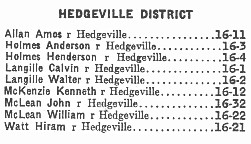
On 4 May 1962, the Hilden MT Co. received official approval to convert its system from four message rate manually operated lines, to fourteen flat rate dial operated lines.
The Hillside MT Co. connected to the North American telephone system at the MT&T exchange in Marion Bridge.
During 1934, the Hillside MT Co. spent $90.00 to replace 8.9 miles 14.3 km of pole line.
On 8 January 1958, the Hillside MT Co. abandoned that portion of its territory "from Alex MacDonald's gate, Hillside, to Thomas Horns', at Horns Road, and to Alex MacAulay's, at Albert Bridge", on the ground that no telephone line had ever been built there and there was no prospect of any being built.
1928

Hillside Mutual Telephone
Company directory, 1928
17 customers on one party line
("r" means residence)
Source: Maritime Telegraph & Telephone Company (MT&T)
Cape Breton Telephone Directory, January 1928, page 65
The Hodson MT Co. connected to the North American telephone system at the MT&T exchange in River John.

On 11 March 1966, at a special general meeting, a two-thirds majority vote of the shareholders approved a resolution to abandon the business. At that time Mrs. Dollina MacIntosh was the Secretary-Treasurer of the company. On 30 November 1966, Homeville MT Co. abandoned its territory and went out of business forever; MT&T took over the territory.
— Source: PUB Annual Report 1966
The Beaton Institute at CBU holds 1923-1966 records of the Homeville MT Co.
— Source: http://www.cbu.ca/beaton
The Jordan Bay MT Co. connected to the North American telephone system at the MT&T exchange in Shelburne.

On February 29, 1916, the Judique MT Co. received official approval that the Company's proportion of Local Toll and Long Distance charges for messages to or from any point on its line would be 5 cents.
— Source: PUB Annual Report 1916
The Lakevale MT Co. connected to the North American telephone system at the MT&T exchange in Antigonish.
On 1 July 1962, the Lakevale MT Co. sold its entire undertaking, including all property, pole lines, rights-of-way, and equipment, in working order, to MT&T for $900.00. On the same day, the Lakevale MT Co. abandoned its territory and went out of business forever; MT&T took over the territory.
See note 6
— Source: PUB Annual Report 1962
Note: In some records, the name is spelled "Lake View", and in others "Lakeview".
Service area: In Richmond County, Lake View.
During 1934, the Lakeview MT Co. spent $180.00 to replace twelve miles nineteen km of pole line.
On 9 April 1958, the Lakeview MT Co. received official approval to enlarge its territory "from Mrs. Bessie MacKay's, West Bay, to Mr. R.N. MacInnes', Marshes, West Bay", a distance of about four miles about six km.
— Source: PUB Annual Report 1958
On 16 December 1973, the Lake View MT Co. abandoned its territory and went out of business forever; MT&T took over the territory.
— Source: PUB Annual Report 1973
The Lakeview Mutual Telephone Company's name appeared in the Halifax Sunday Herald on 9 May 2004, in an article on bank balances left behind when groups disband or become inactive. In a sidebar listing "unclaimed bank balances," Lakeview Mutual Telephone appeared with an unclaimed balance of $4,326.99 at St. Peter's, in an account that has been inactive since August 1980. This was by far the largest unclaimed balance listed in Nova Scotia.
[It was still there on 26 February 2006.]
Unclaimed balances are listed at: Bank of Canada, Unclaimed Bank Balances
http://bank-banque-canada.ca/
The L'Ardoise MT Co. connected to the North American telephone network at the MT&T exchange at St. Peters, Richmond County.
On 8 August 1918, the L'Ardoise MT Co. was incorporated under the Rural Telephone Act.
On 1 February 1962, the L'Ardoise MT Co. put into effect a new rate schedule: For members (shareholders), $10.00 per year for a residence telephone, and $15.00 per year for a business phone; for nonmembers, $15.00 per year for each phone.
— Source: PUB Annual Report 1962
On 16 December 1973, the L'Ardoise MT Co. sold its entire undertaking, including all property, pole lines, rights-of-way, and equipment, in working order, to MT&T for $260.00. On the same day, the L'Ardoise MT Co. abandoned its territory and went out of business forever; MT&T took over the territory. On the day of the shutdown, the L'Ardoise MT Co. was serving 97 subscribers on twenty lines, with 17.3 miles 27.9 km of pole line.
— Source: PUB Annual Report 1973, pages 191-193
The Little Narrows MT Co. connected to the North American telephone network at the MT&T exchange in Whycocomagh, Inverness County.
The Loganville MT Co. connected to the North American telephone network at the MT&T exchange in West Branch, Pictou County.
On 6 December 1965, the Loganville MT Co. sold its entire undertaking, including property, apparatus, pole lines, rights-of-way and equipment in service, in working order, to MT&T (price not specified). On the same day, the Loganville MT Co. abandoned its territory and went out of business forever.
— Source: PUB Annual Report, 1965
Effective on and after 6 December 1965, the MT&T River John Exchange area was enlarged to include the West Branch area, and the MT&T West Branch Exchange was closed permanently.
— Source: PUB Annual Report 1965, pages 332 and 333
The Lorne MT Co. may have been the oldest of the Mutual Telephone Companies. It is the only Mutual Telephone Company listed in the 1912 Annual Report of the Public Utilities Board, which reported the names of all 77 Nova Scotian telephone companies in existence on 31 December 1912. However, the 1917 Annual Report of the PUB states that Lorne MT Co. was incorporated in 1917. (This may not be a contradiction, perhaps the Lorne MT Co. operated for several years as an informal – not legally incorporated – association.)
On 16 September 1973, Lorne MT Co. abandoned its territory and went out of business forever; MT&T took over the territory.
— Source: PUB Annual Report 1973, pages 7-9
The Lower LaHave M.T. Company is known to have been in existence in 1915; it is named in the 1915 Annual Report of the Public Utilities Board, in the list of Telephone Companies Incorporated Under the Rural Telephone Act. This company does not appear in the 1912 list.
In 1965, Mrs. W. Wolfe was Secretary-Treasurer of the Company.
On 21 November 1965, the Lower LaHave MT Co. abandoned its territory and went out of business forever. The territory was taken over by the Maritime Telegraph & Telephone Company (MT&T), and was included in the Riverport Exchange Area.
— Source: PUB Annual Report 1965
The Lower River M.T. Co. connected to the North American telephone network at the MT&T exchange in Port Hawkesbury. The Lower River M.T. Company is known to have been in existence in 1943; it is named in the 1943 Annual Report of the Public Utilities Board, in the list of Telephone Companies Incorporated Under the Rural Telephone Act. This company does not appear in the 1939 list.
In 1965, Father E.N. Tobin was Secretary-Treasurer of the Company.
On 6 December 1965, the Lower River MT Co. abandoned its territory and went out of business forever. The territory was taken over by the Maritime Telegraph & Telephone Company (MT&T), and was included in the Port Hawkesbury Exchange Area.
— Source: PUB Annual Report 1965
The Malagash MT Co. was incorporated under the Rural Telephone Act on 5 May 1925, but had been operating a telephone service in that area since 1904. It connected with the North American telephone system at the MT&T exchange in Wallace, Cumberland County.
On 16 November 1974, Malagash MT Co. abandoned its territory and went out of business forever. At the time of the shutdown, the company had one circuit on 13 miles 21 km of its own pole line and about 3 miles 5 km of wire strung on poles belonging to another company. It served 33 member subscribers who each paid $20.00 per year for their telephones, and 7 nonmember subscribers who paid $2.50 each, per month. The closure of the small telephone company's operation was caused by the plan to convert the MT&T Wallace Exchange in 1974 to dial operation with direct distance dialling, which required all connecting companies, including this one, to choose between spending a lot of money to install new equipment or abandon the territory and let MT&T take over.
— Source: PUB Annual Report 1973, pages 388-389
The Malagawatch MT Co. connected to the North American telephone network at the MT&T exchange in Valley Mills, Inverness County.
The Malagawatch MT Co. was incorporated under the Rural Telephone Act on 1 August 1922.
On 15 July 1974, Malagawatch MT Co. abandoned its territory and went out of business forever. At the time of the shutdown, the company had two circuits on 22 miles 35 km of pole line, and served 29 subscribers who paid $10.00 each, per year.
— Source: PUB Annual Report 1974
The Mansfield MT Co. had its bank account at the Bank of Nova Scotia in Oxford.
On 15 December 1968, Mansfield MT Co. abandoned its territory and went out of business forever. On the same day, MT&T took over the territory.
— Source: PUB Annual Report 1968
The Mattie Settlement MT Co. was incorporated under the Rural Telephone Act in 1965.
— Source: PUB Annual Report 1965, page xxxvi
The Marydale & Beauly MT Co. connected to the North American telephone system at the MT&T exchange in Antigonish.
On 16 September 1962, the Marydale & Beauly MT Co. sold its entire undertaking, including all property, pole lines, rights-of-way, and equipment, in working order, was sold to MT&T for $1,200.00. On the same day, the Marydale & Beauly MT Co. abandoned its territory and went out of business forever; MT&T took over the territory.
See note 6
— Source: PUB Annual Report 1962
The Meadow Green & Pomquet River MT Co. connected to the North American telephone system at the MT&T exchange in Antigonish.
On 16 September 1962, the Meadow Green & Pomquet River MT Co. sold its entire undertaking, including all property, pole lines, rights-of-way, and equipment, in working order, to MT&T for $975.00. On the same day, the Meadow Green & Pomquet River MT Co. abandoned its territory and went out of business forever; MT&T took over the territory.
See note 6
— Source: PUB Annual Report 1962
The Meadowville MT Co. connected to the North American telephone network at the MT&T exchange in Meadowville, Pictou County.
In 1965, this territory was transferred to the Pictou Exchange area, and the former Meadowville Exchange area was cancelled.
— Source: PUB Annual Report 1965
On 18 March 1966, at a special general meeting, a two-thirds majority vote of the shareholders approved a resolution to abandon the business. At that time Louis L. Roberts was the Secretary-Treasurer of the company. On 30 November 1966, Melville MT Co. abandoned its territory and went out of business forever; MT&T took over the territory.
— Source: PUB Annual Report 1966
During 1934, the Middle River & Hunters Mountain MT Co. spent $30.00 to replace 2 miles 3 km of pole line.
The Beaton Institute at CBU holds 1929-1941 records of the Middle River & Hunters Mountain MT Co.
[Source: http://www.cbu.ca/beaton]
On 21 December 1973, the Middle River MT Co. abandoned its territory and went out of business forever; MT&T took over the territory.
— Source: PUB Annual Report 1973
On 16 December 1966, the Milford MT Co. received official approval to lease two additional circuits from MT&T, with the point of connection being at the Annapolis Central Office.
The Mineral Rock MT Co. connected to the North American telephone system at the MT&T exchange in Marion Bridge, Cape Breton County.
|
1928 
|
1952 
|
The Beaton Institute at CBU holds 1939-1951 records of the Mineral Rock MT Co.
[Source: http://www.cbu.ca/beaton]
In May 2004, the Mineral Rock Mutual Telephone Company had an unclaimed balance of $541.50 in a Sydney bank account that had been inactive since February 1975.
[It was still there on 23 January 2013.]
Source: Bank of Canada, Unclaimed Bank Balances
http://bank-banque-canada.ca/
Legend of the Mineral Rock Tramway
During 1934, the Mira River MT Co. spent $185.41 to replace 9 miles of pole line.
On 8 January 1958, the Mira River MT Co. sold its entire undertaking, including all property, pole lines, rights-of-way, and equipment, in working order, to MT&T for $200.00. On that same day, the Mira River MT Co. abandoned its territory and went out of business forever; MT&T took over the territory.
— Source: PUB Annual Report 1958
On 7 February 1922, the Mooseland MT Co. received official approval that the company's proportion of Local Call and Long Distance charges for messages to or from any point on its line would be 10 cents.
On 1 October 1958, the Mooseland MT Co. put into effect a new rate schedule, of $2.00 per month for each telephone. This rate replaced the previous rate which had been in effect since 31 December 1943. Under the new rate, the Mooseland MT Co's share of long distance charges, for calls to and from points on its lines, was ten cents.
— Source: PUB Annual Report 1958
For several days in April 1936, the Moose River Gold Mines MT Co. Ltd. was the most famous telephone company in North America (it certainly had more media mentions in Canada and the United States than any other telephone company then in existence). The one-wire ground-return telephone line operated by the MRGMMT Co. carried J. Frank Willis' round-the-clock commentary on the progress of the effort to rescue three men trapped in a cave-in of the Moose River Mine, broadcast live on hundreds of radio stations in Canada and the U.S.A.
The cave-in occurred at 11pm on 12 April 1936. Frank Willis made his first broadcast report from the mine site at 6pm on April 20 – then for two minutes every half-hour he was live on air throughout North America. He continued for 56 hours straight, 111 consecutive live broadcasts, making his last broadcast at 2am on April 23. An estimated 100 million people were listening. The broadcasts were carried on all 58 radio stations then in existence in Canada, and on an estimated 650 stations in the United States. The BBC picked up the broadcasts for Great Britain and Europe. It was North America's very first live 24-hour news event. During this time, Willis' only link to the outside world was the Moose River Gold Mines Mutual Telephone Company's single number-nine iron wire. Before each broadcast, Willis had to convince everyone on the 18-mile-[29km]-long party-line phone circuit to put down the phone and listen to his reports on the radio. Otherwise, the signal was so weakened that his voice came through no louder than a thin whisper.
Source:
CBC Archives: 1936 Moose River Mine Disaster
http://archives.cbc.ca/economy_business/natural_resources/topics/3818/
Once upon a time, the CBC (Canadian Broadcasting Corporation) had, in its website, an item – including online audio clips – about J. Frank Willis and his reporting of the Moose River Mine tragedy. For some incomprehensible reason, in 1999 the CBC deleted this item from its website. However, archived copies exist —
|
The Wayback Machine has archived copies of this document:
Archived: 1997 May 27
Archived: 1997 July 22
Archived: 1997 October 14
|
The Murrayfield MT Co. connected to the North American telephone network at the MT&T exchange in West Branch, Pictou County.
On 6 December 1965, the Murrayfield MT Co. sold its entire undertaking, including property, apparatus, pole lines, rights-of-way and equipment in service, in working order, to MT&T (price not specified). On the same day, the Murrayfield MT Co. abandoned its territory and went out of business forever.
— Source: PUB Annual Report, 1965
Effective on and after 6 December 1965, the MT&T River John Exchange area was enlarged to include the West Branch area, and the MT&T West Branch Exchange was closed permanently.
— Source: PUB Annual Report 1965, pages 332 and 333.
On 30 September 1958, the New Chester MT Co. put into effect a new rate schedule, replacing the previous rate which had been in effect since 11 January 1955. The new rate was $3.00 per telephone per year for members (shareholders); for non members $22.80 per year for each residence telephone, and $27.60 per year for each business telephone. Under the new rate, the New Chester MT Co's share of long distance charges, for calls to and from points on its lines, was 10 cents.
The New Cornwall MT Co. connected to the North American telephone system at the MT&T exchange in Mahone Bay.

The New Riverside MT Co. connected to the North American telephone system at the MT&T exchange in Antigonish.
On 12 August 1962, the New Riverside MT Co. abandoned its territory and went out of business forever. At the time of the shutdown, the New Riverside MT Co. was a flat rate company, serving twelve subscribers with 5.2 miles 8.4 km of pole line.
See note 6
— Source: PUB Annual Report 1962
The New St. Anns MT Co. connected to the North American telephone system at the MT&T exchange in Baddeck.
On 30 November 1967, the New St. Anns MT Co. abandoned its territory and went out of business forever.
— Source: PUB Annual Report 1967
The New Truro Road MT Co. connected to the North American telephone system at the MT&T exchange in Tatamagouche. During 1934, the New Truro Road MT Co. spent $14.44 to replace 0.9 mile (1.4km) of pole line.
On 30 November 1967, the New Truro Road MT Co. abandoned its territory and went out of business forever.
— Source: PUB Annual Report 1967
In 1922, the New Victoria MT Co. kept its bank account at the Bank of Nova Scotia in Oxford.
On March 7, 1916, the Nine Mile River & Rawdon MT Co. received official approval that the Company's proportion of Local Toll and Long Distance charges for messages to or from any point on its line would be 10 cents. During 1934, the Nine Mile River & Rawdon MT Co. spent $20.83 to replace one mile of pole line.
The North East Margaree MT Co. connected to the North American telephone system at the MT&T exchange in Margaree Forks.
The North Shore MT Co. connected to the North American telephone system at the MT&T exchange in Antigonish.
On 15 February 1962, the North Shore MT Co., sold its entire undertaking, including all property, pole lines, rights-of-way, and equipment (except telephone sets) to MT&T for $10,000.00. On the same day, the North Shore MT Co. abandoned its territory and went out of business forever.
See note 6
— Source: PUB Annual Report 1962
The North Wallace MT Co. was incorporated under the Rural Telephone Act on 13 October 1913. It connected with the North American telephone system at the MT&T exchange in Wallace.
On 16 November 1974, North Wallace MT Co. abandoned its territory and went out of business forever. At the time of the shutdown, the company had 10 miles 16 km of its own pole line and about 4 miles 6 km of wire strung on poles belonging to another company. It served 17 subscribers; shareholders paid 50 cents per month for their telephones and non-shareholders paid $1.00 per month. The closure of the small telephone company's operation was caused by the plan to convert the MT&T Wallace Exchange in 1974 to dial operation with direct distance dialling, which would require all connecting companies, including this one, to choose between spending a lot of money to install new equipment or abandon the territory and let MT&T take over.
— Source: PUB Annual Report 1973, page 387

On 1 June 1962, the Nuttby & North River MT Co. Ltd. abandoned its territory and went out of business forever; MT&T took over the territory.
The Nyanza MT Co. connected to the North American telephone system at the MT&T exchange in Baddeck.
On 30 November 1967, the Nyanza MT Co. abandoned its territory and went out of business forever; MT&T took over the territory.
— Source: PUB Annual Report 1967
The Oban MT Co. connected to the North American telephone network at the MT&T exchange in St. Peter's, Richmond County.
On 16 December 1973, the Oban MT Co. Ltd. abandoned its territory and went out of business forever; MT&T took over the territory.
The Piedmont Valley MT Co. was incorporated in 1960, under the Nova Scotia Rural Telephone Act.
— Source: PUB Annual Report 1960, page xxxvi
On 1 March 1961, the Piedmont Valley MT Co. revised its rates to:
for members (shareholders), $25.00 per telephone per year;
for nonmembers, $30.00 per telephone per year.
For each long-distance call, to or from PVMT Co., the company got 5 cents as its share of the long-distance charge.
— Source: PUB Annual Report 1961
On 1 February 1962, the Piedmont Valley MT Co. revised its rates to:
for members, $27.00 per telephone per year;
for nonmembers, $32.00 per telephone per year.
The long distance share remained at 5 cents.
— Source: PUB Annual Report 1962
The Pinevale MT Co. was incorporated under the Rural Telephone Act on 1 April 1924.
On 5 October 1974, Pinevale MT Co. abandoned its territory and went out of business forever. At the time of the shutdown, the company had one line 7.3 miles long and served five subscribers.
Source: page 369, PUB Annual Report 1973
During 1934, the Pleasant Bay MT Co. spent $101.67 to replace 4 miles of pole line.
Early in 1972, Pleasant Bay MT Co. abandoned its territory and went out of business forever; MT&T took over the territory.
On July 4, 1916, the Pomquet MT Co. received official approval that the Company's proportion of Local Toll and Long Distance charges for messages to or from any point on its line would be 10 cents.
1954

Pomquet Mutual Telephone
Company directory, 1954
Source: Maritime Telegraph & Telephone Company (MT&T)
North Eastern District Telephone Directory, Oct. 1954, page 46
On 30 November 1966, Port Lorne MT Co's entire undertaking, including all property, rights-of-way, pole lines, and equipment, in working order, was sold to MT&T for $64.20. On the same day, the Port Lorne MT Co. abandoned its territory and went out of business forever; MT&T took over the territory.
— Source: PUB Annual Report 1966
In 1960, the Prairie & Petit Etang MT Co. ceased operation and abandoned its territory. Telephone service in this area was taken over by MT&T.
— Source: PUB Annual Report 1960
The Red Islands MT Co. connected to the North American telephone system at the MT&T St. Peter's exchange.
On 9 July 1962, the Red Islands MT Co. Ltd. adopted a new rate schedule: $1.75 per month for members (shareholders) (telephone to be furnished by the Member), and $3.00 per month for nonmembers (telephone to be furnished by the Red Islands MT Co.). The Company's share of long distance charges for calls to and from points on its lines was 10 cents per call.
On 16 December 1973, the Red Islands MT Co. Ltd. abandoned its territory and went out of business forever; MT&T took over the territory.
On 6 October 1916, the River Bourgeois MT Co. received official approval that the Company's proportion of Local Toll and Long Distance charges for messages to or from any point on its line would be 5 cents.
John Joseph Samson (1863-1942) was the first president of the River Bourgeois MT Co.
[Source: http://www.mindspring.com/~giammo/Bissett/wga31.html ]
On 12 May 1961, the River Bourgeois MT Co. was given official approval to enlarge the boundaries of the territory it served, by extending a line from its then-existing terminus westward 1.3 miles 2.1 km to serve the district of Hawker.
On 19 May 1974, the River Bourgeois MT Co. Ltd. abandoned its territory and went out of business forever; MT&T took over the territory.
On 22 February 1973, the Riversdale MT Co. received official approval to lease two additional circuits connecting with MT&T, and on 1 May 1973 for two more circuits, and on 1 June 1973 for one more circuit, making a total of five additional circuits.
On 13 November 1957, Riverside MT Co. abandoned ten miles of its existing telephone lines.
During 1934, the River View MT Co. spent $138.44 to replace 5.2 miles of pole line.
During 1934, the Roseway River MT Co. spent $122.50 to replace 8 miles of pole line.
During 1934, the Roslin MT Co. spent $59.06 to replace 2.2 miles of pole line.
On 31 December 1973, the Ross Ferry MT Co. abandoned that portion of its territory in Victoria County, on Boularderie Island along the Hillside Road between Church Road and Steele's Cross Road, a distance of about 3.5 miles.
On 2 May 1916, the Round Island MT Co. received official approval that the Company's proportion of Local Toll and Long Distance charges for messages to or from any point on its line would be 5 cents.
On 30 November 1966, the Round Island MT Co. Ltd. abandoned its territory and went out of business forever; MT&T took over the territory.
The Beaton Institute at CBU holds 1957-1968 records of the Round Island MT Co.
[Source: http://www.cbu.ca/beaton]
During 1934, the Sable River MT Co. spent $68.28 to replace 2.4 miles of pole line.
On 1 February 1958, the Sable River MT Co. put into effect a new rate schedule: For members (shareholders), 50 cents per month when the telephone was supplied by the member, and $1.00 per month when the telephone was supplied by the Company; and for nonmembers, 75 cents per month when the telephone was supplied by the nonmember, and $1.50 per month when the telephone was supplied by the Company. The Company's share of long distance charges was 10 cents for each message to and from any point on its lines.
Under the Rural Telephone Act of Nova Scotia, an official legal document known as a “Memorandum of Association” was required to be filed with the Public Utilities Board (PUB) by each Mutual Telephone Company in the province. The Act required each company's Memorandum of Association to contain, among other things, the following information:
(1) The official legal name of the company, which was required to include the word “Mutual” as part of the name, and the word “Limited” as the last word of the name.
(2) A statement of the geographical boundaries of the rural district served by the company.
(3) A list of the names of the shareholders, each of whom was required to reside “within the boundaries of the rural district described in the Memoradum”.
— Source: The Rural Telephone Act, chapter 196 of the Revised Statutes of Nova Scotia 1923
The St. Catherine MT Co. filed its Memorandum of Association with the PUB on 3 October 1917.
— Source: PUB Annual Report 1958, page 62
The St. Catherine MT Company's territory was described as follows:
Beginning at the point of commencement, half a mile south of the intersection of the Post Road, so-called, leading from Port Mouton to Port Joli and the road to St. Catherine's River in Queens County; for a distance of four miles to a point south of St. Catherine's River, and including a territory extending half a mile from the centre line of road on the east side thereof and the territory extending to the waters of Port Joli Harbour on the west side thereof.
— Source: PUB Annual Report 1958, page 62
In a decision rendered on 6 February 1958, the Public Utilities Board wrote: "...the Board is satisfied that although the St. Catherine Mutual Telephone Company Limited was incorporated under the Rural Telephone Act, it did not function as a mutual telephone company and was in fact operated in a private manner by one W.A. Kinney for a period of twelve years. ...the Kinney line, so-called, was later acquired by one H.C. Burgess in 1942 and ...Burgess provided telephone service in the area until his death in 1956..." On 31 January 1958, "the administrator and heirs-at-law of the late H.C. Burgess ...relinquished all rights ...to supply telephone service" in this area.
Under the decision of the PUB rendered on 6 February 1958, the territory formerly assigned to the St. Catherine MT Company was taken over by MT&T.
— Source: PUB Annual Report 1958, page 62
The St. Joseph's MT Co. connected to the North American telephone system at the MT&T exchange in Antigonish.
During 1934, the St. Joseph's MT Co. spent $52.50 to replace 3.5 miles of pole line.
On 16 September 1962, the St. Joseph's MT Company's entire undertaking, including all property, pole lines, rights-of-way, and equipment, in working order, was sold to MT&T for $4,000.00. On the same day, the St. Joseph's MT Co. abandoned its territory and went out of business forever; MT&T took over the territory.
See note 6
— Source: PUB Annual Report 1962

The St. Mary's MT Co. connected to the North American telephone system at the MT&T Melrose Exchange.
The Salmon River MT Co. connected to the North American telephone system at the MT&T Guysboro Exchange.
On 15 March 1966 the Salmon River MT Co. Ltd. abandoned its territory and went out of business forever. (The date was definitely 15 March, but the PUB's records are in some conflict about the year, which may have been either 1966 or 1967.)
|
1933 
|
1946 
|
In the 1933 directory (above), note the listing for
“Canadian National Railways Camp” at Salmon River.
This was accomodation – temporary lodging – for the men
working on the construction of the Guysborough Railway.
Guysborough Railway...
by John R. Cameron
Guysborough Railway
Tender deadline: 15 September 1911
The Scotts Bay MT Co. connected to the North American telephone system at the MT&T exchange in Canning.
The Seafoam MT Co. connected to the North American telephone system at the MT&T exchange in River John.
On 30 November 1966, Seafoam MT Co. abandoned its territory and went out of business forever; MT&T took over the territory.

During 1934, the Ship Harbour Lake MT Co. spent $197.26 to replace 8.9 miles 14.3 km of pole line.
On 16 December 1966, the Ship Harbour Lake MT Co. received official approval to lease five additional circuits from MT&T, with the point of connection being in Lake Charlotte.
On 17 April 1973, the Ship Harbour MT Co. put into effect a new rate schedule.
a shareholder in the company. |
The name of the Ship Harbour Lake Mutual Telephone Company appeared in the Halifax Chronicle-Herald, 29 June 2002, on page B2, in an item about the Memory Lane Heritage Village in Lake Charlotte.
The Shulee MT Co. connected to the North American telephone system at the MT&T exchange at River Hebert.
On 1 February 1962, the South Branch MT Co. adopted a new rate schedule, $6.00 per year (the telephone to be furnished by the subscriber).
The South Lochaber MT Co. was incorporated under the Rural Telephone Act on 8 January 1914. It connected to the North American telephone system at the MT&T exchange in Antigonish.
On 16 September 1962, the South Lochaber MT Co. adopted a new rate schedule, $24.00 per telephone per year.
On 5 October 1974, South Lochaber MT Co. abandoned its territory and went out of business forever. At the time of the shutdown, the company had five circuits on 48 miles 77 km of pole line, and served 43 member subscribers and 26 nonmember subscribers.
— Source: PUB Annual Report 1973, page 369
The South River MT Co. connected to the North American telephone system at the MT&T exchange in Antigonish.
The South River MT Co. was incorporated under the Rural Telephone Act on 29 August 1913.
On 5 October 1974, South River MT Co. abandoned its territory and went out of business forever. At the time of the shutdown, the company had sixteen circuits on 36 miles 58 km of pole line, and served 97 subscribers.
— Source: PUB Annual Report 1973, page 369

The South West Margaree MT Co. connected to the North American telephone system at the MT&T exchange in Margaree Forks.
On February 29, 1916, the South West Margaree MT Co. received official approval that the Company's proportion of Local Toll and Long Distance charges for messages to or from any point on its line would be 5 cents.
The Springfield MT Co. connected to the North American telephone system at the MT&T exchange in Antigonish.
On 16 September 1962, the Springfield MT Co. sold its entire undertaking, including all property, pole lines, rights-of-way, and equipment, in working order, was sold to MT&T for $1,100.00. On the same day, the Springfield MT Co. abandoned its territory and went out of business forever.
See note 6
— Source: PUB Annual Report 1962
On 1 November 1973, the Springside MT Co. put into effect a new schedule of rates, $3.50 per month for a residence telephone, and $4.00 per month for a business telephone. These rates applied for members (shareholders) – no rates were stated for nonmembers, which strongly suggests that this company had no nonmember subscribers at that time.
On 1 February 1962, the Spry Bay MT Co. adopted a new rate schedule: For members (shareholders), $10.00 per telephone per year, and for nonmembers, $27.00 per telephone per year. The Company's share of long distance charges was 10 cents per call, for messages to or from any point along its lines.
The Sunrise MT Co. connected to the North American telephone network at the MT&T exchange in Meadowville, Pictou County.
In 1965, this territory was transferred to the Pictou Exchange area, and the former Meadowville Exchange area was cancelled.
— Source: PUB Annual Report 1965
The Telford MT Co. connected to the North American telephone system at the MT&T exchange in New Glasgow.

On 19 January 1959, the Three Brooks MT Co. abandoned its territory and went out of business forever.
The Tor Bay MT Co. connected to the North American telephone network at MT&T's exchange at Guysboro.
|
1933 
|
1946 
|
On 4 June 1961, the Township Line MT Co. abandoned its territory and went out of business forever.
The Trout Brook MT Co. connected to the North American telephone system at the MT&T exchange in Marion Bridge, Cape Breton County.
1928

Trout Brook Mutual Telephone
Company directory, 1928
9 customers on one party line
("r" means residence)
Source: Maritime Telegraph & Telephone Company (MT&T)
Cape Breton Telephone Directory, January 1928, page 65
In 1971 or early in 1972, Upper Clyde MT Co. abandoned its territory and went out of business forever; MT&T took over the territory.
It is not now known when the Upper Meadowville M.T. Company was formed. In most of its Annual Reports, the Public Utilities Board included a list of the Mutual Telephone Companies in existence in Nova Scotia on 31 December in the year of the Report. The Upper Meadowville M.T. Company does not appear in the 1943 list, or in any list before 1943.
In 1965, Charles W. Haslam was Secretary of the Company.
On 6 July 1965, the Upper Meadowville MT Co. abandoned its territory and went out of business forever. The territory was taken over by the Maritime Telegraph & Telephone Company (MT&T) and was included in the Pictou Exchange Area, and the former Meadowville Exchange Area was cancelled.
— Source: PUB Annual Report 1965
The Wallace Point MT Co. was incorporated under the Rural Telephone Act on 6 February 1917. It connected with the North American telephone system at the Wallace Exchange of MT&T.
On 16 November 1974, Wallace Point MT Co. abandoned its territory and went out of business forever; MT&T took over the territory. At the time of the shutdown, the company had one circuit on 2 miles of pole line. It served five subscribers who each paid 50 cents per month for a residential telephone, and 70 cents per month for a business telephone. The closure of the small telephone company's operation was caused by the plan to convert the MT&T Wallace Exchange in 1974 to dial operation with direct distance dialling, which would require all connecting companies, including this one, to choose between spending a lot of money to install new equipment or abandon the territory and let MT&T take over.
— Source: PUB Annual Report 1973, page 389
The Wallace & Wentworth M.T. Co. Ltd. was incorporated under the Rural Telephone Act on 27 July 1949, as successor to the Wallace & Wentworth Telephone Company, an unincorporated company which had served the area for some sixty years previously. The Wallace & Wentworth MT Co. connected with the North American telephone system at the MT&T Wallace Exchange.
On 16 November 1974, Wallace & Wentworth MT Co. abandoned its territory and went out of business forever. At the time of the shutdown, the company had two circuits on 3.5 miles of pole line. It served 24 member subscribers who each paid $1.60 per month, and 13 nonmember subscribers who paid "$2.00 plus" per month. At the time of the shutdown, MT&T took over the existing plant of the Wallace & Wentworth MT Co. but paid "nothing" for it. The closure of the small telephone company's operation was caused by the plan to convert the MT&T Wallace Exchange in 1974 to dial operation with direct distance dialling, which would require all connecting companies, including this one, to choose between spending a lot of money to install new equipment or abandon the territory and let MT&T take over.
— Source: PUB Annual Report 1973, pages 390, 391
On 15 February 1962, the Wentworth Valley MT Co. sold its entire undertaking, including all property, pole lines, rights-of-way, and equipment, in working order, to MT&T for $193.00. On that same day, the Wentworth Valley MT Co. abandoned its territory and went out of business forever.
During 1925, the Westerly MT Co. "wholly replaced and renewed" one-half mile [about one km] of its pole line, and "reset" six miles [ten km] of its pole line. The company withdrew $34.00 from its bank account in Tatamagouche to "help defray the cost of such rebuilding and resetting."
— Source: PUB Annual Report 1925, page 132
During 1934, the West Middle River MT Co. spent $91.50 to replace 5.7 miles 9.2 km of pole line.
During 1934, the West New Annan MT Co. spent $20.00 to replace 1.3 miles 2.1 km of pole line.
During 1934, the West River MT Co. spent $102.95 to replace 4.2 miles 6.8 km of pole line.
On 6 March 1934, the White Brook MT Co. received approval of this rate schedule: Subscribers (shareholders) $6.00 per year, payable monthly. There was no mention of a rate for non-subscribers, and it may be inferred there were no non-subscribers.
On 16 September 1961, the White Rock MT Co. abandoned its territory and went out of business forever.
On 13 November 1961, the Williams Point MT Co. abandoned its territory and went out of business forever.
|
The Wayback Machine has archived copies of this document:
Archived: 2002 July 07
Archived: 2003 January 25
Archived: 2002 May 01
These links were accessed and found to be valid on 09 July 2010. |

• Balls Creek Mutual Telephone Co. Ltd.
• Blomidon Mutual Telephone Co. Ltd.
• Brooks Mutual Telephone Co. Ltd.
• Enon & Terra Nova Mutual Telephone Co. Ltd.
• Groves Point Mutual Telephone Co. Ltd.
• Lorne Mutual Telephone Co. Ltd.
• New Truro Road Mutual Telephone Co. Ltd.
• Pennant Mutual Telephone Co. Ltd.
• Queensville Mutual Telephone Co. Ltd.
• St. Catherine Mutual Telephone Co. Ltd.
• Seafoam Mutual Telephone Co. Ltd.
• Toney River Mutual Telephone Co. Ltd.
• Wallace Point Mutual Telephone Co. Ltd.
• West Branch Mutual Telephone Co. Ltd.
— Source: pages 10-11, PUB annual report 1917
• Bailey's Brook Mutual Telephone Company Limited
• Big Island Mutual Telephone Company Limited
• Piedmont Valley Mutual Telephone Company Limited
— Source: page xxxvi, PUB annual report 1960
• Antigonish Harbour Mutual Telephone Company [1 July 1962]
• Brierly Brook Mutual Telephone Company [12 August 1962]
• Brookdale Mutual Telephone Company [12 August 1962]
• Cloverville Mutual Telephone Company [19 July 1962]
• East St. Andrews Mutual Telephone Company [16 September 1962]
• Fairmont Mutual Telephone Company [19 July 1962]
• Glen Road Mutual Telephone Company [12 August 1962]
• Lakevale Mutual Telephone Company [1 July 1962]
• Marydale and Beauly Mutual Telephone Company [16 September 1962]
• Meadow Green and Pomquet River Mutual Telephone Company [16 September 1962]
• New Riverside Mutual Telephone Company [12 August 1962]
• North Shore Mutual Telephone Company [15 February 1962]
• St. Joseph's Mutual Telephone Company [16 September 1962]
• Springfield Mutual Telephone Company [16 September 1962]
— Source: PUB annual report 1962
The South River Mutual Telephone Company, and the South Lochaber Mutual Telephone Company, both of which also connected to the MT&T Antigonish Exchange, continued operations after the dial conversion, until October 1974.
The mutual telephone campanies and small telephone utilities continue to render important service in their rural areas which as a rule are thinly populated. Although the quality of service is usually of a lesser standard than that supplied by a large commercial company, the rates are correspondingly low; in any case these areas are not often attractive from a purely commercial viewpoint due to their sparsely settled nature and length of lines required to provide service.
Many of the mutual companies were established in the first quarter of this century through cooperative effort on the part of their members in order to provide themselves with party-line telephone service at reasonable rates. In order to accomplish this objective, donated labour, poles and other materials was customary, but such practice is now becoming rare and today all labour and materials must be purchased for cash in most cases. This fact places a severe strain on these small public utilities with low rate of income, while increases in rates is somewhat limited by the recognized inferior quality of service.
It follows that improvement and extension of existing rural services is a real problem, while at the same time there is increasing demand from rural residents for such improvement. Many persons today are no longer content with multi-party shared in some cases among twenty or more subscribers, and requests for private-line service are increasing. At present there is very little service of this type furnished by small companies and the capital cost of providing same must be borne by the applicants in accordance with the Rural Telephone Act.
Loans and subsidies from the provincial government available to mutual companies as well as withdrawals from their compulsory reserve funds have been of real assistance to such companies, although necessarily limited in extent. This type of aid is not available to private rural companies as a rule, which feel the economic pressure and service demands even more acutely... Two of the larger rural companies (Carleton and Coastal) found it necessary to discontinue... during the year.
There was fortunately no major storm damage suffered in 1958, although highway construction continued to raise problems in some areas.
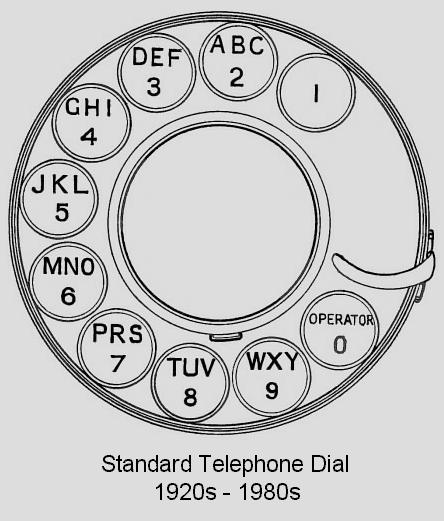
The rotary telephone dial, as used for about seven decades – the 1920s through the 1980s – was a circular device provided on ordinary telephones to enable the user to communicate to the central exchange equipment the telephone number he/she wanted to be connected to. The above diagram shows the dial design. There were ten holes, each of a size to comfortably accomodate an adult index finger, arranged in a circle. Each hole corresponds to a numerical digit, and eight holes also were labelled with alphabetic letters (as shown).
First we will describe the dial operation for a numerical-digit phone number (ignoring the letters for now). The method of operation is for the user first to lift his/her receiver – this releases the cradle switch and establishes an active connection with the exchange equipment. Then, taking as an example he/she wants to call "3708", he/she will enter (dial) these four digits in turn, one at a time. To enter 3 he/she places his/her finger in the hole labelled "3", rotates the front plate of the dial (which is free to rotate in a clockwise direction) until his/her finger and the finger hole for 3 reach the finger stop shown on the right-hand side of the diagram above. He/she then withdraws his/her finger and the rotary plate automatically rotates back to the rest position – driven by a spring that was wound up as the user turned the dial clockwise. As the dial rotates counterclockwise, back to the rest position, the internal mechanism operates a switch that opens and closes the circuit three times. This transmits three pulses of electric current to the exchange equipment, which recognises this as the digit "3". To enter the next digit 7, he/she will now insert his/her finger in the hole labelled "7" and repeat the procedure. The remaining digits are entered in sequence. The impulses are transmitted on the return (counterclockwise) motion, because this is not controlled by the user and the timing of the impulses can be spaced precisely at the rate of ten impulses per second. If the impulses were transmitted on the user-controlled clockwise motion, the timing would be unpredictable, with the user turning the dial sometimes slowly, sometimes quickly, sometimes hesitatingly.
The 24 letters (omitting Q and Z) serve only as a way to make it easier for people to remember long telephone numbers. The telephone equipment recognizes only the numerical digits, not the letters (see "Telephone Exchange Names" below).
Beginning in the mid-1980s, the rotary dial was replaced by push-button "touch-tone" keypads. By the mid-1990s, rotary dial telephones were rare in Canada.
When mentioning telephone numbers, novels and stories written in the 1940s and 1950s often use exchange names. There is a 1940 Glenn Miller song called "PEnnsylvania 6-5000," and Elizabeth Taylor starred in the 1960 movie "BUtterfield 8" — both titles are derived from telephone exchange names.
1-212-736-5000
1-212-PEnnsylvania6-5000
In 2011, the phone number PEnnsylvania 6-5000 still works
(within area code 212) to reach the Hotel Pennsylvania,
401 Seventh Avenue, New York.
Today, if you (anywhere in North America) dial 1-212-PEnnsylvania6-5000,
your call will reach Hotel Pennsylvania in New York City.
(Note: long-distance charges will apply).
In the 1948 movie Sorry, Wrong Number, starring Barbara Stanwyck and Burt Lancaster, the telephone number BOwery 2-1000 appears repeatedly.
In Alfred Hitchcock's Rear Window, released in 1954, James Stewart as L.B. Jefferies makes a phone call to Lars Thorwald's apartment, CHelsea 2-7099. In Hitchcock's North By Northwest, released in 1959, Cary Grant as Roger Thornhill, while at a police station after his arrest for drunk driving, makes a phone call to BUtterfield 8-1098.
In the movie Ocean's Eleven, — released in 1960 but written in the late 1950s — Frank Sinatra as Danny Ocean places a call to DUdley 2-6969. The phone number ELdorado 5-9970 appears four times in the 1962 movie The Manchurian Candidate — also written in the late 1950s.
The phone numbers CRestview 5-1733 and GLAdstone 9281 appear in the 1950 movie Sunset Boulevard, starring William Holden, Gloria Swanson, and Erich von Stroheim. (GLAdstone 9281 is a rare example of an exchange name in which the first three digits are alphabetized.)
In the 1959 movie Some Like It Hot, starring Tony Curtis, Jack Lemmon and Marilyn Monroe, Joe the saxophone player (Tony Curtis) calls phone number WABash 1098.
In the movie Rebel Without a Cause, released in 1955, Natalie Wood as Judy, while at a police station, tells an officer to make a phone call to LExington 0-5549.
In the movie The Godfather, set in the late 1940s, Michael Corleone (Al Pacino), in his father's hospital room, makes an urgent phone call to LOngbeach 4-5620. In a scene that was cut from the original The Godfather theatre release, but was included in the VHS trilogy boxed set, Michael calls ORchard 9-9539.
For many years, "LOnesome 7-7203" has been a favourite country and western song. Two other
songs with named exchange numbers in their titles, "BEechwood 4-5789" and "ECho Valley 2-6809", have been recorded. (Note: In "ECho Valley", the V is capitalized but not dialed.)
The custom was to capitalize the significant letters to make them stand out – the remainder of the name was irrelevant. PEnnsylvania 6-5000 would be dialed as PE6-5000. LIberty 3-2424 would be dialed as LI3-2424, and JUniper 2-7201 as JU2-7201.


In The Simpsons, the long-running animated TV show, many episodes have telephone numbers in the 2L5N form, including:
KL5-1680, KL5-2226, KL5-2233, KL5-3223, KL5-3226,
KL5-3457, KL5-3700, KL5-4796, KL5-5246, KL5-5472.
KLondike5 was not a random choice. It was selected on purpose, because KL5 translates to 555, the "safe" exchange for telephone numbers displayed in movies and on television. KL5 has the advantage that few viewers will realize this is an alternate form of the familiar "555" exchange number.
In the original Twilight Zone television series, one episode was "Person or Persons Unknown," broadcast in March 1962. In this episode, David Gurney makes a phone call to KLondike 5-3472. Telephone exchange KLondike 5 also appears several times in "Night Call" – said by some to be one of the top two or three creepiest Twilight Zone episodes, and by others to be the best ever Twilight Zone episode – original air date February 1964. These examples of the KLondike exchange name, to disguise the familiar "555", were broadcast decades before it appeared in The Simpsons.
        Letters   Digit
        =======   =====
         A B C      2
         D E F      3
         G H I      4
         J K L      5
         M N O      6
         P R S      7
         T U V      8
         W X Y      9
Thus "CEntral 4-5678" is dialed as 234-5678. Letter C in "CEntral" is for digit 2, letter E is for digit 3. The "ntral", the lower-case part of "CEntral", was ignored (not for dialing).
The above is excerpted from the volumnious FAQ file of Telecom Digest, which is provided
courtesy of the Laboratory for Computer Science at the Massachusetts Institute of Technology
Before 911
The above is from the MT&TCape Breton Directory November 1958, page 1 |
|
There was a variety of phone numbers for reporting a fire.
For someone who saw a fire, to figure out what was the proper phone number to call was sometimes a challenge, especially when the fire was located near the boundary between two fire departments. Finding the correct phone number required a knowledge of local geography that summer visitors or new residents often lacked. |
Before 911
|
|---|

Chelsea, 1991 
|

Mahone Bay, 1991 
|

Lockeport, 1991 

Listed under "S" |

Yarmouth, 1991 Listed under "Y" (Not listed under "F") The above are from the MT&T South Shore Directory November 1991 |
|
There was a variety of phone numbers for reporting
a fire. For someone who saw a fire, to figure out what was the proper phone number to call was sometimes a challenge, especially when the fire was located near the boundary between two fire departments. Finding the correct phone number required a knowledge of local geography that summer visitors or new residents often lacked. |
|
Note the Zenith numbers. Zenith was the free
long-distance service in the days before toll-free 800 numbers. “Call your local operator and ask for ZenithX-XXXX, no cost to calling party.” Zenith was not an exchange, and was not dialable. “Call your local operator...” The calling party did not dial “ZE” (many old dials in Canada had “Z” printed on the “0”), but if they did dial “ZE” (03) by mistake, they would be connected to their local operator anyway – this was intentional, and was the reason for choosing “Zenith” for this purpose. |
•
Atlantic Sentinel by Donald R. Tarrant
http://web.archive.org/web/20140623002517/http://www3.nf.sympatico.ca/dtarrant/sentinel.html
•
Primrose versus Western Union Telegraph Company
http://www.oscn.net/applications/oscn/deliverdocument.asp?citeid=414011
United States Supreme Court, May 1894
This is an excellent discussion of the legal responsibilities of telegraph companies for delivery of telegrams, how mistakes in the message text can occur, who is responsible for mistakes, how much compensation can be expected by the injured party when a mistake does occur, and related issues.
"...telegraphic messages by the present system were sent and received by sound, and were all dots and dashes; that 'b' was a dash and three dots, and 'y' was two dots, a space, and then two dots; and that the difference between 'a' and 'u' was one dot, 'a' being a dot and a dash, 'u' two dots and a dash, and the pause upon the last touch of the 'u;' that an experienced telegraph operator, if the words were properly rapped out, and he was paying proper attention, could not well mistake the one for the other, but might be misled if he was not careful... the only mistake of any consequence in the transmission of the message consisted in the change of the word 'bay' into 'buy,' or rather of the letter 'a' into 'u.' In ordinary handwriting, the likeness between these two letters, and the likelihood of mistaking the one for the other, especially when neither the word nor the context has any meaning to the reader, are familiar to all; and in telegraphic symbols, according to the testimony of the only witness upon the subject, the difference between these two letters is a single dot..."
•
Telegraph, Insulator, Telegram & Mining Collector and Information site
http://telegraph.freehostia.com/index.htm
Images of old telegrams
http://telegraph.freehostia.com/page6.htm
Nova Scotia Electric Telegraph Company: Image of 1856 telegram
http://web.archive.org/liveweb/http://telegraph.freehostia.com/teleg78.jpg
•
19th Century Telegraphers a review, by Jim Haynes:
http://massis.lcs.mit.edu/telecom-archives/archives/
history/19th-century-telegraphers
Part I of this review is an attempt to convey the general message of the book. Part II is for fun: a selection of stories about the lives and times telegraphers a century ago... Dr. Gabler had access to a vast amount of material: census records, archives of the telegraph companies, contemporary newspaper accounts, magazines published for the edification and amusement of operators, and even novels in which telegraphers were used as characters. The footnotes and bibliography take up 48 pages... In 1883 Western Union employed 444 telegraphers in New York City, 96 in Boston, 88 in St. Louis, and 83 in Chicago... A number of telegraph operators rose to prominence; Thomas Edison and Andrew Carnegie are the best known... The companies were well aware that women were a bargain compared with men, and continually tried to replace men with women. Nellie Welch had full charge of the telegraph office in Point Arena, California in 1886. She was eleven years old...
The American Telegrapher: A Social History 1860-1900, by Edwin Gabler
Rutgers University Press, 1988
ISBN 0-8135-1284-0 (hardbound), 0-8135-1285-9 (paperback)
•
Morsum Magnificat, the Morse Magazine
http://web.archive.org/web/20131214084851/http://www.g3okd.co.uk/morsum/morsum.html
•
The Telegrapher Web Page
http://www.mindspring.com/~tjepsen/Teleg.html
•
Commercial Telegraphic Code Books
http://web.archive.org/web/20140817225419/http://www.dtc.umn.edu/~reedsj/codebooks.html
•
Samuel F.B. Morse Home Page
http://lcweb2.loc.gov/ammem/atthtml/mrshome.html
•
Canadian Railway Telegraph History Website
http://www.trainweb.org/railwayop/
•
The Morse Telegraph Club
http://www.morsetelegraphclub.org/
•
Milestones in Telegraph History
http://www.morsetelegraphclub.org/files/TelegraphMilestones.pdf
1886 June 9 – The Order of Railroad Telegraphers is founded as a result of a meeting called by Ambrose D. Thurston, Agent for the Burlington, Cedar Rapids & Northern Railway at La Porte City, Iowa. One of the union's first successful actions was to win a concession from management limiting telegraph operators to 17 hours continuous service.
This 'telephone' has too many limitations to be seriously considered as a practical form of communication. The device is inherently of no value to us.
— Western Union internal memo, 1878
• A Social History of Canadian Telecommunications by Dwayne Winseck
• History of the Telephone by Tom Farley
Telephone History 101 Have you ever wondered how the telephone works? Or when the first pay phone was invented? Or how the 911 emergency number was developed?
• Telephony History from Mike Sandman, Chicago's Telecom Expert
• Alexander Graham Bell's Path to the Telephone
• Text of U.S. Patent 174,465 dated 7 March 1876
• Text of U.S. Patent 186,787 dated 20 January 1877
• The Strowger Telecomms Page Until the 1990's, much of the telecomms infrastructre of the UK still relied on electromechanical switching, based on principles invented by Almon B. Strowger. Old Strowger exchanges were something to see, touch and hear...
• The Invention of Automatic Switching In the 1880s, Almon B. Strowger developed a system of automatic switching using an electromechanical switch based around around electromagnets and pawls. With the help of his nephew, Walter S. Strowger, he produced a working model in 1888. Strowger switches remained a mainstay of dial telephone systems well into the 1980s...
Roger B.Hill wrote two excellent articles about the history of automatic (no human operator) telephone systems, which were published in 1953 in the Bell Laboratories Record:
•
Early Work on Dial Telephone Systems by Roger B. Hill
•
The Early Years of the Strowger System by Roger B. Hill
• Automatic Exchange Implementation
The most complete run of telephone directories for Nova Scotia (1888-1999; predominantly 1911-1999) can be found at the Dalhousie University Archives in the Killam Library, University Avenue, Halifax. The Halifax Regional Library System, especially the Spring Garden Road Branch, also has good coverage for the Nova Scotia Telephone Company, MTT and their subsidiaries, from 1915 to the present.

Added
2002 Sep 22: Commercial Cable Co. Ltd.
2003 Feb 19: Lower River Mutual Telephone Co. Ltd.
2003 Feb 21: Upper Meadowville Mutual Telephone Co. Ltd.
2003 Mar 23: Riverport Telephone Co.
2003 Mar 29: Blomidon Mutual Telephone Co. Ltd.
2003 Mar 30: Bass River Telephone Co.
2003 Apr 18: Hants & Halifax Electric Telegraph Co.
2003 Apr 18: Truro & Pictou Electric Telegraph Co.
2003 Sep 25: Nova Scotia & Newfoundland Junction Telegraph Co.
2004 Dec 15: Medford Farmers Telephone Co.
2005 Jan 29: Pictou & Cape Breton Electric Telegraph Co.
2005 Apr 17: Bailey's Brook Mutual Telephone Co. Ltd.
2005 Apr 17: Big Island Mutual Telephone Co. Ltd.
2005 Apr 18: Dominion Government Telegraph & Telephone Service
2005 Apr 18: East Chebogue Mutual Telephone Co. Ltd.
2005 Apr 18: Lorne Rural Telephone Co. Ltd.
2005 Apr 18: Prairie & Petit Etang Mutual Telephone Co. Ltd.
2005 Apr 30: Canadian National Telegraph Co.
2010 Jul 03: Barra Glen Mutual Telephone Co. Ltd.
2010 Jul 04: Caribou Mines Mutual Telephone Co. Ltd.
2010 Jul 04: East Wentworth Mutual Telephone Co. Ltd.
2010 Jul 05: Mansfield Mutual Telephone Co. Ltd.
2010 Jul 05: Mattie Settlement Mutual Telephone Co. Ltd.
2010 Jul 05: New Campbellton Mutual Telephone Co. Ltd.
2010 Jul 05: New St. Anns Mutual Telephone Co. Ltd.
2010 Jul 05: Ostrea Lake Mutual Telephone Co. Ltd.
2010 Jul 05: East Inglisville Rural Telephone Company
2010 Sep 02: Dominion Telegraph Company
2010 Sep 08: Great North Western Telegraph and Cable Company
2013 Jan 22: Glen-Habitant Mutual Telephone Co. Ltd.
2013 Jan 23: River Dennis Mutual Telephone Co. Ltd.
2013 Dec 02: Samuel Gidney Line (Mink Cove, Digby Neck)
2013 Dec 02: Petite Passage Cable Company (Digby Neck)
This includes the main paper and the linked Historical Notes provided for some companies. This paper, with the linked Historical Notes, may be copied or printed for non-commercial purposes, or reproduced on WWW sites so long as it is 100% intact with author credit, citations, and text, including this notice. And please include the date on which you made the copy, because this is a work in progress.
|
The Wayback Machine has archived copies of this webpage from the early days:
Archived: 2000 August 19
Archived: 2000 December 7
Archived: 2000 December 17
Archived: 2001 February 8
Archived: 2001 October 30
Archived: 2002 June 12
Archived: 2002 November 08
Archived: 2003 June 08
Archived: 2003 December 28
Archived: 2004 July 07
Archived: 2004 December 04
Archived: 2005 April 21
Archived: 2005 December 14
Archived: 2006 April 25
Archived: 2006 December 08
Archived: 2007 March 17
Archived: 2007 September 25
Archived: 2008 May 14
Archived: 2008 December 22
Archived: 2009 November 20
Archived: 2010 January 29
Archived: 2010 December 11
Archived: 2011 August 07
Archived: 2012 February 28
Archived: 2013 October 17
These links were accessed and found to be valid on 17 June 2014.
|
|
Library and Archives Canada has an archived copy of this webpage:
Archived: 2007 April 09
|
  Hits per calendar month
       2015 May    304
       2015 Apr    574
       2015 Mar    501
       2015 Feb    448
       2015 Jan    445

       2014 Dec    474
       2014 Nov    471
       2014 Oct    592
       2014 Sep    590
       2014 Aug    678
       2014 Jul    766
       2014 Jun    513
       2014 May    563
       2014 Apr    499
       2014 Mar    470
       2014 Feb    376
       2014 Jan    387

       2013 Dec    422
       2013 Nov    378
       2013 Oct    358
       2013 Sep    345
       2013 Aug    304
       2013 Jul    311
       2013 Jun    359
       2013 May    413
       2013 Apr    372
       2013 Mar    394
       2013 Feb    307
       2013 Jan    538

       2012 Dec    356
       2012 Nov    343
       2012 Oct    317
       2012 Sep    434
       2012 Aug    404
       2012 Jul    369
       2012 Jun    336
       2012 May    467
       2012 Apr    389
       2012 Mar    522
       2012 Feb    456
       2012 Jan    554

       2011 Dec    459
       2011 Nov    527
       2011 Oct    421
       2011 Sep    432
       2011 Aug    399
       2011 Jul    355
       2011 Jun    364
       2011 May    431
       2011 Apr    226  (April 14-30 only)
by Ivan Smith
 W3C HTML Validation Service http://validator.w3.org/ |
 W3C CSS Validation Service http://jigsaw.w3.org/css-validator/ |

First uploaded to the WWW: 1996 November 05
Script upgraded to HTML 4.0: 2001 November 30
Moved to new hosting company: 2011 April 14
Latest update: 2015 June 27