Russian Presence Near Undersea Cables Concerns U.S.
New York Times October 25, 2015
Part of the first transatlantic telecommunication service
|
In its time the telegraph was as exciting as the Web is today.
— Denis Weaire, Physics Department, Trinity College, Dublin, Ireland
|
GPS location: 46°56'32"N 60°27'46"W
Google map
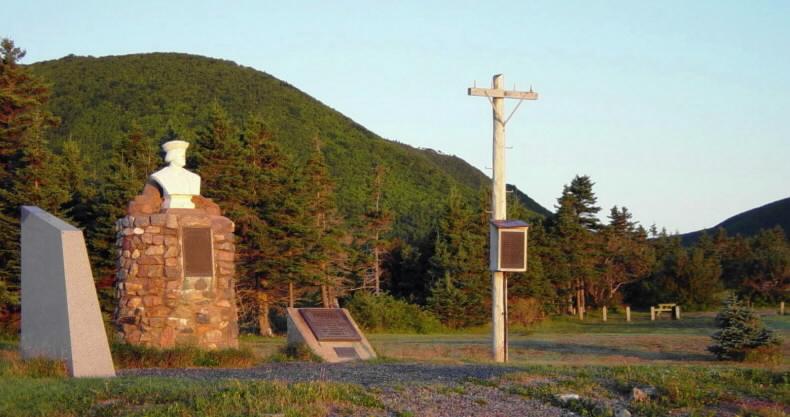
Photographed at 6:25am on 3 September 2003
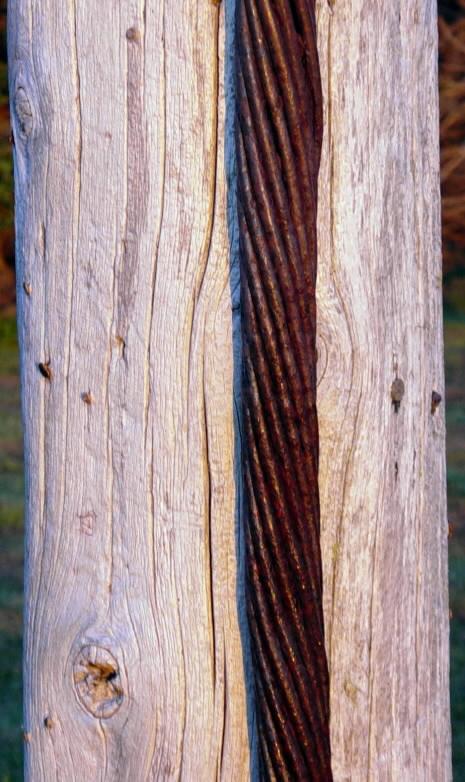
Photographed on 3 September 2003

Photographed on 3 September 2003
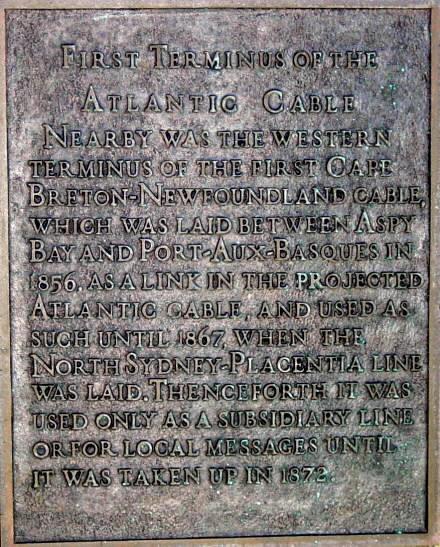
Photographed on 24 June 2003
|
Note: The plaque states that the cable "was taken up in 1872." I doubt this is true. The cable was taken out of service in 1872, but almost certainly it was just abandoned and left on the bottom of Cabot Strait. It would have been very expensive to pick up this long cable from the ocean depths, and whatever small value there might have been in the the salvaged copper would have offset only a small part of the removal cost. Because design and manufacturing techniques for undersea telegraph cables in the 1850s were primitive, these cables had only a short working life. These early cables deteriorated rapidly, and after ten to fifteen years on the ocean floor, the maintenance and repair costs increased and the cable reliability decreased to a point that often required the installation of a new cable. By 1872, the Cabot Strait cable laid in 1856 was sixteen years old, likely near the end of its useful working life (which quite possibly was the main reason for taking it out of service at that time) and it could not be relaid in another location. ICS (30 June 2003) |
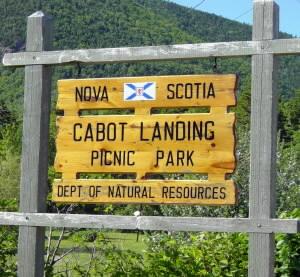
Photographed on 24 June 2003
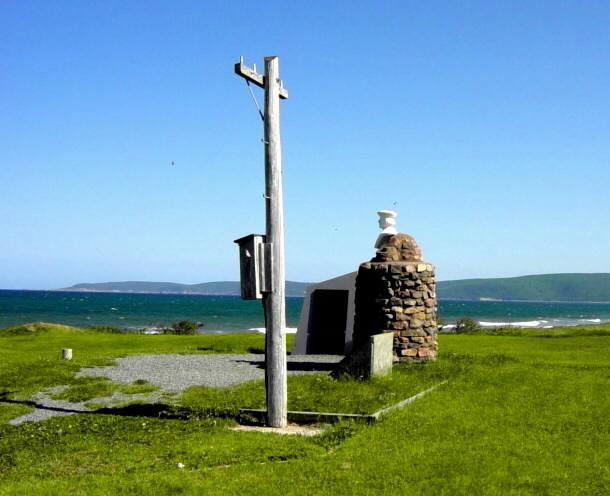
Photographed on 24 June 2003
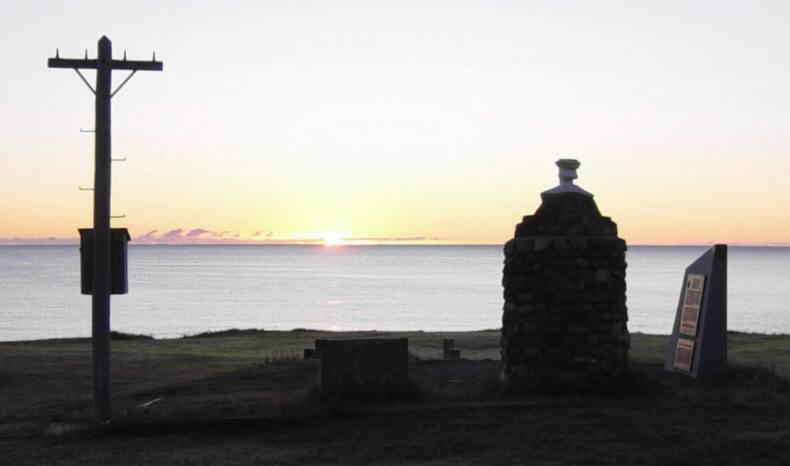
Photographed at 6:24am on 3 September 2003

The railways shown on the map, in Newfoundland and Nova Scotia,
did not exist in 1856. They were built decades after the
Cabot Strait telegraph cable was put into operation.
To adjust the map, use the pan and zoom controls in the upper left corner.
...The history of the initial failures and final success in laying the Atlantic cable has been well told by Mr. Charles Bright (see The Story of the Atlantic Cable, London, 1903). The first cable laid in 1857 broke on the 11th of August during laying. The second attempt in 1858 was successful, but the cable completed on the 5th of August 1858 broke down on the 20th of October 1858, after 732 messages had passed through it. The third cable laid in 1865 was lost on the 2nd of August 1865, but in 1866 a final success was attained and the 1865 cable also recovered and completed...
— Encyclopedia Britannica 1911, volume 9, page 187
http://www.gutenberg.org/files/35092/35092-h/35092-h.htm

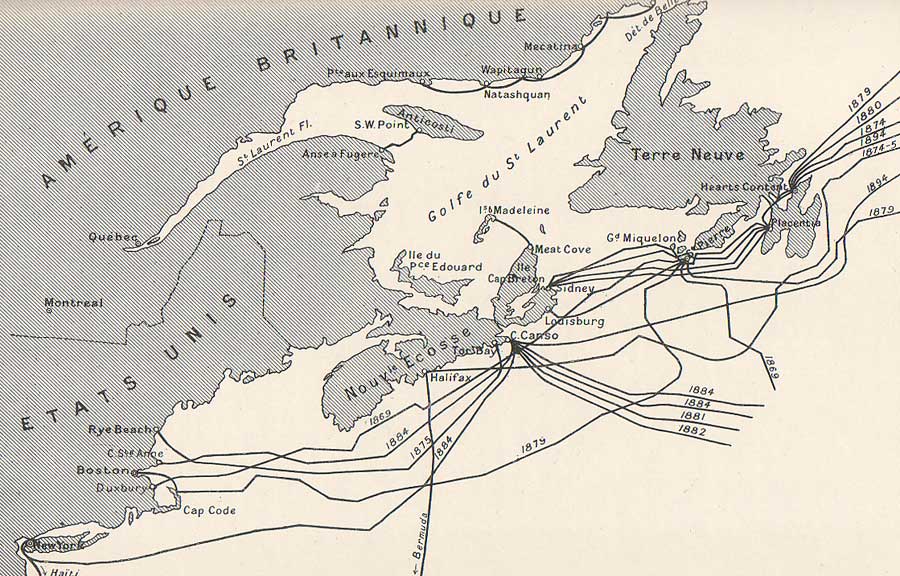
The 1856 cable across Cabot Strait is not shown
on this map. It was abandoned in the 1870s.
Source: History of the Atlantic Cable... (an excellent history)
After one abortive attempt in the summer of 1855, Cyrus Field's New York, Newfoundland and London Telegraph Company succeeded in laying a submarine cable across the Cabot Strait in 1856. Also completed that year was the Company's trans-Newfoundland overland line. The entire operation, which established a telegraph link all the way between New York and St. John's, cost over a million dollars...
Excerpted and adapted from:
The Atlantic Cable,
published by Minister, Department of Tourism, Culture and Recreation
Historic Resources Division, Government of Newfoundland and Labrador
http://www.ewh.ieee.org/reg/7/diglib/library/hearts-content/historic/provsite.html
IEEE (Eye-triple-E): the Institute of Electrical and Electronics Engineers, Inc.
The St. John's to Cape Ray overland telegraph line followed the south coast of Newfoundland, allowing supplies to be delivered by ship to construction sites. The construction of this telegraph line employed 600 men, and was completed in the fall of 1856.
The first message was sent on 1 October 1856 to Baddeck, Cape Breton from St. John's merchant J.S. Pitts. This message travelled along the overland telegraph line across Newfoundland from St. John's to Cape Ray, then across Cabot Strait through the underwater electric telegraph cable, then along the overland telegraph line across Cape Breton from Aspy Bay to Baddeck.
Excerpted and adapted from:
History of Clarenville: Telegraph and Telephone Companies
http://web.archive.org/web/20070217152722/http://www.k12.nf.ca/discovery/Commmunities/acdrom/clarenville/telegraph.html
One of the important challenges of the 1850s and 1860s was to get European news to New York as fast as possible. The New York newspapers were willing to pay enormous amounts of money for news from Europe if it could be delivered to them even a few hours ahead of the arrival of the mail steamship from England.
Frederick Gisborne saw the potential of St. John's as a transfer point for messages arriving by steamship from Europe to be telegraphed to the United States, but only (at least for the time being) in the sense that if a New York bound ship dropped off the news in Newfoundland, and it could then be telegraphed to New York, and the news would arrive at least 48 hours ahead of the ship. The newspapers would pay big money for that advantage.
So Gisborne moved to Newfoundland, and began to promote a connection by electric telegraph along the south coast of Newfoundland and across Cabot Strait to Cape Breton.
But St. John's was not a port of call for ships on their way to New York, and Gisbourne had a novel solution for that. The big steamships passed near Cape Race, and he proposed that they toss a barrel containing the messages over the side, where it would be recovered by a waiting small boat and rushed ashore to Trepassey, where the news would be forwarded by telegraph. Believe it or not, this system eventually became operational, and New York newspapers carried numerous items of European news with the byline "Via Cape Race".
Excerpted and adapted from:
Isambard Kingdom Brunel (1806-1859)
by Ross Peters, Faculty of Engineering and Applied Science, Memorial University of Newfoundland
http://www.engr.mun.ca/~gpeters/5101brun.html
In 1859 (after the failure of the 1858 transatlantic telegraph cable) the Associated Press of New York stationed a boat at Cape Race to intercept transatlantic steamships on their way to Halifax and New York. News and messages from Europe, thrown overboard from the steamers in water-tight canisters, were picked up and telegraphed to North American newspapers from the telegraph office at Cape Race. This practice continued up to the completion of the first successful transatlantic cable in August 1866 and was acknowledged in North American newspapers by the byline "Via Cape Race".
Excerpted and adapted from:
History of Clarenville: Telegraph and Telephone Companies
http://www.k12.nf.ca/discovery/Commmunities/acdrom/clarenville/telegraph.html
|
The Cabot Strait Telegraph Cable Seven Years at the Heart of Transatlantic News 1859-1866 NEWS WESTBOUND (from Europe to North America) |
|
The receipts from the Newfoundland telegraph lines throughout this period of hope deferred (1858-1866) were very small and very precarious.
In 1859 a news boat was placed at Cape Race by the Associated Press to intercept ocean steamers; the first ship met was the S.S. Vigo, of the Inman Line. The public constantly saw the heading in English and American papers, "Via Cape Race," but few had any idea of those daring trips of bold John Murphy to catch the outward and homeward bound steamers; considering the imminent peril of landing and launching boats from such a wild spot, it is marvellous how much news was sent in this extraordinary way. Source: footnote 2, page 641 of "A History of Newfoundland from the English, Colonial, and Foreign Records" by Daniel Woodley Prowse, Q.C., Judge of the Central District Court of Newfoundland published 1895 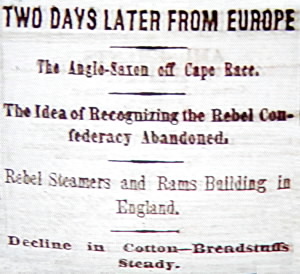 "The Anglo-Saxon off Cape Race" Newspaper clipping, 1862 (believed to be from the New York Times) When the S.S. (Steam Ship) Anglo-Saxon departed Europe it had the latest European news on board. As the ship passed Cape Race without stopping or even slowing down, a package (barrel) was tossed overboard to be retrieved by the A.P. news boat. While the transatlantic steamship Anglo-Saxon continued westward at top speed, the news barrel was picked up at sea and brought ashore by the news boat at Cape Race and immediately telegraphed to the Associated Press in New York – over the one-wire electric telegraph line owned and operated by the New York, Newfoundland and London Telegraph Company. This extraordinary effort got the latest European news to New York, and all North America, days ahead of the ship's arrival at its destination. The heading "Two Days Later From Europe" means this brief news item — brief because of the per word cost of telegrams from Newfoundland to New York — contained European news two days later (more up-to-date) than was previously available in North America. From 1859 to 1866, "Via Cape Race" in a newspaper headline was the equivalent of the "Breaking News" graphic we now see flashed on our television screens when important up-to-date news has arrived. Along the way, all of this news travelled through the Cabot Strait telegraph cable. Note: Part of this newspaper clip conveys the information that shipyards in England are building steamships and rams for the Confederacy. This refers to efforts by the Confederate Navy, during the American Civil War, to obtain warships from builders in Great Britain. "...The Confederate agent Bulloch extended his ambitions when he contracted with Birkenhead shipbuilders, Laird and Sons, to construct two turreted ironclad rams. Bulloch based the rams upon the ideas of Capt. Cowper Coles of the Royal Navy, an outspoken British ironclad designer. They were impressive ships displacing 1,423 tons (light) and were 224 feet long. Their iron hulls had ram bows supporting two turrets carrying 220-pounder Armstrong guns; lighter guns were mounted on raised forecastles and quarterdecks. Bark sailing rigs gave them range; powerful twin-screw engines combined with ram bows gave them ability to fight the most imposing Union ships... Bulloch was disappointed by the loss of the Laird rams..." Source – The Diplomats Who Sank a Fleet: The Confederacy's Undelivered European Fleet and the Union Consular Service by Kevin J. Foster http://www.archives.gov/publications/prologue/2001/fall/confederate-fleet-1.html
This news item travelled through
|
|
See:
TransAtlantic Telegraph Companies
(On April 27, 1863, about 240 people died when the S.S. Anglo-Saxon
|
...Cape Race is also the terminal point eastward of that remarkable system of telegraph lines which extends throughout the whole of the United States and the British possessions [in North America]. The Americans delight in the telegraph, and use it continually for every sort of purpose, and in a way and extent that Europeans have no notion of. From this lonely rock, standing out in the Atlantic amid fogs and storms, European news is flashed to the most distant parts of America. From Boston to New Orleans the newspapers have it, print it, and the intelligence is old when the ship arrives at New York, three or four days after passing Cape Race...
From "Cape Race, Newfoundland" in
The Illustrated London News London, England, 24 August 1861
http://cti.library.emory.edu/iln/browse.php?id=iln39.1104.060
|
The Cabot Strait Telegraph Cable Seven Years at the Heart of Transatlantic News 1859-1866 NEWS WESTBOUND (from Europe to North America) |
|
"By the steamer City of Washington we have received New York journals to the 18th ult. and a short telegram from Cape Race to the 22nd..."
The Illustrated London News London, England, 2 November 1861 http://cti.library.emory.edu/iln/browse.php?id=iln39.1115.127
Interpretation:— The steamship City of Washington departed New York on 18 October 1861. As was usual for all ships departing New York for any distant port, it was carrying the latest copies of New York newspapers ("journals"), brought on board at the last minute before the ship cast loose its lines and steamed away from the dock.
On their way from New York to Cape Race,
|
|
"By the arrival of the steamer North American we have advices (news) to the evening of the 26th ult. (26 October 1861). The most important event of the week has been the completion of the great continental telegraph line, uniting San Francisco with New York, and so with Cape Race, Newfoundland – a connected line of 6000 miles (10,000 km], and the longest in the world. It was finished on the 25th ult. (25 October 1861)..."
The Illustrated London News London, England, 9 November 1861 http://cti.library.emory.edu/iln/browse.php?id=iln39.1116.134
The Cabot Strait telegraph cable was a crucial link in this
|
The first Transatlantic cable (1858) did not survive much beyond the exchange of greetings between Queen Victoria and the President of the United States. These messages were not as peremptory as is sometimes said. The Queen sent one of 99 words. It took 16½ hours to transmit it. No wonder that early telegraphic technologists were already very interested in compression; many codes were invented to achieve it.
The rapid failure of the first Atlantic cable was a commercial disaster and the improvement of its technology a demanding imperative. It suffered from electrical breakdown. Lord Kelvin made a rapid diagnosis and recommendation for the second attempt, which included using lower voltages than proposed, thicker insulation, and more sensitive detection. For this he developed an especially-sensitive mirror galvanometer.
The compelling force of Kelvin's personality overcame the opposition of the ignorant and the amateurs, and a new system based on his ideas worked wonderfully well in 1866. It made the amazing sum of one thousand pounds on its first day of operation. So he became rich and famous...
— Denis Weaire, Physics Department, Trinity College, Dublin, Ireland
Cecil Powell Memorial Lecture
European Physical Society General Meeting, Budapest, 2002
http://www.europhysicsnews.com/full/17/article4/article4.html
Europhysics News (2002) Vol. 33 No. 5
From 1859 to 1866, the Associated Press kept a newsboat at Cape Race to meet ocean liners passing by on their way from Europe so that news could be telegraphed to New York three days before the ship reached New York. These news items carried the byline "via Cape Race".
|
The steamship Arago which sailed from this port on Saturday last, will touch at Cape Race, on Wednesday evening, for dispatches for Europe. Dispatches (messages) left with George Stoker, telegraphic commercial agent, No. 145 Broadway, up to noon of Wednesday, will be forwarded for the Arago. — New York Times, Monday, 23 July 1861 |
|
Interpretation:— These were messages from New York (or anywhere in the United States then connected by electric telegraph) to be delivered as telegrams soon as possible in Great Britain and Europe. Then (1861) the fastest (shortest time) route for a message from anywhere in the United States to anywhere in Europe, was by electric telegraph to Cape Race and then across the North Atlantic Ocean by fast steamship. Of course, the actual time required to get a message from origin to destination depended greatly on the connection at Cape Race between the telegraph system and the steamship – a message could get from New York or Washington to Cape Race in a couple of hours, but then it had to wait until the next ship came along headed east, a delay that could easily extend to several days. However, the best time from the eastern United States to Great Britain could be as short as seven days if the message happened to arrive at Cape Race just in time to make the connection, and the ship made good time across the ocean (no storms, no head winds, no fog, no problems with the ship's engines). Messages (telegrams) taken to the telegraph office at 145 Broadway, New York, were sent by electric telegraph to Cape Race, where they were written on paper and held awaiting the arrival of the steamship. The telegraph line between New York and Cape Race passed through Boston, Calais (Maine), Saint John and Moncton (New Brunswick), Amherst and New Glasgow and Baddeck (Nova Scotia) to Aspy Bay. From New York to Aspy Bay the telegraph line was a single overhead iron wire supported on poles. The telegraph line continued through the new (1857) submarine (underwater) cable across the Cabot Strait, between Cape Breton Island and Newfoundland. From Port-aux-Basques there was an overhead one-wire telegraph line along Newfoundland's southern shore to Cape Race. These transatlantic messages could be news reports. They could be private communications between two companies about purchases of grain or industrial equipment or raw materials of all sorts. They could be confidential government business such as secret instructions to an ambassador, or negotiations with a manufacturer of expensive special equipment such as locomotives or cannons. This system of transatlantic communication – the connection at Cape Race between the North American telegraph system and transatlantic shipping services, both eastbound and westbound – remained in full operation until August 1866. This period included the whole of the American Civil War (1862-1865). One last thought: This telegraphic communication system, thousands of kilometres long, worked by electricity. Where did the electricity come from? In the 1860s there were no electric utility companies anywhere in the world to supply electric power for telegraph companies (or anyone else). The electric power, required to operate these telegraph lines, came from batteries, that remarkable device invented by Alessandro Giuseppe Volta in 1800 (well within living memory in the 1860s). |
|
London, England 24 August 1861 The great point of interest on the south coast is Cape Race – the subject of Illustration – as it is the point of land which nearly all the steamers running to New York, Boston, and Portland endeavour to make. The coast at Cape Race is bold and rocky, the cliffs rising precipitately out of the water, cracked and split asunder in many places by some great convulsion of nature; a huge black rock lifts its head up out of the deep water immediately in front of the Cape; the eternal wash of the Atlantic has worn deep hollows, and in some cases masses of rock stand out isolated from the great granite wall that breaks the ever-restless ocean that thunders against it. On top of the cliffs, a short distance from the edge, is a well-built lighthouse painted white and striped with red vertical stripes, which distinguishes it from the lighthouse on Cape Pine, an important point of the coast, about thirty miles west of Cape Race, where the lighthouse is striped with horizontal red stripes. Cape Race is also the terminal point eastward of that remarkable system of telegraph lines which extends throughout the whole of the United States and the British possessions. The Americans delight in the telegraph, and use it continually for every sort of purpose, and in a way and extent that Europeans have no notion of. From this lonely rock, standing out in the Atlantic amid fogs and storms, European news is flashed to the most distant parts of America. From Boston to New Orleans the newspapers have it, print it, and the intelligence is old when the ship arrives at New York, three or four days after passing Cape Race. As there is no place on this iron-bound coast where ships can touch at, peculiar means must be adopted to catch the European news on its way west. The Associated Press of America therefore employ vessels to cruise constantly in the neighbourhood of the Cape, and board the outward-bound steamships. Having got the important intelligence, they hasten to the shore, and forward their dispatch by wires passing through Newfoundland, across the sea between it and Breten Island, and afterwards the Gut of Canseau, through Nova Scotia, across the head of the Bay of Fundy, to the United States. This arrangement of telegraph brings Europe practically within seven days of America. Thus the Cunard ships leaving New York on Wednesday are off Cape Race the following Sunday; being there boarded by the telegraph-boat, they receive the New York news up to that time; on the following Sunday that ship arrives at Cork harbour, Ireland, when its news is instantly forwarded to London. And the same on the outward-bound voyages. Since the introduction of the electric telegraph this lonely mass of storm-washed rock, whose existence was scarcely known to any one except the mariner, who sought it only that he might know his whereabout and carefully avoid it, has become as well known and its name as familiar as is that of New York or Boston. It would be difficult to take up an American newspaper now without finding a paragraph headed "Latest News from Europe, via Cape Race." On the western side of the States the telegraph ends at the Missouri River; but, as the States on the west side of the Rocky Mountains are as anxious for early news as the Yankees themselves, the latest intelligence from Europe, being passed through to the Missouri, is then taken up by a remarkable line of communication called the Pony Express – a line of small, fleet horses being maintained across the great plains, over the Rocky Mountains, to San Francisco. On arrival of the telegraph from Cape Race at St. Joseph, on the Missouri River, a horse starts at a gallop on its journey west. Every twenty-five miles [40km] a fresh horse is employed to carry the telegraph message. The journey of two thousand miles is thus accomplished in about nine days, so connecting California with England in little over a fortnight. — Illustrated London News, 24 August 1861 http://beck.library.emory.edu/iln/browse.php?id=iln39.1104.060 A Joint Project by Sandra J. Still, Emily E. Katt, Collection Management, and the Beck Center of Emory University, Atlanta, Georgia, U.S.A. |
|
London, England 16 November 1861 The first telegram sent from the Pacific to the Atlantic was sent by Chief Justice Field, of California, to the President. It was as follows:– Sacramento, Oct. 24. In the tempoaray absence of the Governor of the State, I am requested to send you the first message which will be transmitted over the wires of the telegraph line which connect the Pacific with the Atlantic States. The people of California desire to congratulate you upon the completion of the great work. They believe that it will be the means of strengthening the attachment which binds both the East and the West to the Union; and they desire in this the first message across the Continent to express their loyalty to that Union and their determination to stand by the Government in this its day of trial. They regard that Government with affection, and will adhere to it under all fortunes. The European news which starts from Newfoundland at, say, 4 p.m. would reach San Francisco at 11.30 a.m., or four hours and a half ahead of time. — Illustrated London News, 16 November 1861 http://beck.library.emory.edu/ iln/browse.php?id=iln39.1117.140 A Joint Project by Sandra J. Still, Emily E. Katt, Collection Management, and the Beck Center of Emory University, Atlanta, Georgia, U.S.A. |

There was a New Moon on 23 Sept 1862. This rendevous between the AP yacht and the steamship was performed on the open ocean at night only five days after the New Moon – that is, there was very little moonlight even if there was no cloud cover. We do not know what the state of the ocean was – it could have been anything from a calm sea and a light breeze (unlikely) to five-metre waves and a howling gale (also unlikely) or anything in between. This brief meeting, between the Associated Press and a fast transatlantic steamship running on a tight schedule, somewhere off Cape Race, was a routine event that was performed several times times each month, summer and winter, for more than six years. How did they find each other? The AP yacht went out to sea, to a position as close to the regular shipping lane as could be managed with the primitive navigation methods then available, and then simply waited until a steamship came along. Remember, this was done when there was no radio, no way to communicate between the two ships other than by flag signals (useless at night) or by flashing lights (with the lanterns then available this was useful only at close range and only when there was no fog, an unusual condition at Cape Race). It is an interesting question: How did they find each other?
The last telegraph cable was laid into Newfoundland in 1953. The Heart's Content office (then of Western Union) finally closed in 1965. Telephone cable traffic more and more replaced telegraph through the 1960s and 1970s, and that too is now gone. By the late 1990s the only underwater communications cables to operate to Newfoundland were two large fibre optic connections across the Cabot Strait.
Excerpted and adapted from:
The Electric Age
by Ross Peters, Faculty of Engineering and Applied Science, Memorial University of Newfoundland
http://www.engr.mun.ca/~gpeters/eplec1c.html
Links to Relevant Websites
Laying the Cabot Strait Cable, 1855 by Peter Cooper, president of
Laying the Ocean Cable by Peter Cooper, president of
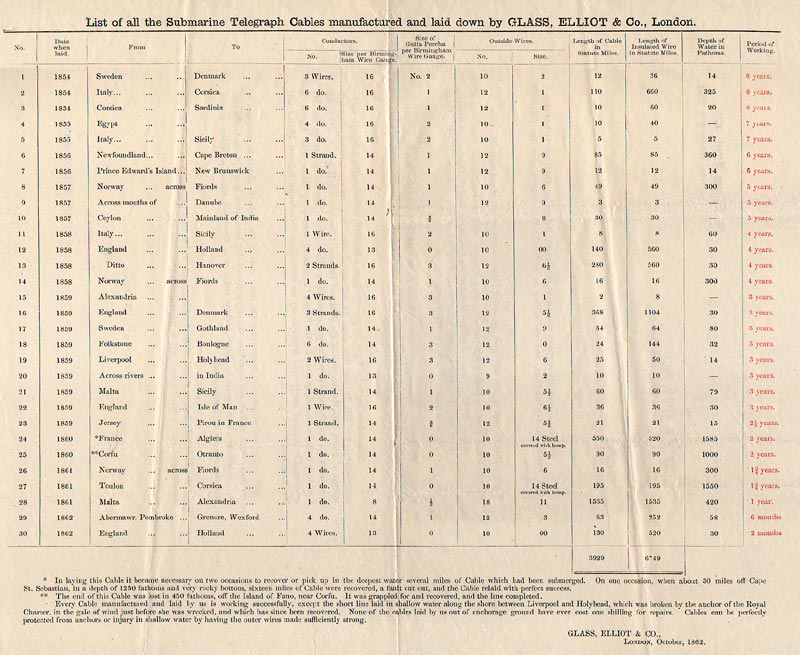
1862 List of Submarine Telegraph Cables manufactured and laid down
Richard Atwood Glass
History of the Atlantic Cable & Submarine Telegraphy
1858 New York Celebration
Transatlantic Telegraph Companies
1897 Atlantic Telegraph Cable Map
On Submerging Telegraphic Cables presented to the
Wire Rope and the Submarine Cable Industry by Bill Burns
Submarine Cable Timeline: 1850-1900 by Bill Glover
Facts and Observations Relating to the Invention of the Submarine Cable
Cyrus Field and the Epic Struggle to lay the First Transatlantic Cable
Atlantic Sentinel by Donald Tarrant
Nova Scotia's Telegraphs, Landlines And Cables by D.G. Whidden, 1938
| |
Submarine Cables Making A Comeback
| |
|
The Anatomy of Submarine Telegraph Cables
Faults in Submarine Telegraph Cables Some of the things that could go wrong...
Gutta percha
| |
The End of the Transatlantic Telegraph
Transatlantic Telephone Cables, 1956-1990 Wikipedia
A chronology of Telegraph, Telephone and Radiotelephone, the three services
The First Transatlantic Telephone Cable, September 1956
|

 John Cabot 1497 memorial Aspy Bay
 A.G. Bell National Historic Park Baddeck
 Three plaques: Bell, Baldwin, McCurdy Baddeck
 First Aeroplane Flight monument Baddeck
 St. Margarets Village war memorial St. Margarets Village
 South Harbour war memorial South Harbour
 Neils Harbour war memorial Neils Harbour
 Ingonish war memorial Ingonish
 Indian Brook war memorial Indian Brook
 Belle Cote war memorial Belle Cote
 Cheticamp war memorial Cheticamp
 French Mountain war memorial French Mountain
 North River war memorial North River
 Port Dauphin Naval Base monument, 1713-1719 Englishtown
 Englishtown war memorial Englishtown
 Middle River war memorial Middle River
 Inverness coal miners monument Inverness
 Whycocomagh war memorial Whycocomagh
|
The Wayback Machine has archived early copies of this website:
Archived: 2007 March 09
Archived: 2008 January 26
Archived: 2009 May 22
Archived: 2011 July 06
|
  Hits per calendar month
       2015 Sep   237
       2015 Aug   447
       2015 Jul   266
       2015 Jun   267
       2015 May   199
       2015 Apr   221
       2015 Mar   225
       2015 Feb   249
       2015 Jan   219

       2014 Dec   206
       2014 Nov   272
       2014 Oct   216
       2014 Sep   202
       2014 Aug   158
       2014 Jul   185
       2014 Jun   163
       2014 May   192
       2014 Apr   105
       2014 Mar   210
       2014 Feb   145
       2014 Jan   171

       2013 Dec   189
       2013 Nov   161
       2013 Oct   146
       2013 Sep   175
       2013 Aug   133
       2013 Jul   116
       2013 Jun   131
       2013 May   194
       2013 Apr   181
       2013 Mar   205
       2013 Feb   205
       2013 Jan   288

       2012 Dec   245
       2012 Nov   281
       2012 Oct   347
       2012 Sep   796
       2012 Aug   156
       2012 Jul   181
       2012 Jun   201
       2012 May   331
       2012 Apr   414
       2012 Mar   513
       2012 Feb   556
       2012 Jan   426

       2011 Dec   315
       2011 Nov   430
       2011 Oct   481
       2011 Sep   759
       2011 Aug   197
       2011 Jul   167
       2011 Jun   214
       2011 May   306
       2011 Apr   246
       2011 Mar   385
       2011 Feb   571
       2011 Jan   452

       2010 Dec   408
       2010 Nov   552
       2010 Oct   706
       2010 Sep  1100
       2010 Aug   282
       2010 Jul   242
       2010 Jun   348
       2010 May    -
       2010 Apr    -
       2010 Mar   554
       2010 Feb  1019
       2010 Jan   579

       2009 Dec   428
       2009 Nov   582
       2009 Oct   657
       2009 Sep  1115
       2009 Aug   174
       2009 Jul   177
       2009 Jun   277
       2009 May   373
       2009 Apr   345
       2009 Mar   522
       2009 Feb   740
       2009 Jan   472

       2008 Dec   333
       2008 Nov   612
       2008 Oct   802
       2008 Sep  1275
       2008 Aug   337
       2008 Jul   257
       2008 Jun   523
       2008 May   970
       2008 Apr   683
       2008 Mar   663
       2008 Feb  1076
       2008 Jan   711

       2007 Dec   537
       2007 Nov   478
       2007 Oct   615
       2007 Sep  1085
       2007 Aug   273
       2007 Jul   236
       2007 Jun   282
       2007 May   548
       2007 Apr   462
       2007 Mar   352
       2007 Feb   378
       2007 Jan   257

       2006 Dec   113
       2006 Nov   143
       2006 Oct    -
       2006 Sep    -
       2006 Aug    -
       2006 Jul    -
       2006 Jun    -
       2006 May    -
       2006 Apr    -
       2006 Mar    -
       2006 Feb   417
       2006 Jan   356
"-" means data is not available

       2005 Dec   247
       2005 Nov   355
       2005 Oct   395
       2005 Sep   469
       2005 Aug   212
       2005 Jul   159
       2005 Jun   168
       2005 May   204
       2005 Apr   327
       2005 Mar   267
       2005 Feb   377
       2005 Jan   321

       2004 Dec   266
       2004 Nov   355
       2004 Oct   352
       2004 Sep   374
       2004 Aug   162
       2004 Jul   263
       2004 Jun   221
       2004 May   233
       2004 Apr   278
       2004 Mar   292
       2004 Feb   288
       2004 Jan   265

       2003 Dec   156
       2003 Nov   275
       2003 Oct   296
       2003 Sep   207
       2003 Aug    50
       2003 Jul    15
       2003 Jun     5
       2003 May     0
First uploaded to Internet: 2003 June 30
New photographs installed: 2003 September 06
Cabot Strait map installed: 2003 October 27
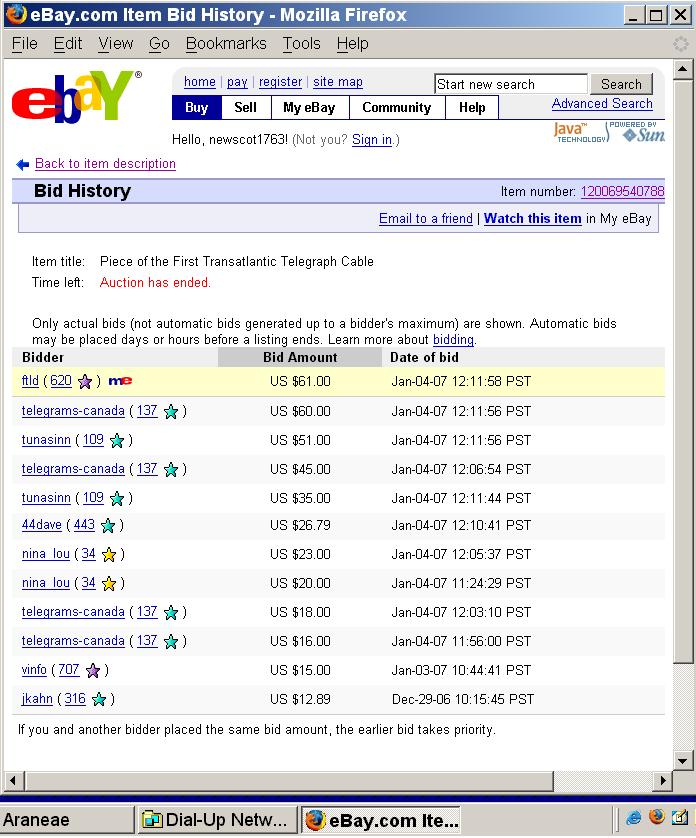
eBay screenshots added: 2007 January 18
Added Google Map link: 2007 December 09
Latest update: 2015 October 25